










Mafatlal builds a solutions platform beyond legacy textiles
Key highlights
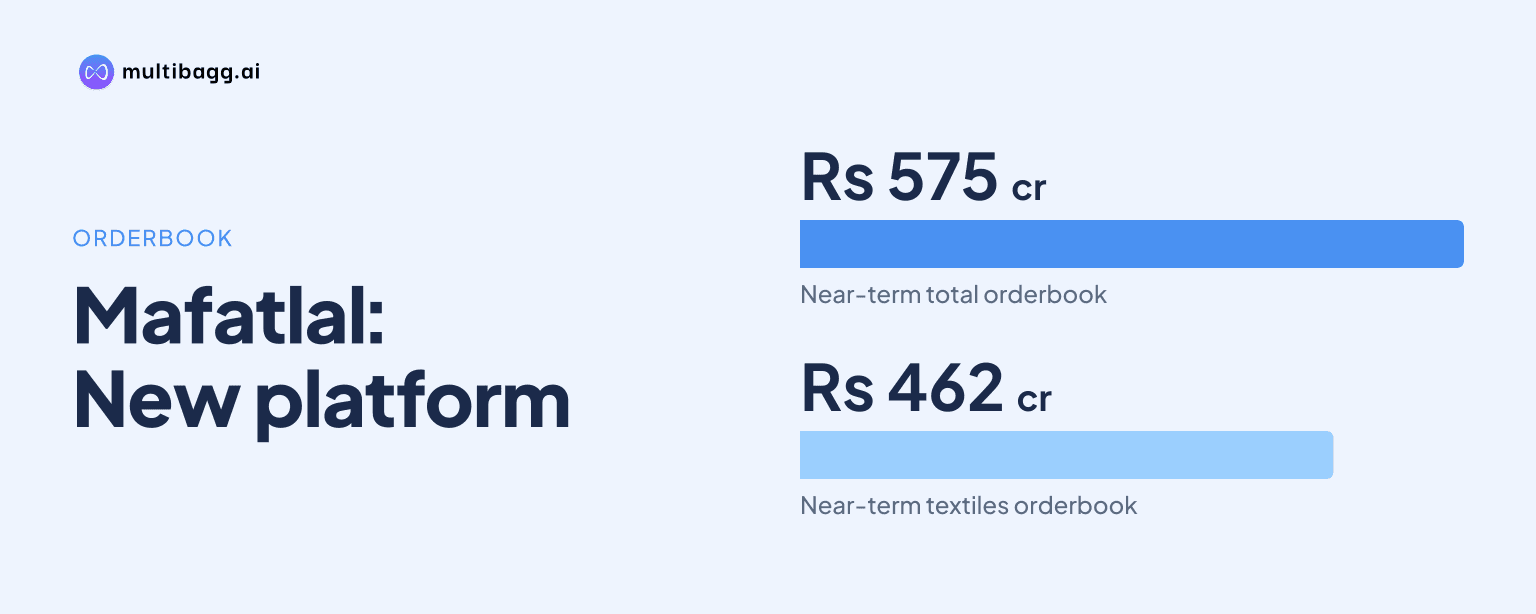
- Mafatlal reports a Rs 575 crore running consolidated orderbook for near-term execution.
- Textiles and related products represent Rs 462 crore of Mafatlal’s Rs 575 crore disclosed orderbook.
- Digital infrastructure represents Rs 87 crore of the disclosed orderbook and includes long-term AMC contracts.
- Mafatlal reported Rs 1,736.5 crore of revenue from operations in H1FY27.
powered by IRIS
Arvind Mafatlal Group (Mafatlal) is repositioning its business beyond conventional textiles through integrated uniforms, digital infrastructure and consumer durables, supported by a Rs 575 crore running consolidated orderbook for near-term execution. The presentation identifies 2019 to 2025 as the diversification phase and outlines further garmenting, export and software-capability expansion from 2026 onward.
Know Mafatlal Industries inside out
Results, valuation, peers and who's buying, in one view.
How is Mafatlal changing its business model?
Mafatlal is moving from a traditional product-led textile approach to solution-led offerings for institutional and business-to-business customers. Its strategic framework specifies an asset-light, execution-led model, product-agnostic and demand-driven growth, diversified market access, and solution-led offerings intended to generate annuity income. The company says its vendor and sourcing ecosystem has been built over more than 120 years.
The 2019 to 2025 period involved financial challenges, adoption of the asset-light model and diversification beyond textiles, according to the presentation. Mafatlal says it expanded relationships with institutional and corporate customers and entered digital infrastructure during this period. Its 2026-and-beyond plan includes expanding integrated uniforms, strengthening corporate and institutional capabilities, growing apparel manufacturing and exports through Mafatlal Apparel Exports, and building application and software capabilities through Pieflowtech Solutions Private Limited.
The reported financial data show that the group continues to operate at substantial scale while pursuing this transition. Revenue from operations was Rs 1,736.5 crore in H1FY27, compared with Rs 3,870.4 crore in FY26. Operating earnings before interest, tax, depreciation and amortisation, or EBITDA, were Rs 38.2 crore in H1FY27, with a 2.2% margin, versus Rs 113.8 crore and a 2.9% margin in FY26.
The H1FY27 and FY26 figures cover a half-year and a full year respectively, so they are not a like-for-like growth measure. However, operating EBITDA margin was 0.7 percentage points lower in H1FY27 than in FY26, while profit-before-tax margin was 0.5 percentage points lower. The presentation also reports FY26 return on capital employed, or ROCE, of 23.0%, excluding dividend income and the investment in NOCIL Ltd.
What does Mafatlal’s integrated uniforms platform include?
Mafatlal’s integrated uniforms platform covers design, sourcing, manufacturing and distribution for institutions across education, healthcare, aviation, security, automobiles, quick-service restaurants, petrochemicals, oil and gas, and the public sector. The company describes this end-to-end model as a key pillar of its textiles portfolio, supported by a pan-India supply network and garmenting capability.
The textiles business also extends beyond uniforms into woven white, Rubia and polyester-cotton fabrics, home furnishings, and voile-fabric exports to the Middle East. Mafatlal’s stated plan from 2026 is to add further end-to-end garmenting capacity and expand its presence in corporate and institutional uniforms. The source does not provide separate revenue, margin or orderbook figures for uniforms, fabrics, furnishings or exports.
Its beyond-uniforms offering includes non-woven healthcare products such as patient wear and surgical gowns for hospitals and healthcare institutions. The hygiene portfolio covers sanitary napkins, baby diapers and adult diapers, while the home-furnishings range includes bed and bath products for households across income segments. These categories use the same broad vendor and supply-chain infrastructure that Mafatlal says supports large and time-sensitive orders.
Got a follow-up? Ask IRIS
How does digital infrastructure create recurring-service potential?
Mafatlal’s digital-infrastructure business combines information and communications technology, or ICT, artificial intelligence, exam centres, robotic laboratories, smart classrooms, learning-management-system software, hardware components and long-term annual maintenance contracts, or AMCs. The presentation says the model combines project execution with recurring service revenues, which it says improves revenue visibility.
The company identifies digital-education projects under Samagra Shiksha, PM SHRI Schools and ICT@Samagra Shiksha as relevant opportunities. This route to market differs from textiles because it combines education-related project delivery with software, hardware and service arrangements. The presentation does not disclose the revenue split between projects, hardware, software and AMCs, or the duration and value of individual service contracts.
Pieflowtech Solutions Private Limited is being used to strengthen application and software capabilities and deepen long-term customer relationships, according to Mafatlal. Pieflowtech has been appraised at Capability Maturity Model Integration, or CMMI, Maturity Level 5 for CMMI-DEV and CMMI-SVC. Mafatlal describes this as the highest process-maturity level, based on continuous and data-driven process optimisation, but does not quantify its effect on revenue, wins or profitability.
What does Mafatlal’s orderbook show about segment mix?
Mafatlal reports a Rs 575 crore running consolidated orderbook to be executed in the near future, comprising Rs 462 crore in textiles and related products, Rs 87 crore in digital infrastructure and Rs 26 crore in consumer durables. The three displayed segment amounts total Rs 575 crore, linking the portfolio snapshot to the running consolidated orderbook.
Textiles and related products account for the largest disclosed portion of the orderbook at Rs 462 crore, followed by digital infrastructure at Rs 87 crore. Consumer durables is the smallest disclosed segment at Rs 26 crore. This mix indicates that textiles remain the main near-term execution category even as Mafatlal develops non-textile businesses.
The consumer-durables portfolio includes utensils, toys, furniture, footwear and other products for public-welfare-led institutional projects. Mafatlal says it uses the textile segment’s institutional relationships, supply chain and last-mile delivery network to serve government and institutional customers. Management describes this as a large-scale procurement-led business with a calibrated focus on margin improvement, without disclosing a segment margin target.
The presentation does not provide orderbook execution dates, cancellation terms, expected margins or the portion associated with specific government programmes. It also does not state how much of the Rs 87 crore digital-infrastructure orderbook is tied to AMCs rather than one-time projects. Those omissions limit assessment of the revenue timing and recurring-income mix within the disclosed Rs 575 crore total.
Conclusion
Mafatlal’s stated transformation is an expansion from a legacy textile base into an institutional solutions model spanning uniforms, digital infrastructure and consumer durables. The Rs 575 crore orderbook shows that textiles and related products remain the largest disclosed execution pool at Rs 462 crore, while digital infrastructure contributes Rs 87 crore through a mix of education projects, software, hardware and service arrangements.
The next stage to watch is Mafatlal’s 2026-and-beyond plan to expand integrated garmenting, develop apparel exports through Mafatlal Apparel Exports and strengthen software capabilities through Pieflowtech Solutions Private Limited. The presentation also leaves unresolved the timing and margins of the orderbook, the share of digital revenue that is recurring, and the financial contribution of individual textile and non-textile categories.