










Mahant Tool Room expects aerospace ramp in years four and five
Key highlights
- Management said MTR aerospace should remain small for the next two to three years, with a larger ramp in years four and five.
- MTR has the required product and bearing certifications, but management said securing bearing business takes at least 18 months.
- Management said MTR began with Rs 2.5 crore of turnover and is moving towards Rs 1 crore per quarter in nine months to one year.
- Management said customer wins could raise MTR revenue in Rs 10 crore increments.
powered by IRIS
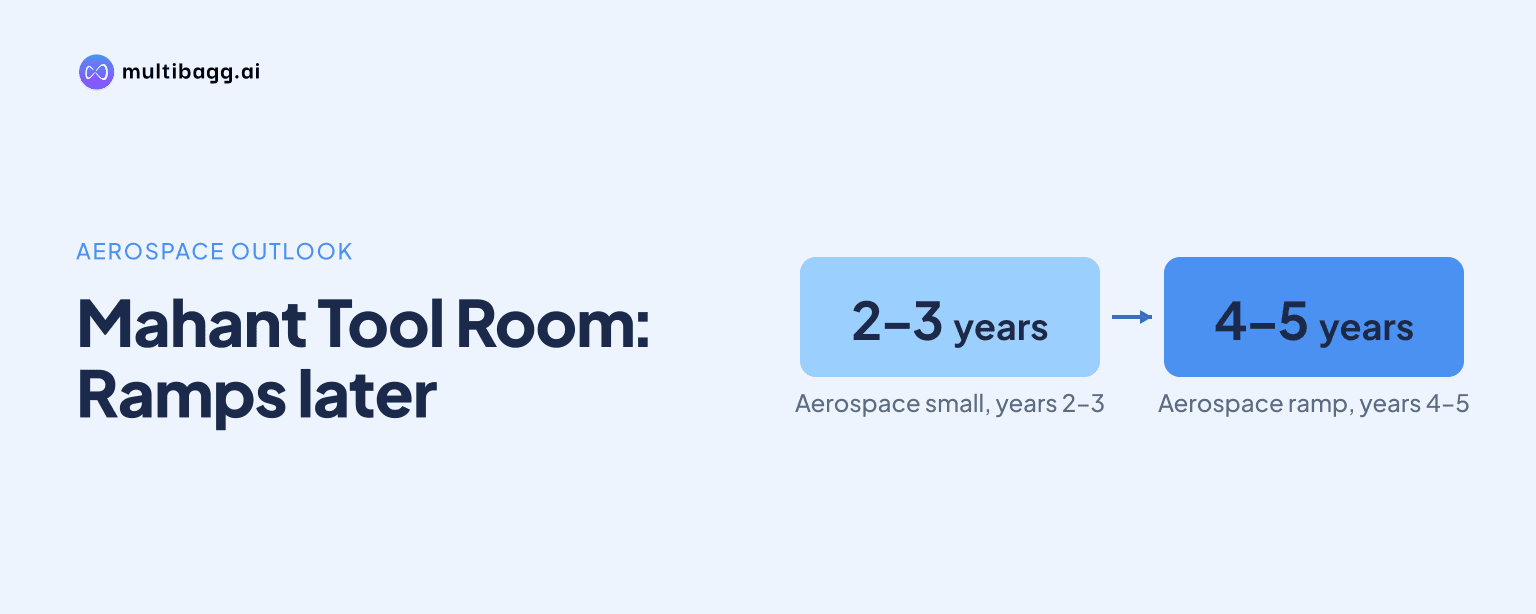
Mahant Tool Room expects its aerospace business to remain small for the next two to three years, while management expects the larger revenue ramp in years four and five; it said bearing business takes a minimum 18 months to secure even though MTR already has the required certifications.
Know NRB Bearings inside out
Results, valuation, peers and who's buying, in one view.
When will MTR's aerospace business become meaningful?
MTR's aerospace business is expected to remain small for the next two to three years, with management placing the larger growth phase in year four and year five. Management gave this timetable when asked about the route from the Rs 30 crore order book cited by an analyst to the Rs 300 crore revenue guidance for 2031. It did not disclose MTR's contribution to second-quarter revenue in its answer.
Management described a gradual near-term increase from a small base. MTR began with turnover of Rs 2.5 crore and is moving towards Rs 1 crore per quarter, a level management said could take another nine months to one year. That progression is distinct from the later step-up: management said revenue could rise in Rs 10 crore increments once MTR obtains the customers under discussion.
The disclosed sequence is therefore commercial rather than simply capacity-led. MTR first aims to reach Rs 1 crore of quarterly turnover, while bearing business development requires a minimum 18 months. Management did not provide annual revenue milestones between the current level and the 2031 Rs 300 crore guidance, nor did it identify the customers behind the potential Rs 10 crore increments.
Why does MTR need at least 18 months for bearing business?
MTR needs at least 18 months to obtain bearing business because certification does not itself convert into customer orders, management said. It said MTR has completed the required certifications and is now focused on business development. The transcript does not specify individual customer approval stages, programme dates or the volume that could follow an 18-month sales cycle.
Management distinguished aerospace bearings from MTR's other aerospace products by calling bearings the most difficult product. It said the company's other products are easier, while aerospace bearings are highly customised and engineered. For commercial-aircraft applications, management cited plain spherical bearings, saying only one or two companies worldwide make this type, although it gave no market-size or pricing data.
An analyst asked how supply shortages in high-mix, low-volume aerospace bearings could be addressed over the next 18 months. Management did not name an aircraft maker, customer programme or supply agreement. Its answer was that customised products require flexibility and tailored manufacturing solutions, unlike the high-volume production model traditionally associated with some bearing peers.
Got a follow-up? Ask IRIS
What aerospace products and certifications does MTR have?
MTR has all required certifications for its product range and for bearings used in those applications, according to management. It said no additional certifications are needed, making business development rather than a further approval process the stated constraint on the minimum 18-month bearing timeline. Management did not identify the certifying bodies, certification dates or programme-specific scope.
Management cited existing work on Sukhoi defence aircraft as evidence of MTR's aerospace capability. It said MTR supplies landing-gear applications and doors used for pilot evacuation, describing both as critical applications. The call did not disclose revenue, contract length, order value or production volumes for these Sukhoi-related supplies.
For commercial aircraft, management said comparable applications can include the same types of components alongside plain spherical bearings. It also said aerospace products need exact customisation and engineering flexibility. No capital-expenditure figure, plant-capacity number or utilisation level was disclosed for MTR, so the discussion does not establish how much additional aerospace output it could produce without further investment.
How does MTR's timeline compare with NRB Bearings' established businesses?
MTR's aerospace timetable is slower than growth discussed for NRB Bearings' established operations because MTR starts from Rs 2.5 crore of turnover and faces a minimum 18-month bearing-business cycle. In the wider business, management said industrial sales grew 48%, compared with its earlier stated 34% expectation. It also said two- and three-wheelers, passenger vehicles, commercial vehicles and farm equipment all grew.
NRB Bearings said 60% to 70% of its capacity is common across applications, while 20% to 30% is dedicated capacity. Management said common capacity can be used across two- and three-wheelers, passenger vehicles and tractors, giving it flexibility to shift production. It did not disclose an equivalent common-versus-dedicated capacity split for MTR's aerospace operations.
Management also described diversification in the established bearing business. It said NRB Bearings has a 30% global market share in trucks and a 30% global market share in two-wheelers, while commercial-vehicle demand moves more with infrastructure and broader growth and farm equipment and two-wheelers move with rural development in India. MTR's aerospace activity is therefore presented as a later-stage addition rather than the stated cause of the 48% industrial growth.
Conclusion
MTR has completed the certifications management identified for its aerospace products and bearings, but that milestone does not remove the commercial lead time. Management expects the business to stay small for two to three years, with a larger ramp in years four and five, while the immediate objective is to move from Rs 2.5 crore of turnover towards Rs 1 crore per quarter.
The next disclosed milestones are the nine-month-to-one-year path to Rs 1 crore of quarterly turnover and progress through the minimum 18-month bearing-business cycle. Management's 2031 guidance of Rs 300 crore and its statement that customer wins can add Rs 10 crore at a time leave future order conversion, customer programmes and the timing of larger aerospace revenue unresolved.