










NRB says 19% growth can continue as capacity mix shifts upward
Key highlights
- NRB reported Q2 FY27 revenue of Rs 386 crore, up 18.8% year on year.
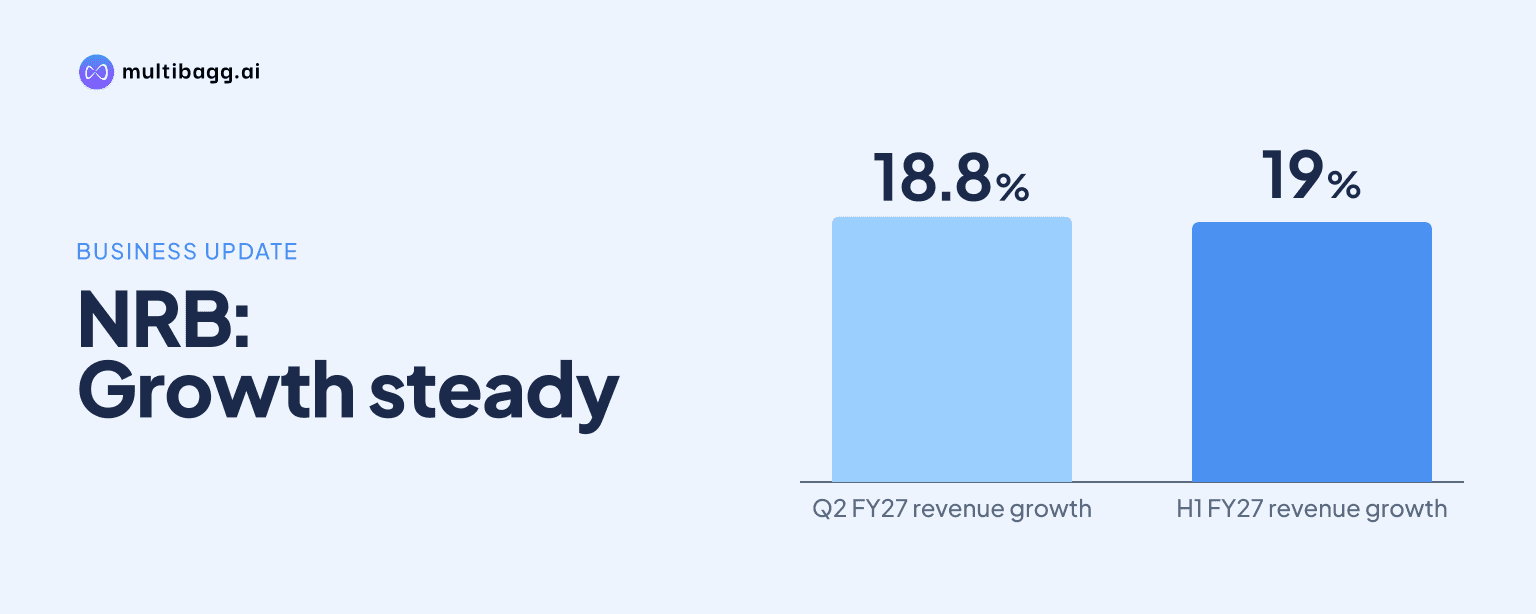
- NRB reported first-half FY27 revenue growth of 19%, compared with 18.8% in Q2 FY27.
- Adjusted EBITDA was Rs 71 crore in Q2 FY27, producing an 18.2% margin.
- NRB said its commercial-vehicle segment grew 47%, and the Unitec joint venture is on track for April 2027 commissioning.
powered by IRIS
NRB Bearings Limited said its 19% first-half FY27 revenue-growth pace can continue, citing Q2 FY27 revenue growth of 18.8% to Rs 386 crore, adjusted EBITDA of Rs 71 crore and an 18.2% margin. Management attributed the result to higher-value products, customer co-engineering and capacity being added against existing orders.
Know NRB Bearings inside out
Results, valuation, peers and who's buying, in one view.
Why does NRB think 19% revenue growth can continue?
NRB says 19% growth is sustainable because management believes the business has reached a higher growth threshold through product mix and customer programs, rather than benefiting only from cyclical automotive demand. Revenue from operations increased 18.8% year on year in Q2 FY27, while first-half FY27 growth was 19%. Management said it intends to sustain and surpass the new threshold, while characterising its financial commitments as conservative.
The comparison shows first-half growth was 0.2 percentage points above the Q2 FY27 rate. Management linked the expansion to deeper customer engagement, increased content per platform, a higher share of wallet at existing customers and business from new customers. It also said growth came from high-precision, proprietary friction solutions and critical customer-platform nominations, while capacity additions were being made for orders already in place.
NRB reported Rs 71 crore of adjusted earnings before interest, tax, depreciation and amortisation, or EBITDA, on quarterly revenue of Rs 386 crore, equivalent to an 18.2% EBITDA margin. Profit after tax was Rs 36 crore in Q2 FY27. Management said depreciation affects profit after tax because the company is expanding capacity for growth opportunities, and asked investors to focus on EBITDA and operational EBITDA rather than profit after tax or profit before interest and tax.
Which five verticals is NRB building capacity for?
NRB is pursuing five connected verticals: aerospace and defence, automotive adjacencies, electrification beyond passenger electric vehicles, broader mobility and mission-critical friction solutions. Management said the five-year strategy is intended to address markets where precision engineering, technical complexity and customer relationships matter. The approach combines legacy automotive products with new applications that use the same friction-management, sealing, lubrication and material capabilities.
Within automotive adjacencies, NRB plans to extend beyond its traditional transmission and chassis products into tapered and ball bearings, wheel hubs, spherical roller bearings, steering systems, one-way clutches and wheel bearings. Management said its commercial-vehicle segment grew 47%, with the growth concentrated in higher-value applications. It also said commercial vehicles and two-wheelers were showing double-digit demand, although it did not give segment revenue figures.
NRB described its electrification strategy as electric-vehicle agnostic. The company is targeting high-frequency drives, commercial electric fleets, electric two-wheelers, off-highway equipment and other e-mobility applications, rather than limiting development to passenger electric vehicles. Management said this broader definition also supports mobility applications such as robotics, automated guided vehicles, urban air mobility and automated transit systems, all of which need precision friction management.
Got a follow-up? Ask IRIS
How does NRB's engineering model support its product mix?
NRB says its engineering model supports the shift toward premium products by placing proprietary capabilities inside customer development programs. Management cited material science, copyrighted multi-body simulation software, in-house dynamic test validation and high-precision automated manufacturing as parts of its platform. It said customers increasingly seek co-development partners that can address friction, noise, torque, mechanical and thermal problems from design through product launch.
The company also referred to shop-floor Internet of Things technology and artificial-intelligence partnerships in manufacturing and product development. Management said the model can shorten development lead times and support customised geometry for applications with sub-micron tolerances, extreme loads and high reliability requirements. These are management statements about the intended mechanism behind product differentiation, not formal financial guidance.
On margins, management did not provide new forward guidance. It said it had previously discussed moving toward 20% growth while maintaining an EBITDA-to-sales ratio of 17% to 18%, and that it wants to maintain EBITDA as a percentage of sales. The reported 18.2% adjusted EBITDA margin in Q2 FY27 was 0.2 percentage points above the upper end of that previously cited range, but management stressed that NRB is not managed on a quarter-by-quarter basis.
What does the Unitec joint venture add to NRB's plan?
NRB said the Unitec joint venture at Aurangabad remains on track for commissioning by April 2027. Management declined to disclose its expected FY28 revenue contribution. An analyst referred to revenue potential of Rs 130 crore, but management said a new business division would not be expected to utilise its entire capacity in FY28, making the timing of the revenue ramp unresolved.
Management said the joint venture will serve broad industrial applications, with a heavy focus on industrial gearboxes. It identified industrial gearboxes as an area with high growth potential in India and better pricing. This provides an industrial channel alongside automotive, aerospace, electrification and mobility applications, while fitting the company’s stated plan to invest in technology, innovation, capacity expansion and product development.
The capacity strategy is intended to add capability as well as machines. Management said NRB does not want to use capacity at any price and instead is prioritising areas where legacy and new verticals can deliver performance through capability enhancement. That framing is consistent with the Q2 FY27 result of Rs 386 crore in revenue and the company’s emphasis on a rising share of premium engineered products.
Conclusion
NRB’s Q2 FY27 results support management’s case that recent growth has a product-mix component: revenue rose 18.8% year on year to Rs 386 crore, first-half growth reached 19%, and adjusted EBITDA was Rs 71 crore at an 18.2% margin. Management connects those figures to higher-value engineering solutions, platform-level customer relationships and capacity allocated to automotive, industrial, aerospace, electrification and mobility applications.
The next disclosed operational milestone is the Unitec joint venture’s planned April 2027 commissioning at Aurangabad. The key unresolved issues are the pace of FY28 utilisation and revenue from the new division, as management has not provided a revenue split or formal forward guidance, while it has said it aims to maintain EBITDA as a percentage of sales.