










Manappuram Home Finance AUM falls to Rs 1,814 crore
Key highlights
- Home Finance reported AUM of Rs 1,814 crore in Q2 FY27, down from Rs 1,847 crore in Q1 FY27.
- Gold loans reached Rs 35 crore in Q2 FY27 after Home Finance launched the product in Q1 FY27.
- Home loans accounted for 61% of Q2 FY27 AUM, down from 68% in FY26.
- Home Finance’s GNPA ratio declined to 2.5% in Q2 FY27 from 2.7% in Q1 FY27.
powered by IRIS
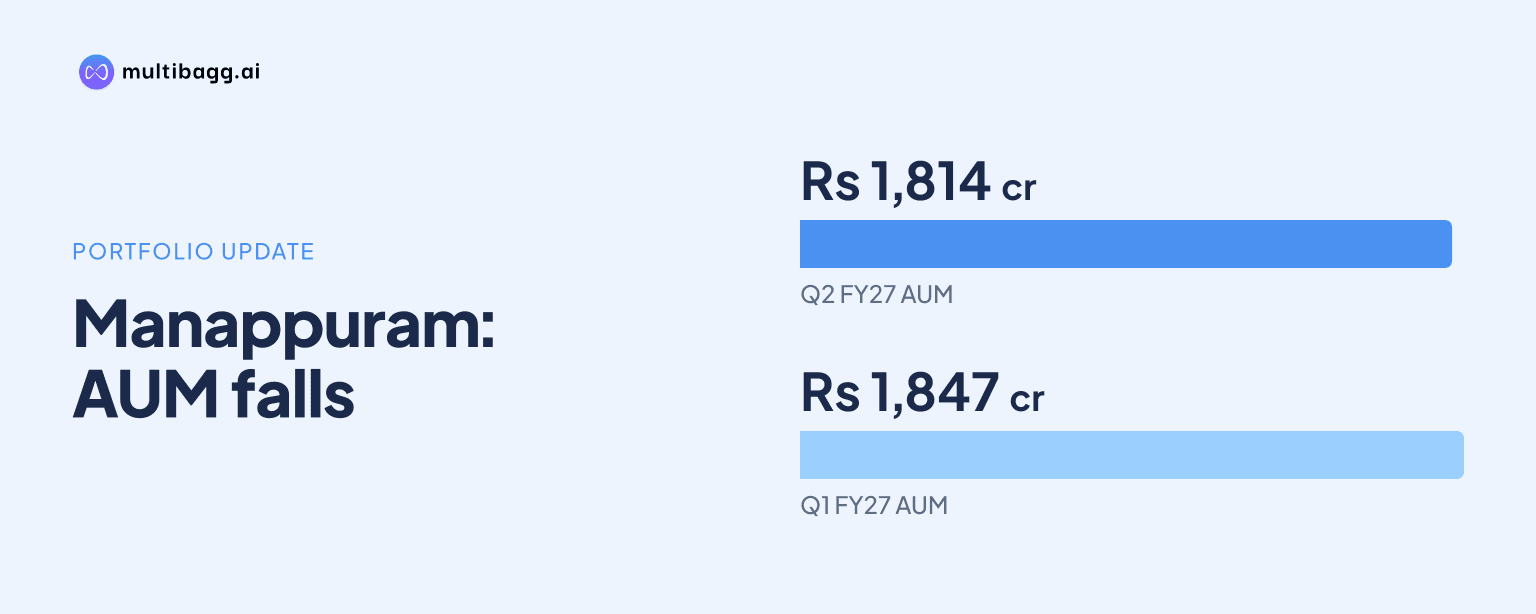
Manappuram Home Finance reported assets under management of Rs 1,814 crore in Q2 FY27, down Rs 33 crore from Q1 FY27, while its gold-loan book reached Rs 35 crore after a Q1 FY27 launch. The update shows a smaller total portfolio, a declining home-loan share and an early move into gold lending.
Know Manappuram Finance inside out
Results, valuation, peers and who's buying, in one view.
Why did Home Finance’s AUM decline in Q2 FY27?
Home Finance’s AUM fell to Rs 1,814 crore in Q2 FY27 from Rs 1,847 crore in Q1 FY27 and Rs 1,852 crore in FY26. The presentation does not identify a cause for the Rs 33 crore sequential decline, so it establishes the portfolio movement without attributing it to disbursements, collections, repayments or write-offs.
The Q2 FY27 balance followed four financial years of expansion. AUM rose from Rs 845 crore in FY22 to Rs 1,096 crore in FY23, Rs 1,510 crore in FY24 and Rs 1,824 crore in FY25 before reaching Rs 1,852 crore in FY26. The latest balance was therefore more than twice the FY22 level, but below both the FY26 closing balance and the preceding quarter.
Home Finance began commercial operations in January 2015 and had 108 branches in the Q2 FY27 operating review. Its stated affordable-housing focus covers mid- to low-income self-employed and salaried customers, with about 80% of customers identified as self-employed, and its branch focus is South and West India.
How significant are gold loans in Home Finance’s portfolio?
Gold loans were 2% of Home Finance’s AUM in Q2 FY27, or Rs 35 crore, through five exclusive branches. The business launched gold loans in Q1 FY27, when gold accounted for 0.4% of AUM, making the Q2 figure the first disclosed rupee balance for the product.
The new product remained smaller than the established lending categories in Q2 FY27: home loans represented 61% of AUM and loan against property, or LAP, represented 37%. LAP is lending secured against property, while home loans were the main reported category in every period from FY22 through FY26. The presentation does not disclose gold-loan disbursements, borrower numbers, delinquencies, yields or collection data.
Gold lending broadened the product mix as the overall book contracted by Rs 33 crore during Q2 FY27. The source does not say whether the Rs 35 crore gold book came from new customers, cross-selling, branch conversion or refinancing, so the early growth of this line cannot be separated into sourcing channels.
Got a follow-up? Ask IRIS
How have Home Finance’s loan mix and asset quality changed?
Home Finance’s home-loan share fell to 61% in Q2 FY27 from 68% in FY26, while LAP increased to 37% from 32% and gold reached 2%. The shift was also visible quarter on quarter: home loans were 63% in Q1 FY27, LAP was 37% and gold was 0.4%.
The mix had already begun changing before the gold launch. In Q4 FY26, home loans represented 65% of AUM and LAP 35%, compared with the 68% and 32% respective shares for FY26. Across FY22 to FY26, home loans had ranged from 68% to 69%, so the Q2 FY27 reading marks a lower reported home-loan allocation.
Gross non-performing assets, or GNPA, were 2.5% in Q2 FY27, compared with 2.7% in Q1 FY27 and 2.6% in Q4 FY26. The ratio was also below 3.1% in Q2 FY26 and 4.9% in Q3 FY26; however, the presentation provides no GNPA amount, provisioning figure or product-level delinquency split.
The presentation lists average ticket size, or ATS, figures of Rs 2.8 lakh, Rs 6.2 lakh and Rs 6.2 lakh alongside yields of 21.1%, 20% and 17.2%. It does not label those figures by period or product, preventing a conclusion about whether Q2 FY27 ATS or yield changed from earlier periods.
What is Home Finance planning after Q2 FY27?
Home Finance says it plans to expand its branch network across 12 states and focus on higher-ATS customers. Management also lists its parent brand, access to a customer base, performance-enablement programmes and digital interventions as drivers for future expansion, but discloses no AUM target, branch-addition target or implementation timetable.
The sourcing model includes a cluster-driven approach, partnerships with direct selling agents, or DSAs, and connectors, plus region-specific marketing. Home Finance also cites market coverage in suburbs of Tier 1, Tier 2 and Tier 3 locations and a broad product suite as elements of origination, alongside its 108-branch South and West India focus.
For customer servicing and collections, Home Finance lists a customer-facing mobile application, customer relationship management capabilities, digital-first collection infrastructure and in-house legal and field collection networks. Its underwriting framework includes multi-level loan approvals and profile-based assessment templates, although the Q2 FY27 presentation sets no numerical target for collections, credit costs or asset quality.
Conclusion
Home Finance’s Q2 FY27 update shows a Rs 1,814 crore portfolio that declined sequentially while its composition changed. Home loans fell to 61% of AUM from 68% in FY26, LAP reached 37% and newly introduced gold loans were Rs 35 crore, or 2% of AUM. GNPA declined to 2.5% from 2.7% in Q1 FY27.
The next disclosure should indicate whether planned expansion across 12 states, higher-ATS lending, DSA partnerships and digital productivity initiatives reverse the AUM decline. It should also show whether gold lending grows beyond the first five exclusive branches and whether Home Finance provides product-level information on disbursements, yield and portfolio quality.