










Manipal Hospitals Plans 500-Bed Gurugram Hospital Under 30-Year Lease
Key highlights
- Manipal Hospitals signed an approximately 30-year lease for about 3.5 acres in Gurugram.
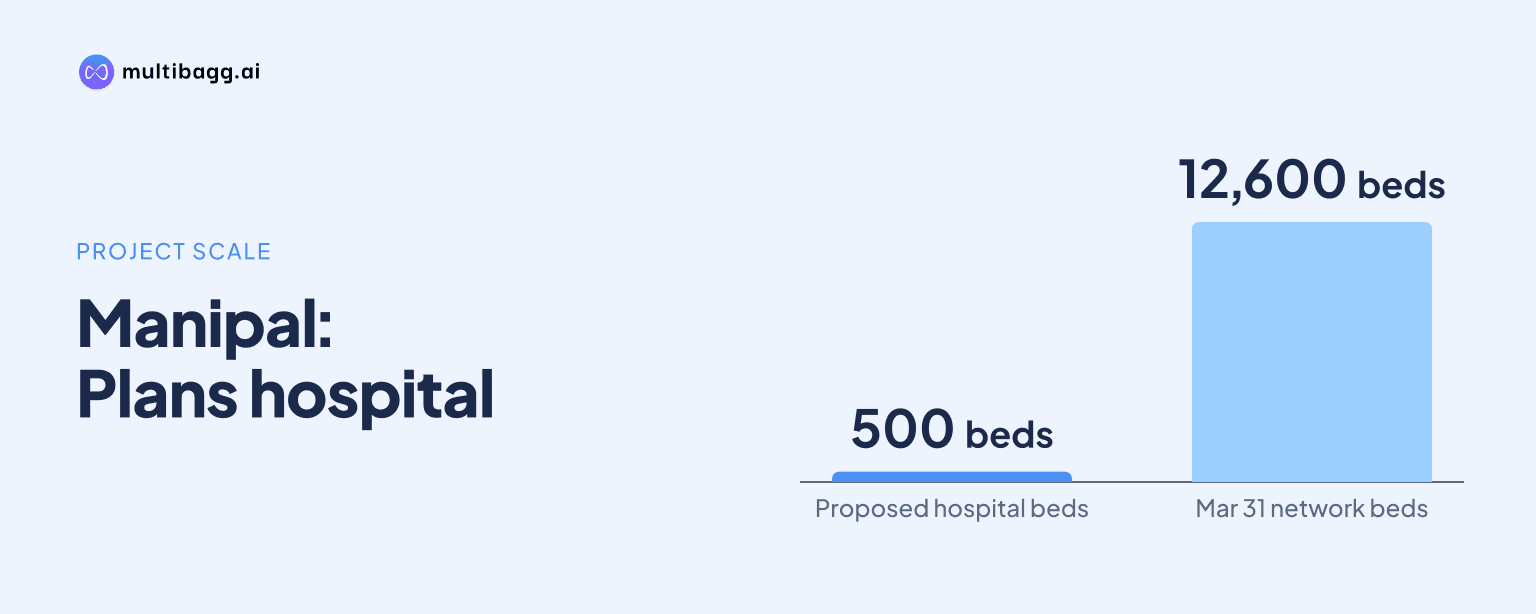
- The first phase of the proposed multispecialty hospital is expected to have up to 500 beds.
- Manipal Hospitals did not disclose project investment, though its earlier ₹1.5 crore-per-bed benchmark implies about ₹750 crore for selected 500-bed costs.
- Manipal Hospitals had more than 12,600 beds across 49 hospitals as of March 31, 2026.
powered by IRIS
Manipal Health Enterprises Limited has signed a 30-year lease to develop and operate a multispecialty hospital with a first phase of up to 500 beds in Gurugram. The agreement with Thakral Corporation's Indian subsidiary, TIL Investments, expands Manipal Hospitals' presence in Delhi NCR, where demand is being supported by residential and infrastructure development.
Know Manipal Health Enterprises inside out
Results, valuation, peers and who's buying, in one view.
What has Manipal Hospitals agreed to develop in Gurugram?
Manipal Hospitals will construct, operate, manage and maintain a multispecialty hospital on about 3.5 acres of land in Gurugram under the long-term lease agreement. The first phase of the proposed facility is expected to have up to 500 beds, according to the company's regulatory filing.
The agreement was signed with TIL Investments, the Indian subsidiary of Singapore Exchange Mainboard-listed Thakral Corporation. The filing did not disclose a project investment figure, construction schedule or opening date. It said the land parcel is well connected to Indira Gandhi International Airport and other major infrastructure nodes, and is located near upcoming residential developments and infrastructure projects.
The proposed development is intended to be more than a standalone hospital. Anchored by the tertiary-care facility, the Manipal Hospitals board has proposed an integrated health and wellness ecosystem supported by hospitality and retail offerings. Thakral described the arrangement as its entry into healthcare-focused real estate.
Why is Gurugram important for Manipal Hospitals' expansion?
Gurugram is important because Manipal Hospitals has identified Delhi NCR as a priority market for expanding its hospital network. Chief Executive Officer Dilip Jose said the proposed hospital would strengthen the group's presence in the region and help it serve growing healthcare needs.
Manipal Hospitals already has facilities in Delhi, Gurugram and Ghaziabad. In an earlier interview, Jose said the company was seeking further opportunities in north India, including hospitals in the 250- to 300-bed range in the National Capital Region. He noted that brownfield opportunities could be attractive because greenfield hospital projects generally take longer to complete.
The new Gurugram proposal is a greenfield development. Its location near the airport and major infrastructure links gives the hospital access to a large urban catchment across Delhi NCR. However, neither Manipal Hospitals nor Thakral has stated expected patient volumes, commissioning timelines, lease rentals or revenue targets for the facility.
Got a follow-up? Ask IRIS
What could the proposed hospital cost to build?
The Gurugram project's investment has not been disclosed, though earlier comments by Jose provide an indicative benchmark for certain hospital-development costs. He had said that medical equipment, technology, information technology and interiors typically require spending of around ₹1.5 crore per bed.
Applied to a first phase of up to 500 beds, that benchmark implies expenditure of about ₹750 crore on those components. This is only an illustrative calculation and should not be treated as Manipal Hospitals' confirmed capital commitment for the Gurugram project. It excludes factors that can materially affect overall project cost, including land, building construction and the final scope of clinical services.
Jose had also said that a greenfield hospital with around 250 beds typically needs ₹380 crore to ₹390 crore, excluding land and building costs. The two benchmarks indicate the capital-intensive nature of hospital expansion, particularly where operators must invest in specialised medical equipment, digital systems and patient-facing infrastructure before operations begin.
How does the lease affect Thakral and the healthcare real-estate market?
The lease gives Thakral a platform to build a healthcare, hospitality and retail-led wellness ecosystem on its Gurugram land parcel. For Manipal Hospitals, the arrangement enables an expansion in Delhi NCR without acquiring the land outright, while retaining responsibility for constructing and operating the hospital.
For investors and industry observers, the agreement highlights how long-tenure land arrangements can support capacity additions in urban healthcare markets. Hospital operators need suitably located sites near population centres, transport corridors and complementary infrastructure, while property owners can participate in specialised real-estate development through leases with established healthcare providers.
Manipal Hospitals operates a pan-India multispecialty network providing services ranging from outpatient care to tertiary and quaternary interventions. As of March 31, 2026, its network was spread across 14 states and union territories, with more than 12,600 beds across 49 hospitals. The group is backed by Temasek, which has been a major shareholder and has supported its expansion strategy.
Conclusion
The 30-year lease between Manipal Hospitals and TIL Investments sets the framework for a proposed 500-bed multispecialty hospital in Gurugram. The project supports Manipal Hospitals' stated focus on Delhi NCR and marks Thakral's entry into healthcare-focused real estate, while the proposed wellness ecosystem broadens the planned use of the site.
The key matters to watch are the final capital commitment, construction schedule, operating launch date and the detailed scope of the hospital and associated hospitality and retail facilities. Manipal Hospitals has confirmed the land area, lease tenure and first-phase bed capacity, but has not disclosed those next-stage project details.