










VL E-Governance Reports Zero Q2 Revenue, ₹52.79 Lakh Loss
Key highlights
- VL E-Governance reported nil revenue from operations in Q2 FY27, versus ₹325.19 lakh in Q2 FY26.
- Q2 FY27 total income was ₹2.05 lakh, entirely from other income.
- Net loss was ₹52.79 lakh in Q2 FY27, compared with a loss of ₹52.38 lakh a year earlier.
- Cash reserves fell 98.7% in six months, while total assets declined to ₹4,600.23 lakh.
powered by IRIS
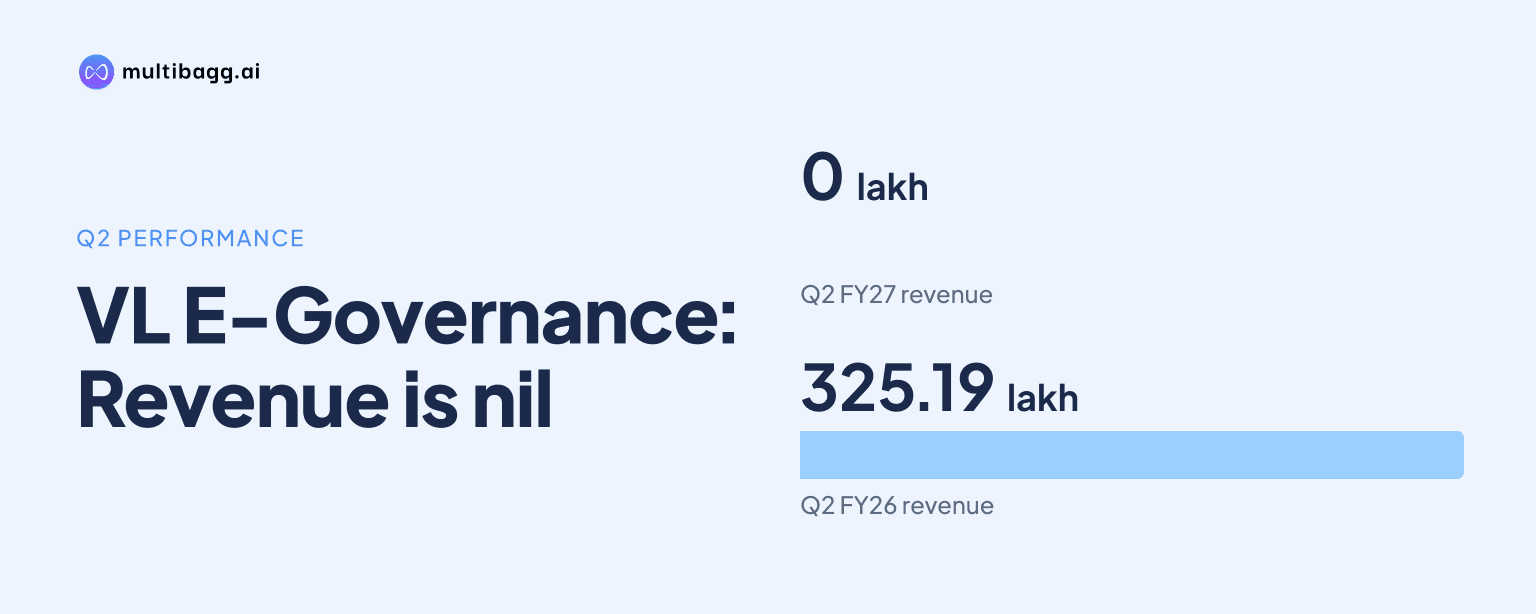
VL E-Governance & IT Solutions Limited reported zero revenue from operations in Q2 FY27 ended September 30, 2026, and posted a net loss of ₹52.79 lakh, compared with operating revenue of ₹325.19 lakh in the corresponding quarter a year earlier. The results underline the company’s immediate revenue and liquidity challenge as it pursues larger government and infrastructure projects.
Know VL E-Governance & IT Solutions inside out
Results, valuation, peers and who's buying, in one view.
What did VL E-Governance report for Q2 FY27?
VL E-Governance reported total income of ₹2.05 lakh for the September 2026 quarter, entirely comprising other income. Revenue from operations was nil, against ₹325.19 lakh in Q2 FY26. Total income was ₹330.63 lakh in the year-earlier quarter.
The absence of operating revenue resulted in a loss before tax of ₹52.59 lakh, compared with a loss before tax of ₹51.74 lakh in Q2 FY26. Net loss stood at ₹52.79 lakh, marginally higher than the ₹52.38 lakh loss reported in the corresponding quarter last year.
The Board of Directors approved the unaudited standalone financial results on November 4, 2026. Statutory auditor B K G & Associates issued an unmodified opinion on the financial statements, which were prepared in accordance with Indian Accounting Standard 34, or Ind AS 34.
Why did operating revenue fall to zero?
VL E-Governance did not report any revenue from operations during Q2 FY27. This represented a 100% year-on-year reduction from the ₹325.19 lakh of operating revenue recorded in Q2 FY26. The available update does not specify individual projects, customers, or operational factors behind the absence of revenue during the quarter.
The decline in income was much larger than the movement in quarterly losses. While revenue from operations fell to zero, net loss increased by about 0.8% year on year, from ₹52.38 lakh to ₹52.79 lakh. This indicates that the reported quarterly loss remained broadly stable despite the loss of operating income.
The company has stated that it is shifting its focus towards large-scale government projects and infrastructure. Its stated approach includes pursuing larger-ticket opportunities, including a cited ₹800 crore smart city contract, to address the structural gap in operating revenue. The results, however, do not provide a timeline for revenue recognition from these opportunities.
What does the balance sheet show about VL E-Governance?
VL E-Governance remained debt-free at the end of the reported period, with zero long-term debt and zero short-term debt. Total assets were ₹4,600.23 lakh, down from ₹4,719.82 lakh as of March 2026, a decrease of ₹119.59 lakh over six months.
Other equity was negative ₹6,498.69 lakh, reflecting accumulated losses in excess of paid-up capital. Negative other equity is an important indicator of the company’s historical losses and its limited internal financial cushion, even though there was no reported borrowing on the balance sheet.
The company’s cash reserves were reported to have declined by 98.7% over six months. The available information describes the company as relying on asset sales rather than operating cash flow to fund deficit spending. This makes the resumption of operating activity relevant to its financial position, particularly because Q2 FY27 generated no revenue from operations.
Got a follow-up? Ask IRIS
How does the Q2 result affect investors and operations?
For investors, the Q2 FY27 update highlights a substantial gap between the company’s current operating revenue and its stated growth strategy. The company has no financial debt, but the sharp reduction in cash reserves and negative other equity remain central financial considerations alongside the nil operating revenue figure.
For operations, the stated pivot towards government and infrastructure work places greater importance on the execution and monetisation of large projects. Large government-linked contracts can have extended approval, implementation and billing cycles, but the company has not disclosed an earnings timeline or management guidance in the provided update.
The September-quarter results also contrast with the prior-year quarter, when the company generated ₹325.19 lakh in operating revenue. The loss before tax was only ₹0.85 lakh wider year on year despite this revenue decline, which points to a cost base that did not move in line with the drop in operating income during the reported period.
What is the background to VL E-Governance’s current strategy?
VL E-Governance was founded on March 18, 2016 and is headquartered in Mumbai. The company’s current stated strategy is to pursue large-scale government projects and infrastructure assignments, rather than relying on smaller operating revenue streams.
For FY25, the company reported revenue of ₹3,591 lakh and net profit of ₹421 lakh. Those annual figures provide context for the scale of the Q2 FY27 operating revenue shortfall, although a single quarter cannot be directly compared with a full financial year.
The company released a performance update presentation for Q2 FY27, while the Board approved the unaudited standalone results on November 4, 2026. No earnings-call transcript or management guidance for the quarter was provided in the available material. As a result, the reported financial numbers and the stated project focus are the clearest disclosed indicators of the company’s near-term position.
Conclusion
VL E-Governance’s Q2 FY27 results show a complete halt in reported operating revenue, with revenue from operations falling from ₹325.19 lakh in Q2 FY26 to nil. The net loss remained comparatively stable at ₹52.79 lakh, but lower assets, negative other equity and a 98.7% fall in cash reserves underline the pressure on the company’s financial resources.
The next area to watch is whether the company provides specific execution, billing or revenue-recognition details for its proposed large government and infrastructure projects, including the cited ₹800 crore smart city contract. Investors will also monitor future quarterly disclosures for evidence of operating revenue recovery and changes in cash reserves.