










Manipal Hospitals Holds 64.2% CONGO-R Mix, Oncology Up 51%
Key highlights
- Manipal Hospitals reported a 64.2% CONGO-R mix in H1FY27, compared with 64.1% in H1FY26.
- Oncology grew 51% year on year in H1FY27, the fastest rate among six reported centres of excellence.
- Oncology’s mix share rose to 12.0% from 11.3%, while cardiac remained the largest category at 15.2%.
- Manipal Hospitals reported 19 linear accelerators, 16 PET CT systems and 27 orthopaedic and spine surgical robots across its network.
powered by IRIS
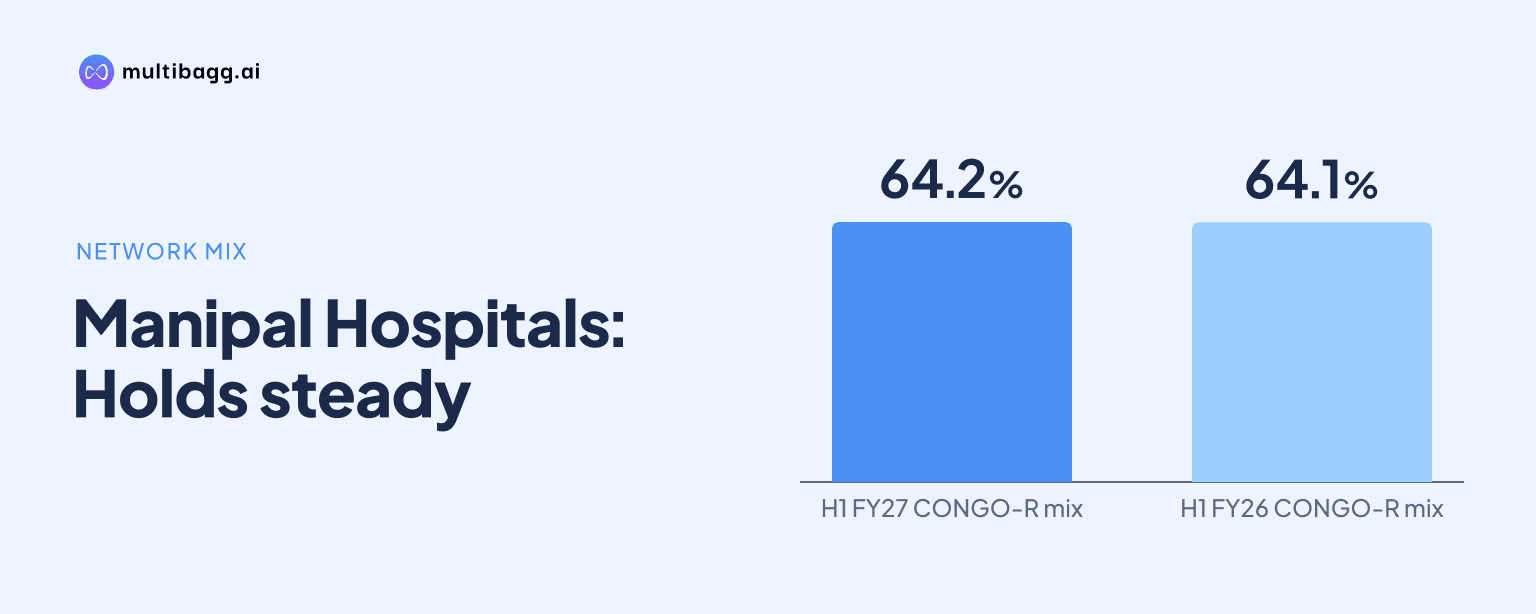
Manipal Hospitals held a 64.2% CONGO-R mix in H1FY27, compared with 64.1% in H1FY26, while oncology grew 51% year on year, the fastest rate among its six reported centres of excellence. The result came as H1FY27 revenue rose 37.7% to Rs 6,490 crore, including Rs 707 crore from Sahyadri.
Know Manipal Health Enterprises inside out
Results, valuation, peers and who's buying, in one view.
What was Manipal Hospitals’ CONGO-R revenue mix in H1FY27?
Manipal Hospitals reported a CONGO-R mix of 64.2% in H1FY27, up 0.1 percentage point from 64.1% in H1FY26. The presentation does not define the CONGO-R abbreviation, but it identifies cardiac, oncology, neuro, gastro, ortho and renal as the reported centres of excellence within this disclosure.
The broadly stable aggregate mix was reported alongside 37.7% revenue growth to Rs 6,490 crore in H1FY27 from Rs 4,713 crore in H1FY26. H1FY27 included Rs 707 crore of Sahyadri revenue, while the prior-year period did not include Sahyadri because Manipal Hospitals acquired it on October 3, 2025.
How did Manipal Hospitals’ specialty mix change by centre of excellence?
Manipal Hospitals’ oncology share recorded the largest disclosed increase, rising 0.7 percentage point to 12.0% in H1FY27 from 11.3% in H1FY26. Neuro increased by 0.3 percentage point to 9.1%, and ortho increased by 0.2 percentage point to 13.6%.
The increases in oncology, neuro and ortho were partly offset by lower shares in cardiac, gastro and renal. Cardiac declined 0.4 percentage point to 15.2%, gastro fell 0.4 percentage point to 7.1%, and renal declined 0.2 percentage point to 7.3%.
Cardiac remained the largest reported centre of excellence at 15.2% of mix in H1FY27, followed by ortho at 13.6% and oncology at 12.0%. The six displayed shares total about 64% because the presentation reports them as components of the 64.2% CONGO-R mix and rounds the individual percentages.
Which Manipal Hospitals specialties grew fastest in H1FY27?
Oncology was Manipal Hospitals’ fastest-growing reported centre of excellence in H1FY27, with 51% year-on-year growth. Neuro followed at 47%, ortho grew 44%, cardiac grew 39%, renal grew 38%, and gastro grew 36%.
The growth ranking differed from the mix ranking: oncology represented 12.0% of H1FY27 mix, below cardiac’s 15.2%, but its 51% growth was 12 percentage points higher than cardiac’s 39%. Gastro had the lowest disclosed growth rate at 36%, despite accounting for 7.1% of mix.
Network volumes also increased during the period. Inpatient volumes rose 36.8% to 325,000 in H1FY27 from 237,000 in H1FY26, occupied beds increased to 4,897 from 3,546, and occupancy rose 230 basis points to 67.6%.
What operating metrics accompanied Manipal Hospitals’ specialty growth?
Manipal Hospitals reported outpatient volumes of 3.287 million in H1FY27, up 26.6% from 2.596 million in H1FY26. Average length of stay increased to 2.8 days from 2.7 days, while operational beds rose to 7,248 from 5,430.
Average revenue per occupied bed, or ARPOB, was Rs 71,100 per day in H1FY27, compared with Rs 70,800 per day in H1FY26. Excluding Sahyadri, H1FY27 ARPOB was Rs 76,900 per day, which the presentation says was 8.6% higher year on year.
Sahyadri’s inclusion affected the reported network comparison because it contributed 55,000 of the 325,000 inpatient volumes in H1FY27. Sahyadri recorded Rs 707 crore of revenue, Rs 131 crore of earnings before interest, tax, depreciation and amortisation, or EBITDA, and 67.0% occupancy in H1FY27.
Got a follow-up? Ask IRIS
What advanced equipment did Manipal Hospitals report across its network?
Manipal Hospitals reported 19 linear accelerators, 16 positron emission tomography-computed tomography, or PET CT, systems, two tomotherapy units, 59 catheterisation laboratories and 44 magnetic resonance imaging systems across its network, including operations-and-maintenance hospitals. It also reported 27 orthopaedic and spine surgical robots, 24 soft-tissue robots and six gamma cameras.
During H1FY27, Manipal Hospitals added a high-end linear accelerator and a PET CT system at MH Kundanhur. It also added an artificial intelligence-assisted neuro biplane catheterisation laboratory system at MH Mukundapur and an artificial intelligence-enabled catheterisation laboratory at Old Airport Road.
The H1FY27 additions also included orthopaedic robots at MH Patiala, MH Vijayawada and MH Pune Baner. The equipment disclosure was presented as medical infrastructure supporting tertiary and quaternary care, while ortho was the third-fastest-growing reported centre of excellence at 44%.
What clinical procedures did Manipal Hospitals highlight in H1FY27?
Manipal Hospitals highlighted a laser-guided renal artery angioplasty at MH Dhakuria for a 60-year-old patient and the excision of a 10 x 10 x 10 centimetre neck lymphangioma at MH Broadway. The MH Broadway case involved an airway-compressing growth close to major blood vessels and nerves, according to the presentation.
MH Electronic City reported South India’s first use of 5-ALA fluorescence-guided surgery for a 61-year-old patient with a brain tumour in the sensory cortex. MH Kanakapura performed its first Bentall procedure, described in the presentation as aortic root and valve replacement, while MH Goa reported Goa’s first covered self-expandable metallic stent procedure for an airway blockage and tracheoesophageal fistula caused by an esophageal tumour.
Other cited activity included robot-assisted orthopaedic surgery at MH Patiala and a balloon pulmonary valvotomy at MH Deccan Gymkhana for a two-month-old baby. MH Sarjapur also hosted India’s first dedicated adaptive deep brain stimulation summit, focused on Parkinson’s care and other movement disorders.
Conclusion
Manipal Hospitals’ H1FY27 disclosure shows a largely unchanged 64.2% CONGO-R mix alongside growth in all six reported centres of excellence. Oncology was the clearest shift, with 51% growth and a 0.7-percentage-point increase in mix share to 12.0%, while cardiac remained the largest reported category at 15.2%.
The next disclosed milestone is the phased Sahyadri brand transition, which management plans to complete in Q4 FY27 while engaging government agencies. Sahyadri’s Rs 707 crore of H1FY27 revenue, 18.5% EBITDA margin and 67.0% occupancy make the progress of that integration relevant to future network comparisons.