










Mankind expects India Rx to outgrow market after reset
Key highlights
- Mankind expects India Rx to grow at 1.1 to 1.2 times the Indian pharmaceutical market over the next two quarters.
- India Rx volume growth improved to 6.2% in Q2 FY27 from a 0.5% decline in Q2 FY26.
- Field-force productivity rose to about Rs 7.4 lakh per medical representative from about Rs 7 lakh in FY26.
- Hospital revenue grew 23% year on year in Q2 FY27, while chronic therapies accounted for about 37% of the portfolio mix.
powered by IRIS
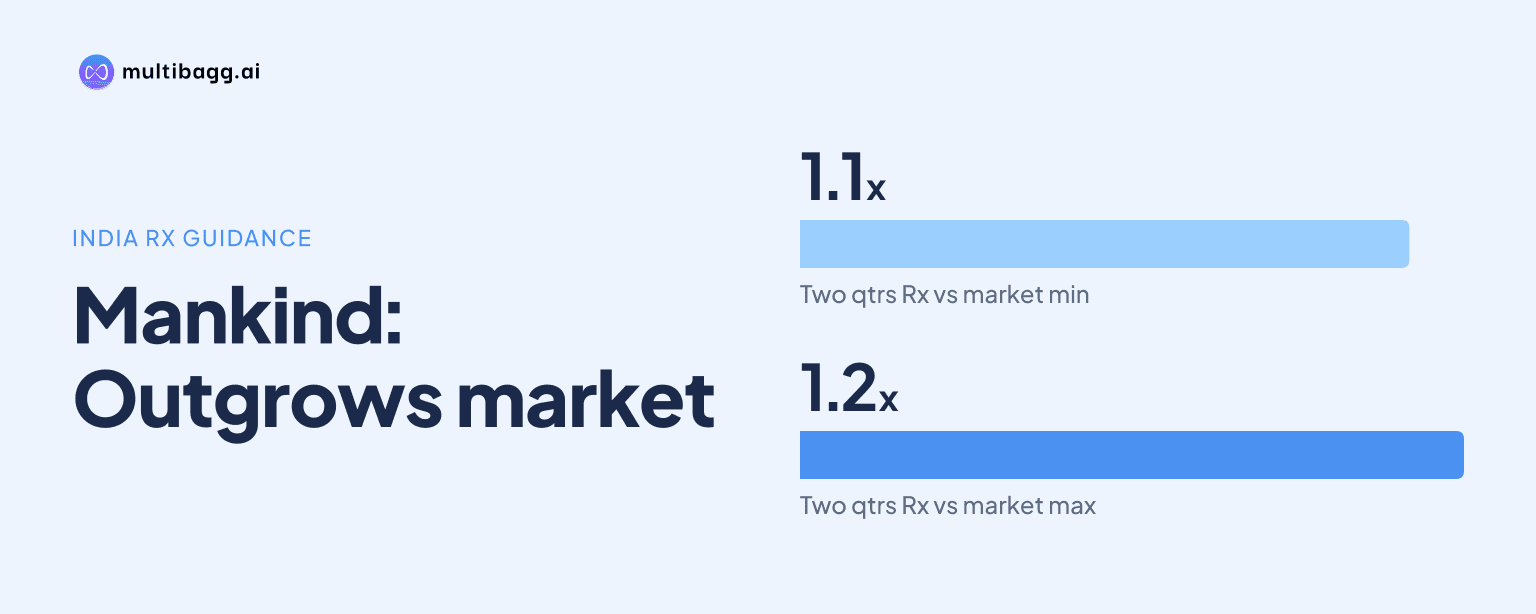
Mankind Pharma Limited said its India Rx business can grow at 1.1 to 1.2 times the Indian pharmaceutical market over the next two quarters after leadership and field teams stabilised. Management cited Q2 FY27 volume growth of 6.2%, compared with a 0.5% decline in Q2 FY26, alongside improvement across chronic and acute therapies.
Know Mankind Pharma inside out
Results, valuation, peers and who's buying, in one view.
Can Mankind sustain India Rx outperformance?
Mankind said it expects India Rx to outperform the Indian pharmaceutical market, or IPM, by about 1.1 to 1.2 times over the next two quarters. Management did not give an absolute India Rx growth target, saying IPM growth over the coming two or three quarters was unpredictable.
The outlook follows India Rx growth of 15.7% in Q2 FY27, which management also described as 16% during the analyst discussion. An analyst noted that the business grew 5% in Q2 FY26 and estimated its two-year compound annual growth rate, or CAGR, at about 11%, compared with IPM growth of around 12% to 13%; management accepted the observation while saying the recovery was continuing.
Mankind contrasted its near-term 1.1 to 1.2-times objective with historical growth of 1.3 to 1.4 times IPM over many years. Management did not commit to returning to that earlier range, but said domestic growth remains its central focus and it aims to outperform IPM.
What changed after Mankind's field-force reset?
Mankind attributed the improvement to stabilised leadership and field teams after disruption over the preceding six to eight quarters. Management said the teams had stabilised over the last three to four quarters, allowing domestic volume growth to improve progressively rather than merely benefiting from the Q2 FY26 comparison base.
The volume sequence cited by management moved from a 0.5% decline in Q2 FY26 to 1.5% growth in Q3 FY26, 2% in Q4 FY26, 4.7% in Q1 FY27 and 6.2% in Q2 FY27. Mankind described volume as a key measure because it indicates underlying prescription demand rather than only price or sales mix.
Field-force productivity also rose during hiring for new divisions. Management said trailing-12-month productivity per medical representative, or MR, increased to about Rs 7.4 lakh at the end of Q2 FY27 from about Rs 7 lakh in FY26, with growth coming from both established brands and newer launches.
An analyst referred to 63 brands with sales above Rs 50 crore, compared with 54 in FY26. Mankind said its operating objective is to build more Rs 50 crore and Rs 100 crore brands, particularly in chronic therapies, but did not quantify the separate contribution of existing brands, launches or added representatives to India Rx growth.
Got a follow-up? Ask IRIS
Which therapies are supporting Mankind's domestic recovery?
Mankind said chronic therapies, acute products, gastroenterology and multivitamins are supporting broader domestic growth. Management said the latest momentum had picked up in chronic and acute segments, while the preceding quarter was dominated by chronic, gastro and multivitamin growth.
Chronic medicines are central to the plan because Mankind ended the previous year with chronic contribution of about 38.5% to 39%, although management said the Q2 mix appeared at 37% because of a higher base. It aims to add 100 to 200 basis points annually and reach a 50% chronic contribution over four to five years; a basis point is one-hundredth of a percentage point.
The hospital channel is another component. Mankind reported hospital revenue growth of 23% year on year during the quarter and said specialist engagement and targeted launches would support the segment. Its hospital strategy is broad-based across metros, Tier-1 and Tier-2 cities rather than restricted to larger urban markets.
Mankind also said it has started entering the semaglutide opportunity strategically, with one launch in cardio-diabetes and one in gynaecology. Management did not disclose a revenue target, share goal or timetable, saying it would assess the response as the products progress.
Can Mankind's anti-infective business catch up with IPM?
Mankind said anti-infective growth has improved quarter by quarter and could match IPM growth in coming quarters. Management also said it aims to exceed IPM as new-product contribution increases, addressing an analyst's observation that key brands such as Moxikind and Cefakind had appeared to lag the market.
Management said antibiotic trends improved from Q3 FY26 through Q4 FY26, Q1 FY27 and Q2 FY27, including for Moxikind-CV, Cefakind and Gudcef. It said Gudcef outperformed the market in Q2 FY27, while Mankind rebuilt mass-specialty coverage for antibiotics and added consultant coverage among surgeons and ear, nose and throat specialists.
The antibiotic recovery is distinct from the higher chronic contribution that supported the quarter. Management said monsoon conditions affect seasonal anti-infectives more than chronic, gastro and multivitamin products, and acknowledged some weather effect while saying it was limited because chronic and semi-chronic portfolios contributed more to growth.
Mankind said its performance in cardio, diabetes, vitamins and gastro exceeded the market even in Q2 of the previous year. That comparison supports management's view that the latest recovery is not solely a result of a lower year-earlier base, although Mankind did not disclose category revenue or individual therapy growth rates.
Conclusion
Mankind's domestic recovery case rests on volume growth moving from a 0.5% decline in Q2 FY26 to 6.2% growth in Q2 FY27, alongside stabilised leadership and field teams. Its 1.1 to 1.2-times IPM objective for the next two quarters is below the 1.3 to 1.4-times historical range management cited, but would establish continued relative outperformance if achieved.
The next measures to watch are whether India Rx volume growth continues after Q2 FY27, whether anti-infectives match IPM growth, and whether chronic contribution rises by the planned 100 to 200 basis points a year. Management's disclosed plans also include expanding hospital activity after 23% quarterly revenue growth and taking chronic contribution to 50% over four to five years.