










Manoj Jewellers H1 revenue up 34% as EBITDA margin falls
Key highlights
- Manoj Jewellers reported H1 FY27 operating revenue of Rs 92.545 crore, up 33.9% year on year.
- H1 FY27 EBITDA was Rs 4.8568 crore, and EBITDA margin fell to 5.25% from 11.82% in H1 FY26.
- H1 FY27 PAT declined 52.0% year on year to Rs 2.7169 crore, with PAT margin at 2.94%.
- B2B represented 87.08% of Manoj Jewellers’ FY26 revenue, compared with 62.99% in FY24.
powered by IRIS
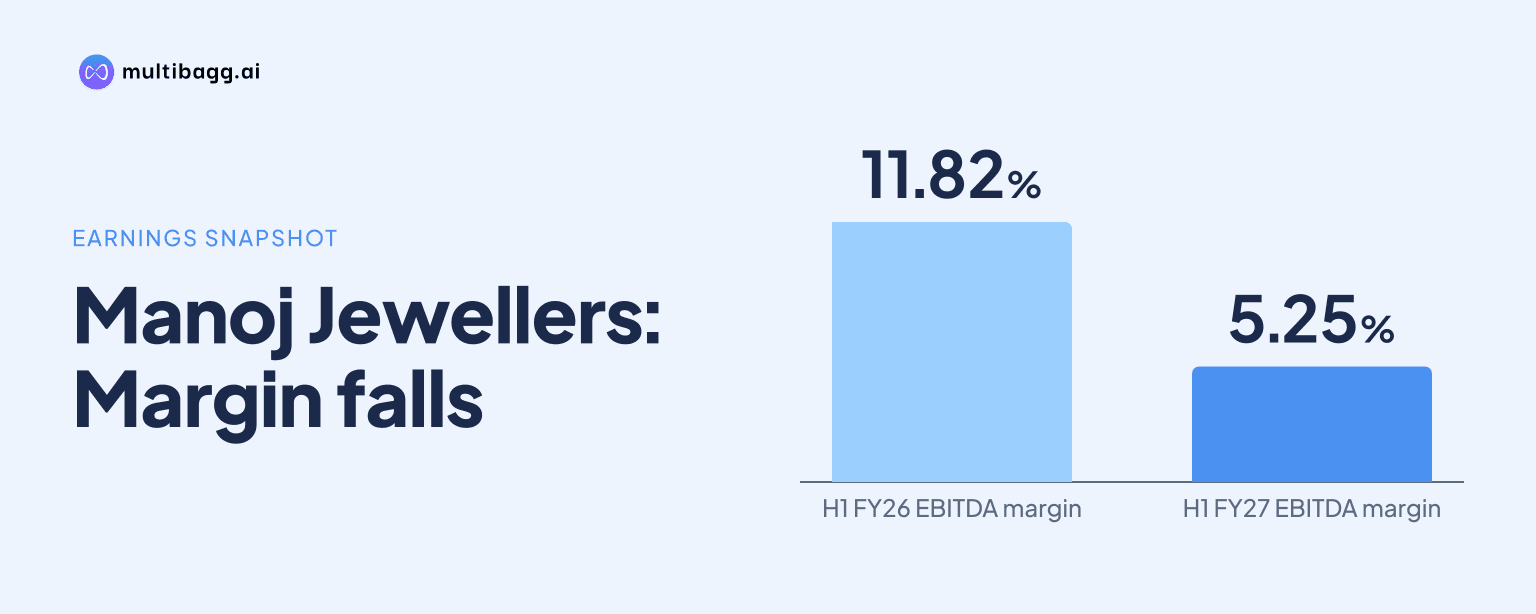
Manoj Jewellers Limited reported H1 FY27 operating revenue of Rs 92.545 crore, 33.9% higher year on year, but earnings before interest, tax, depreciation and amortisation (EBITDA) margin fell 657 basis points to 5.25% from 11.82%, as management cited softer gold-price realisations and a greater wholesale mix.
Know Manoj Jewellers inside out
Results, valuation, peers and who's buying, in one view.
Why did Manoj Jewellers’ revenue rise in H1 FY27?
Manoj Jewellers’ revenue rose because higher volumes through its business-to-business (B2B) wholesale network increased sales. Revenue from operations was Rs 92.545 crore in H1 FY27, against Rs 69.1398 crore in H1 FY26, and was also 105.6% above Rs 45.0213 crore in H2 FY26.
Management described the wholesale scale-up as an investment in reach, volumes and inventory velocity. Manoj Jewellers supplies hallmarked gold ornaments and collections to regional jewellers and bulk buyers across South India, sourcing jewellery from contract manufacturers. Its retail presence includes a 2,000-square-foot Sowcarpet showroom and a 1,500-square-foot Kilpauk outlet in Chennai.
The sales increase did not translate into higher operating profit. Total expenses rose 43.8% year on year, faster than the 33.9% increase in operating revenue, while EBITDA declined 40.6% from H1 FY26. Revenue more than doubled from H2 FY26, but EBITDA was 11.4% lower than the Rs 5.4793 crore reported in that preceding half.
How far did Manoj Jewellers’ profitability decline in H1 FY27?
Manoj Jewellers’ EBITDA fell 40.6% year on year to Rs 4.8568 crore, and its EBITDA margin fell to 5.25% from 11.82%. The 657-basis-point decline also placed the H1 FY27 margin below the 12.17% recorded in H2 FY26, when EBITDA was Rs 5.4793 crore.
Management attributed the lower margin to softer gold-price realisations and a higher contribution from wholesale, which it says has structurally lower margins than retail. The presentation characterises wholesale as a volume-driven model with moderate margins, whereas retail is described as the higher-margin vertical. These disclosed factors link the margin decline to sales mix and realisations rather than to a reduction in H1 revenue.
Profit after tax (PAT) fell 52.0% year on year to Rs 2.7169 crore, while PAT margin declined 524 basis points to 2.94%. Financial cost increased 104.1% to Rs 1.0868 crore from Rs 0.5325 crore in H1 FY26. Diluted earnings per share fell 55.41% to Rs 3.01 from Rs 6.75.
Got a follow-up? Ask IRIS
How has Manoj Jewellers’ revenue mix changed?
Manoj Jewellers has become more dependent on B2B wholesale, which represented 87.08% of FY26 operating revenue, compared with 62.99% in FY24. Retail’s share declined to 12.92% in FY26 from 37.01% in FY24, providing context for management’s statement that a greater wholesale contribution affected H1 FY27 profitability.
B2B revenue increased from Rs 27.31 crore in FY24 to Rs 45.62 crore in FY25 and Rs 99.41 crore in FY26. Retail revenue moved from Rs 16.05 crore in FY24 to Rs 14.00 crore in FY25 and Rs 14.75 crore in FY26. Total operating revenue increased from Rs 43.35 crore in FY24 to Rs 114.16 crore in FY26.
The presentation does not provide a numerical H1 FY27 split between B2B and retail sales, so the exact latest-half wholesale share cannot be calculated from the disclosed figures. It does explicitly connect the higher wholesale mix with the 5.25% H1 FY27 EBITDA margin. Manoj Jewellers also identifies gold-plated and Italian silver jewellery as new categories, stating that gold-plated silver can replicate gold bridal designs costing more than Rs 10 lakh for Rs 1.5 lakh to Rs 2 lakh.
What is Manoj Jewellers planning after H1 FY27?
Manoj Jewellers plans during FY27 to commission its own bangle manufacturing unit, launch a chains line, scale the Thanga Kovil collection and expand its old-gold exchange programme. Management said it closed a Rs 17.97 crore rights issue in September at Rs 20 per share to fund business growth, but did not disclose commissioning or launch dates for the bangle unit and chains line.
The company also plans selective boutique silver showrooms across Tamil Nadu, a relaunch of zulry.com as its core digital platform, and technology-led inventory tracking to speed stock rotation. Management’s steady-state margin framework calls for wholesale margins of roughly 2%, retail margins of 6% to 8%, and silver margins above 50%. These are management expectations, not reported H1 FY27 segment margins.
Balance-sheet movements provide further context for the planned scale-up. Trade receivables were Rs 45.841 crore at H1 FY27, up from Rs 7.514 crore at FY26, while inventory declined to Rs 23.133 crore from Rs 49.059 crore. Short-term borrowings increased to Rs 13.987 crore from Rs 8.254 crore, alongside the company’s stated inventory-efficiency initiative.
Conclusion
Manoj Jewellers delivered a substantial H1 FY27 sales increase through wholesale-led volumes, but the higher wholesale mix, softer gold-price realisations and faster expense growth coincided with lower profits. The contrast with H1 FY26 is clear: revenue rose to Rs 92.545 crore, while EBITDA margin fell from 11.82% to 5.25% and PAT margin declined from 8.18% to 2.94%.
The next disclosed developments are the FY27 bangle unit, chains line, Thanga Kovil expansion and old-gold exchange programme, alongside planned silver and digital initiatives. Management’s segment-margin framework and the H1 FY27 increase in receivables to Rs 45.841 crore provide measurable areas to track as these plans proceed.