










Marco Cables moves borrowing mix toward long-term debt in H1
Key highlights
- Marco Cables' short-term borrowings fell Rs 17.86 crore to Rs 25.24 crore at September 30, 2026.
- Marco Cables' long-term borrowings rose Rs 13.00 crore to Rs 28.68 crore at September 30, 2026.
- Marco Cables' combined borrowings declined Rs 4.86 crore to Rs 53.92 crore over the six-month period.
- Marco Cables reported finance cost of Rs 3.46 crore for the half year ended September 30, 2026.
powered by IRIS
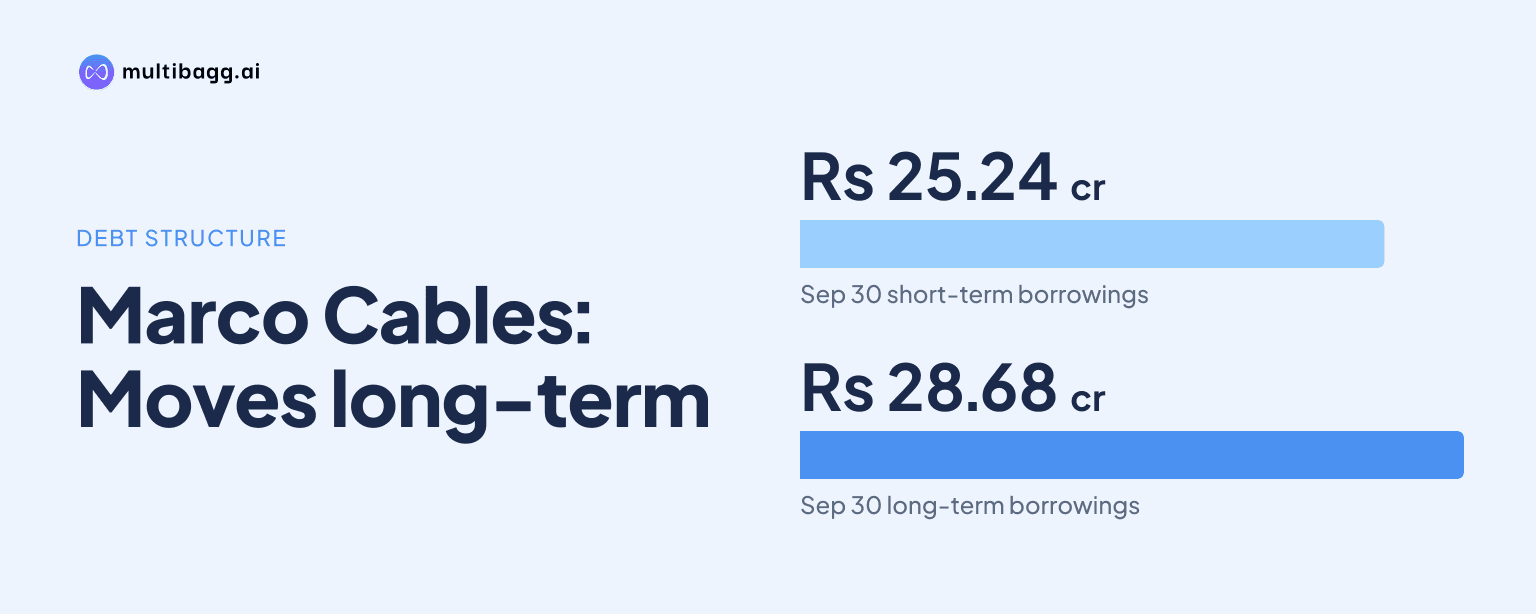
Marco Cables & Conductors Limited shifted its reported borrowing mix toward longer-term debt in the half year ended September 30, 2026, with short-term borrowings falling Rs 17.86 crore to Rs 25.24 crore and long-term borrowings rising Rs 13.00 crore to Rs 28.68 crore. Combined borrowings declined Rs 4.86 crore to Rs 53.92 crore.
Know Marco Cables & Conductors inside out
Results, valuation, peers and who's buying, in one view.
How did Marco Cables' borrowing mix change in H1?
Marco Cables made long-term borrowings its larger reported debt category at September 30, 2026. Long-term borrowings increased from Rs 15.68 crore at March 31, 2026 to Rs 28.68 crore, while short-term borrowings declined from Rs 43.10 crore to Rs 25.24 crore during the six-month period.
The two borrowing lines moved in opposite directions. At March 31, 2026, short-term borrowings exceeded long-term borrowings by Rs 27.42 crore; at September 30, 2026, long-term borrowings exceeded short-term borrowings by Rs 3.44 crore. Based on the reported balances, long-term debt represented about 53% of combined borrowings at September 30, compared with about 27% at March 31.
What does Marco Cables' cash flow statement show about borrowing?
Marco Cables reported Rs 14.58 crore of net proceeds from long-term borrowings and a Rs 19.50 crore net outflow from short-term borrowings in the cash flow statement for the half year ended September 30, 2026. Those financing movements are consistent with the direction of the closing borrowing balances in the statement of assets and liabilities.
The cash flow statement is headed for the half year ended September 30, 2026, although its comparative columns are labelled “for the year ended” September 30, 2026 and March 31, 2026. It reports finance cost of Rs 3.46 crore and net cash used in financing activities of Rs 8.38 crore for the September 2026 period.
The March 31, 2026 comparative column showed net proceeds of Rs 12.33 crore from short-term borrowings and Rs 10.68 crore from long-term borrowings. In the September 2026 period, the short-term borrowing line changed from proceeds to an outflow of Rs 19.50 crore, while the long-term borrowing line remained a source of funds at Rs 14.58 crore.
Did Marco Cables' overall borrowings decline?
Marco Cables' combined long-term and short-term borrowings declined Rs 4.86 crore to Rs 53.92 crore at September 30, 2026. The Rs 17.86 crore reduction in short-term borrowings was larger than the Rs 13.00 crore increase in the long-term borrowing balance.
Non-current liabilities totalled Rs 29.85 crore at September 30, 2026, compared with Rs 16.96 crore at March 31, 2026. The September balance included Rs 28.68 crore of long-term borrowings, deferred-tax liabilities of Rs 33.22 lakh and another non-current liability line of Rs 90.10 lakh.
Marco Cables reported total equity of Rs 38.75 crore at September 30, up from Rs 36.38 crore at March 31. Paid-up equity share capital was unchanged at Rs 18.70 crore, while reserves and surplus increased to Rs 20.05 crore from Rs 17.68 crore. Total assets were Rs 107.80 crore at September 30, compared with Rs 107.67 crore at March 31.
Got a follow-up? Ask IRIS
How did Marco Cables' cash and working-capital flows compare?
Marco Cables reported Rs 8.85 crore of net cash generated from operating activities in the half year ended September 30, 2026, compared with net cash used of Rs 16.47 crore in the March 31, 2026 comparative period. The September period included a Rs 5.46 crore movement in accounts receivable and a Rs 2.21 crore movement in trade payables.
Inventories used Rs 1.20 crore of cash in the September 2026 period, while short-term loans and advances used Rs 1.95 crore. Other current liabilities decreased by Rs 27.86 lakh and other bank balances decreased by Rs 25.70 lakh, according to the cash flow statement.
Cash and cash equivalents increased to Rs 82.06 lakh at the end of the September 2026 period from Rs 51.21 lakh at its beginning. Marco Cables also reported Rs 21.67 lakh of net cash used in investing activities, relating to purchase or sale of property, plant and equipment, while the statement recorded a net increase in cash and cash equivalents of Rs 30.85 lakh.
How did Marco Cables' earnings and finance costs compare?
Marco Cables reported finance cost of Rs 3.46 crore for the six months ended September 30, 2026, compared with Rs 2.90 crore in the six months ended September 30, 2025 and Rs 3.36 crore in the six months ended March 31, 2026. The filing does not attribute the change in finance cost to the movement between short-term and long-term debt.
Revenue from operations was Rs 54.69 crore in the September 2026 half year, compared with Rs 54.03 crore in the corresponding September 2025 half year and Rs 48.79 crore in the preceding six months ended March 31, 2026. Profit before tax was Rs 3.17 crore, below Rs 4.02 crore a year earlier but above Rs 1.88 crore in the immediately preceding six months.
Profit after tax was Rs 2.37 crore for the half year ended September 30, 2026, versus Rs 3.01 crore in the September 2025 half year and Rs 1.19 crore in the March 2026 half year. Basic earnings per share, not annualised, were Rs 1.27, compared with Rs 1.61 and Rs 0.64 respectively.
What review status and unresolved balances did Marco Cables disclose?
Marco Cables said its September 2026 results were unaudited, reviewed by the audit committee and approved by the board on November 11, 2026. Jay Gupta & Associates issued a limited review report dated November 11, stating that nothing had come to its attention indicating a material misstatement or a failure to make required disclosures.
The auditor said a review consists primarily of enquiries and analytical procedures, provides less assurance than an audit, and did not result in an audit opinion. The notes to the financial results also state that closing balances of trade receivables, trade payables and loans and advances are subject to balance confirmations.
Conclusion
Marco Cables' September 2026 statements document a change in the composition of reported borrowings rather than an increase in total debt. Short-term borrowings fell to Rs 25.24 crore, long-term borrowings rose to Rs 28.68 crore and combined borrowings declined to Rs 53.92 crore, while financing cash flows showed short-term repayment alongside long-term borrowing proceeds.
The next reported results can show whether the revised borrowing mix persists and whether finance cost, which was Rs 3.46 crore in the September 2026 half year, changes. Investors can also watch for confirmation of the closing balances for trade receivables, trade payables and loans and advances, which Marco Cables identified as subject to balance confirmations.