










TSF Investments operating cash flow falls 31% in first half
Key highlights
- TSF Investments reported operating cash flow of Rs 125.98 crore for the half year ended September 30, 2026, down from Rs 181.32 crore.
- Receivables and inventories used Rs 39.34 crore and Rs 52.62 crore of cash respectively in the first half.
- Cash and cash equivalents fell to Rs 21.72 crore at September 30, 2026 from Rs 85.82 crore at March 31, 2026.
- Manufacturing revenue rose to Rs 530.00 crore in the first half from Rs 353.08 crore a year earlier.
powered by IRIS
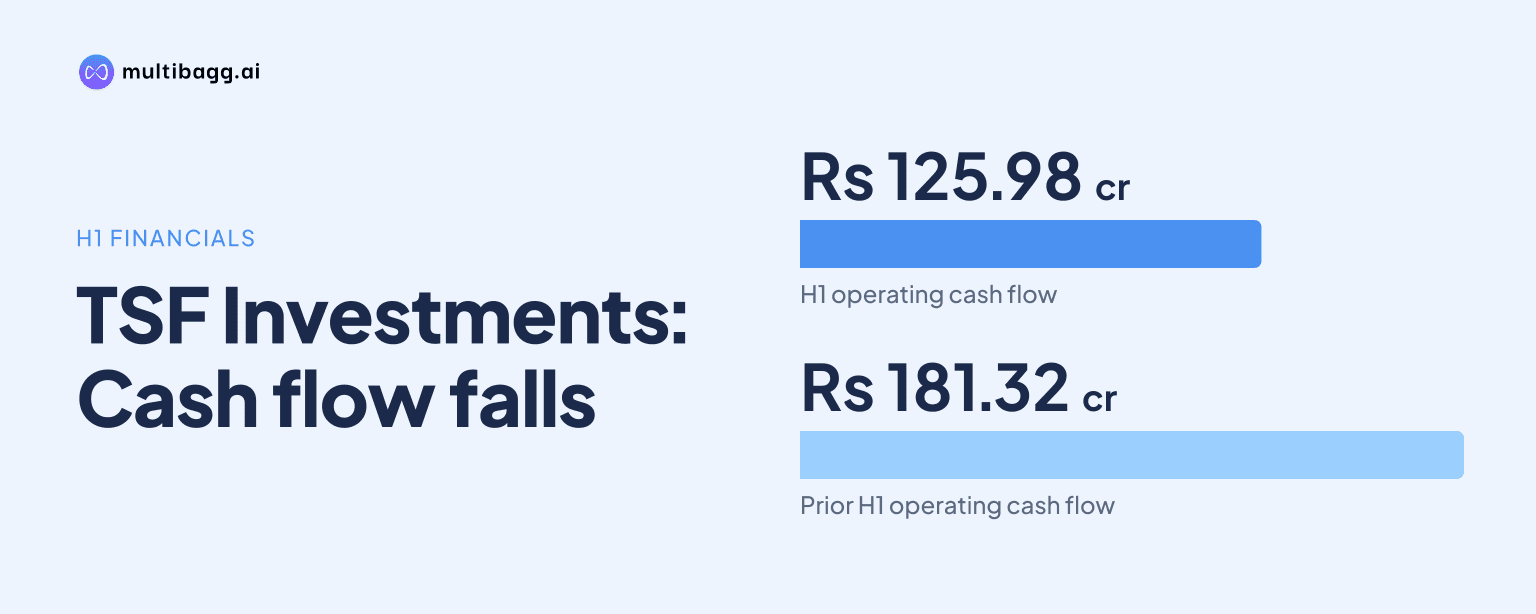
TSF Investments Limited reported operating cash flow of Rs 125.98 crore for the half year ended September 30, 2026, down 31% from Rs 181.32 crore a year earlier, despite profit before tax rising 44% to Rs 122.52 crore. Higher receivables, inventory and tax payments reduced the cash generated from operations.
Know Tsf Investments inside out
Results, valuation, peers and who's buying, in one view.
Why did TSF Investments operating cash flow decline?
TSF Investments generated Rs 125.98 crore of net cash from operating activities in the half year ended September 30, 2026, compared with Rs 181.32 crore in the corresponding 2025 period. The Rs 55.34 crore decline came even as profit before tax increased from Rs 85.11 crore to Rs 122.52 crore. The consolidated cash-flow statement was unaudited and subject to limited review.
The difference between reported profit and cash generation emerged in the operating reconciliation and working-capital movements. Profit before tax, adjusted for depreciation, fair-value changes, finance costs and dividends from associates, resulted in Rs 212.90 crore before working-capital adjustments, compared with Rs 189.19 crore a year earlier. Cash after working-capital adjustments was Rs 159.26 crore, below Rs 206.75 crore in the prior period, before income-tax payments of Rs 33.28 crore.
How did working capital change in the first half?
TSF Investments’ working-capital movements used cash overall in the first half of 2026, whereas they added cash in the year-earlier period. Trade and other receivables absorbed Rs 39.34 crore, compared with a Rs 22.10 crore source of cash in the previous year. Inventory absorbed another Rs 52.62 crore, reversing a Rs 7.45 crore cash contribution in the corresponding 2025 period.
Receivables and inventories were both higher at September 30, 2026 than at March 31, 2026. Receivables increased to Rs 246.79 crore from Rs 208.54 crore, while inventories rose to Rs 204.36 crore from Rs 151.73 crore. Those balance-sheet movements correspond with the cash-flow statement’s outflows over the six-month period.
Some working-capital items offset part of these outflows. Trade and other payables generated Rs 74.07 crore of cash, compared with a Rs 8.35 crore outflow in the prior-year period, while non-financial liabilities and provisions added Rs 4.56 crore after using Rs 22.94 crore a year earlier. Other non-financial assets used Rs 18.55 crore, versus a Rs 16.76 crore cash inflow in the prior period, and other financial assets used Rs 2.39 crore.
Got a follow-up? Ask IRIS
Which segments drove profit while cash generation fell?
TSF Investments’ higher first-half profit before tax was supported by the investments and manufacturing segments, although operating cash flow declined. Total segment revenue rose to Rs 622.61 crore from Rs 428.85 crore, while total segment results increased to Rs 124.03 crore from Rs 86.85 crore. Manufacturing supplied Rs 530.00 crore of revenue, compared with Rs 353.08 crore a year earlier, and its segment result rose to Rs 65.06 crore from Rs 39.59 crore.
The investments segment recorded Rs 57.41 crore of revenue and Rs 45.91 crore of segment result, compared with Rs 46.16 crore and Rs 33.25 crore respectively in the first half of 2025. Overseas Support Services revenue increased to Rs 35.20 crore from Rs 29.60 crore, but its segment result declined to Rs 13.07 crore from Rs 14.01 crore. Reported earnings growth was therefore led by investments and manufacturing rather than being shared across all three segments.
The cash-flow reconciliation included Rs 121.62 crore of dividends received from associates, slightly above Rs 119.91 crore in the prior period. Fair-value changes in financial instruments reduced the reconciliation from accounting profit by Rs 48.46 crore, compared with Rs 43.83 crore a year earlier. These adjustments and the working-capital movements explain why the increase in reported profit did not result in higher operating cash flow.
What happened to TSF Investments cash, investments and financing?
TSF Investments ended September 30, 2026 with cash and cash equivalents of Rs 21.72 crore, down from Rs 85.82 crore at March 31, 2026 and Rs 62.66 crore at September 30, 2025. The group reported a Rs 65.24 crore decrease in cash and cash equivalents during the half year. This was partly offset by a Rs 1.09 crore adjustment on initial application of amendments to Indian Accounting Standard 109, or Ind AS 109, on April 1, 2026.
Investment activity included a Rs 226.34 crore net outflow on other investments, against a Rs 187.97 crore net inflow in the earlier period. TSF Investments recorded a Rs 169.54 crore net sale of mutual funds and alternative investment funds, compared with a Rs 403.46 crore net purchase a year earlier. It also reported Rs 64.13 crore from maturity of fixed deposits with banks, non-banking financial companies and bonds, versus a Rs 52.12 crore investment in such instruments in the prior period.
Financing cash flow was a Rs 194.13 crore outflow, compared with a Rs 150.28 crore inflow in the half year ended September 2025. Dividends paid to non-equity holders were Rs 98.84 crore and dividends paid to non-controlling interests were Rs 4.05 crore, together exceeding the prior-year total of Rs 49.37 crore. The cash-flow statement reported Rs 86.92 crore as a negative amount under proceeds from borrowings, while balance-sheet borrowings fell to Rs 143.85 crore at September 30 from Rs 219.66 crore at March 31.
Conclusion
TSF Investments’ first-half figures show a divergence between profit and cash generation: profit before tax increased to Rs 122.52 crore and segment revenue reached Rs 622.61 crore, while operating cash flow fell to Rs 125.98 crore. Higher receivables, inventories, other non-financial assets and tax payments absorbed cash, and financing outflows contributed to cash and cash equivalents declining to Rs 21.72 crore.
The next disclosed development to watch is TSF Investments’ October 2026 sale of its entire listed-equity holding in TVS Holdings Limited for net consideration of Rs 822.51 crore. TSF Investments said the transaction produced a net gain after tax of Rs 731.22 crore after adjusting Rs 188.89 crore recorded in other comprehensive income, and it occurred outside the September 30 half-year cash-flow period.