










TSF Investments Approves ₹1,500 Crore Group Debt Plan
Key highlights
- TSF Investments approved up to ₹1,500 crore of investments in debt instruments issued by group companies.
- The proposed ₹1,500 crore limit equals about 135% of TSF Investments' ₹1,112 crore trailing twelve-month revenue.
- The investment ceiling represents about 15.4% of TSF Investments' ₹9,761 crore market capitalisation.
- Shareholder approval through a postal ballot is required for the material related-party transaction.
powered by IRIS
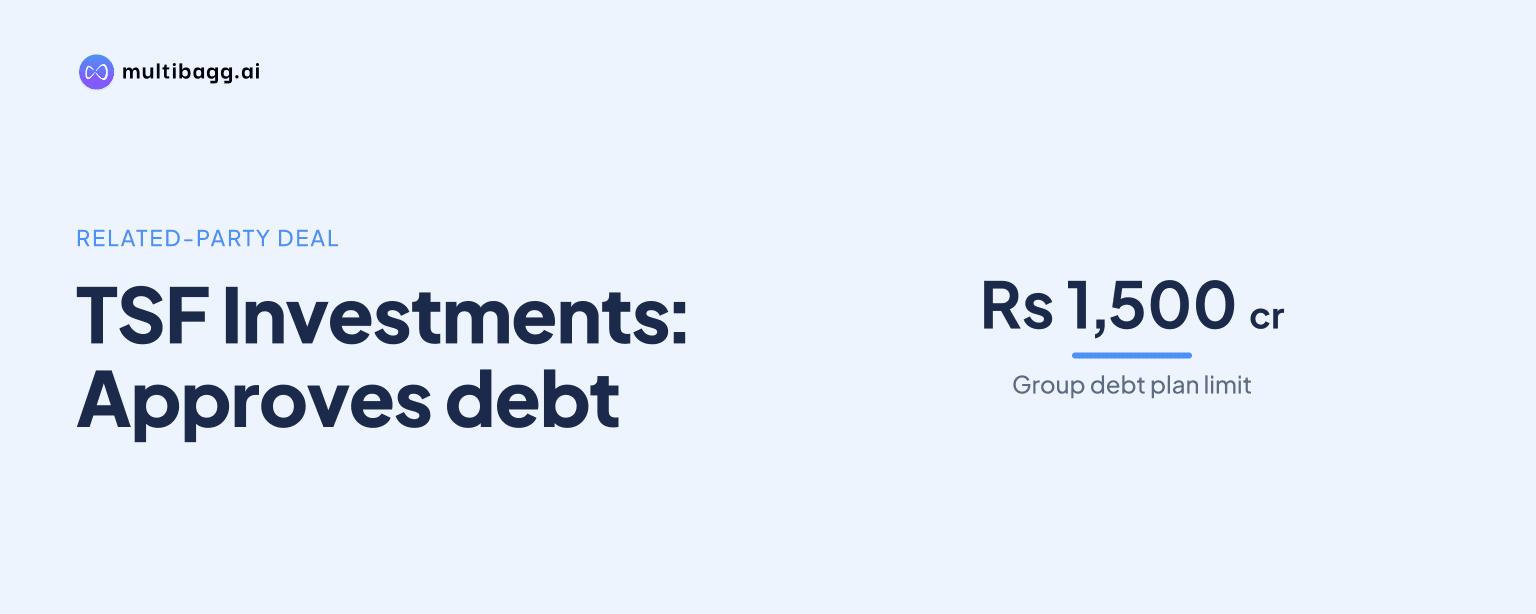
TSF Investments Limited has approved investments of up to ₹1,500 crore in debt instruments issued by group companies, a limit equal to about 135% of its trailing twelve-month revenue of ₹1,112 crore. The proposal requires shareholder approval through a postal ballot and will be executed in one or more tranches.
Know Tsf Investments inside out
Results, valuation, peers and who's buying, in one view.
What has TSF Investments approved?
TSF Investments has approved a mandate to invest up to ₹1,500 crore in debt instruments issued by its group companies. The board's decision allows the company to make these investments in one or more tranches, rather than requiring the full amount to be deployed at once.
The proposed transaction is classified as a material related-party transaction under Regulation 23 of the Securities and Exchange Board of India Listing Obligations and Disclosure Requirements regulations. TSF Investments' Audit Committee reviewed and approved the proposal before it was placed before the board.
Shareholders must approve the limit through a postal ballot before the company can proceed. The filing does not specify the group entities that may issue the debt instruments, the interest rates, the maturity profile, or a timetable for drawdowns. These terms will be important in assessing the eventual financial effect of any investments made under the mandate.
Why is the ₹1,500 crore mandate material for TSF Investments?
The ₹1,500 crore ceiling is material because it is larger than TSF Investments' trailing twelve-month revenue of ₹1,112 crore. It represents about 135% of that revenue and approximately 15.4% of the company's market capitalisation of ₹9,761 crore.
The proposed deployment follows another related-party capital allocation proposal announced in August 2026. At that time, TSF Investments' board approved a cash subscription of up to ₹150 crore to the preferential issue of Wheels India, subject to shareholder approval. That proposal covered 10,57,827 shares at ₹1,418 per share and was intended to consolidate the company's holding in Wheels India.
Both decisions point to an active capital-deployment phase for the listed holding company. The new debt mandate differs from the Wheels India transaction because it would provide financing through debt instruments rather than add to an equity holding. Returns from the mandate would therefore depend on the yield, repayment record and financial strength of the borrowing group entities.
How does the transaction fit TSF Investments' business model?
TSF Investments is a listed holding company and an exempted Core Investment Company. It is a subsidiary of Sundaram Finance Limited and focuses on strategic investments, including investments linked to financial-services enablers, fintech and smaller start-up-type businesses, while also operating business-processing, support and training activities.
The company was formerly known as Sundaram Finance Holdings Limited and was renamed TSF Investments Limited following the consolidation of the T.S. Santhanam Family Group. Its strategic investment focus has included auto-component and manufacturing businesses, reflecting the wider group's experience in the sector.
Investment income is a significant part of the company's earnings profile. Dividends, fair-value gains and profits from associates accounted for about 90% of revenue in FY24, while its BPO and shared-services subsidiary accounted for roughly 10%. This structure means reported performance can be influenced by the operating results of investee companies, dividend receipts and changes in investment valuations.
The source material also identifies holdings in auto-parts associates as concentrated investments. It notes that earnings move with the auto cycle and that valuations of unlisted associates rely on estimates, making them a key audit matter. The proposed debt investments add a new potential source of investment income, while also introducing credit exposure to group borrowers.
Got a follow-up? Ask IRIS
What should investors assess before the postal-ballot vote?
Investors should assess the borrower-specific terms disclosed for any investments made after approval, particularly the interest rate, tenor, security, repayment conditions and purpose of funding. Since the mandate concerns related parties, the commercial rationale and arm's-length nature of each transaction will be central considerations.
The company's balance-sheet position provides relevant context. TSF Investments was described as almost debt free, with latest net debt of negative ₹63.45 crore as of March 2026, compared with negative ₹31.84 crore in March 2025. Its debt-to-equity ratio was reported at 0.04, while standalone cash and equivalents stood at ₹163.38 crore in March 2024.
However, the approved ceiling should not be treated as confirmation that the entire ₹1,500 crore will be invested immediately or at all. The filing permits multiple tranches and remains subject to shareholder approval. The available information does not state whether funding would come from internal resources, investment proceeds, borrowings or another source.
For shareholders, the scale of the limit makes disclosure quality important. The investment amount is substantial relative to reported revenue and market capitalisation, while the ultimate return will be determined by the contractual yield and the credit quality of the group companies receiving funds.
How could the mandate affect TSF Investments' financial profile?
If shareholder approval is received and investments are made, TSF Investments could earn interest or other contractual returns from group-company debt instruments. The precise accounting treatment, timing of income recognition and cash-flow impact cannot be determined from the announced mandate because the transaction terms have not been disclosed.
The proposal may also change the composition of the company's investment portfolio. TSF Investments has historically depended materially on dividends, fair-value movements and associate profits. Debt investments could increase exposure to fixed-income-style returns, but they would also make counterparty credit risk and repayment performance relevant to future results.
The wider impact on investors will depend on the eventual use of the mandate and on the terms presented to shareholders. The board and Audit Committee approvals establish the internal governance process required for a material related-party transaction, while the postal ballot gives shareholders the decision on the proposed ceiling.
Conclusion
TSF Investments' proposed ₹1,500 crore group-company debt mandate is a significant capital-allocation decision because of its size relative to the company's ₹1,112 crore trailing revenue and ₹9,761 crore market capitalisation. The plan expands the company's potential investment activity beyond equity and associate holdings into intra-group debt, with returns dependent on lending terms and borrower credit quality.
The next disclosed step is the shareholder postal ballot. Investors will need to watch for the voting outcome and any subsequent disclosures on the group borrowers, instrument structure, interest rates, maturity periods, funding source and actual amount deployed under the approved limit.