










Kataria Industries Limited H1 Sales Fall 36% to ₹109 Crore
Key highlights
- Kataria Industries reported H1 FY27 sales of ₹109 crore, down 36.0% from ₹170 crore a year earlier.
- H1 FY27 net profit declined 6.0% year on year to ₹4.1 crore, while EPS was ₹1.92.
- Operating profit margin improved 67 basis points year on year to 5.9%, but was below 7.5% in the preceding half-year.
- Borrowings rose 143% to ₹55.9 crore at September 2026 from ₹23.0 crore at March 2026.
powered by IRIS
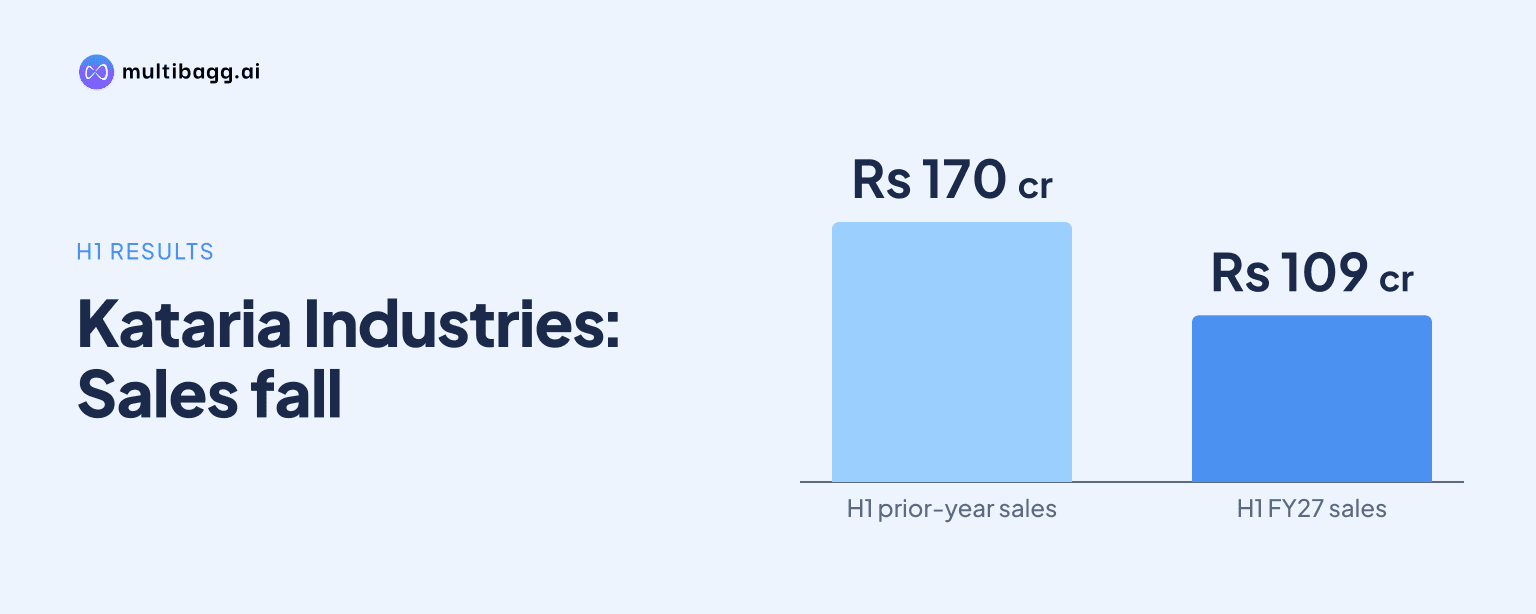
Kataria Industries Limited reported H1 FY27 standalone sales of ₹109 crore, a 36% year-on-year decline from ₹170 crore, while net profit fell 6% to ₹4.1 crore. The filing also showed borrowings rising 143% from March 2026 to ₹55.9 crore, making balance-sheet movement a key factor alongside the weaker half-year revenue.
Know Kataria Industries inside out
Results, valuation, peers and who's buying, in one view.
What did Kataria Industries report for H1 FY27?
Kataria Industries reported standalone sales of ₹109 crore for the half year ended September 2026, compared with ₹170 crore in the corresponding period a year earlier. Operating profit declined to ₹6.4 crore from ₹8.9 crore, while net profit was ₹4.1 crore against ₹4.4 crore in H1 FY26.
The company filed its H1 FY27 results on 11 November 2026. Sales were also 32.3% lower than the immediately preceding half-year level of ₹161 crore reported for March 2026. The data indicates a lower revenue base across both the year-on-year and sequential half-year comparisons.
Operating profit margin improved by 67 basis points year on year to 5.9% from 5.2%. However, the margin was lower than 7.5% in the preceding half. Net profit margin increased to 3.8% from 2.6% a year earlier, but declined from 5.0% in the March 2026 half-year period.
Earnings per share stood at ₹1.92 in H1 FY27, compared with ₹2.03 in H1 FY26 and ₹3.60 in the preceding half-year. The reported figures therefore show that profit declined less sharply than sales, although earnings remained below the company’s recent half-year performance.
How did revenue, profit and margins change?
Kataria Industries recorded a ₹61 crore fall in sales from H1 FY26, while operating profit declined by ₹2.5 crore and net profit declined by ₹0.3 crore. The comparatively smaller fall in net profit reflected better year-on-year operating and net margins, despite the lower sales base.
Other income rose to ₹0.5 crore from ₹0.4 crore a year earlier. Pre-tax profit was ₹5.4 crore, of which ₹4.9 crore, or 91%, was attributed to the core business and ₹0.5 crore, or 9%, came from other income and one-off items. Core profit was down 16.4% year on year, compared with a 6.0% fall in reported profit.
The filing’s comparison with Kataria Industries’ own trend placed sales at 35.1% below the ₹168 crore trend level. Net profit of ₹4.1 crore was 12.8% below the stated trend of ₹4.7 crore. These comparisons show that the H1 performance was below the company’s historical reference levels used in the filing.
Why have borrowings become an important H1 FY27 metric?
Kataria Industries’ borrowings rose to ₹55.9 crore at the end of September 2026 from ₹23.0 crore at the end of March 2026. This was an increase of ₹32.9 crore, or 143%, over six months.
The increase in debt comes during a half-year in which sales and operating profit declined. The available data does not specify the use of the additional borrowings, so it does not establish whether the increase was linked to working capital, capital expenditure, or another funding requirement.
For context, the company reported cash from operations of ₹20.0 crore for FY26. Investors tracking the next disclosures may compare operating cash generation, debt levels and working-capital movement to assess how the September 2026 borrowing position develops.
Got a follow-up? Ask IRIS
What business does Kataria Industries operate in?
Kataria Industries manufactures and supplies low relaxation pre-stressed concrete strands and steel wires, post-tensioning anchorage systems, HDPE single-wall corrugated sheathing ducts, couplers and aluminium conductors. These products are used in infrastructure and construction-linked applications, particularly where pre-stressing and post-tensioning systems are required.
The company’s historical half-year data shows that revenue and profitability have moved unevenly. Sales were ₹186 crore in September 2023, ₹153 crore in March 2024, ₹141 crore in September 2024, ₹209 crore in March 2025, ₹170 crore in September 2025 and ₹161 crore in March 2026.
Profit has also varied across these periods. Net profit was ₹6 crore in September 2023, ₹4 crore in March 2024, ₹5 crore in September 2024, ₹6 crore in March 2025, ₹4 crore in September 2025 and ₹8 crore in March 2026. This history provides context for the filing’s comparison of current sales and profit with their respective trend values.
How does the H1 result affect investors and operations?
For investors, the central financial signals are the 36% decline in H1 sales, the lower operating profit and the substantial increase in borrowings. While operating profit margin and net profit margin improved from the year-earlier period, both were below the March 2026 half-year levels.
The reported profit mix is also relevant. Core business contributed 91% of pre-tax profit, while other income and one-off items accounted for 9%. This indicates that most pre-tax earnings came from operations, although core profit declined more sharply than reported net profit on a year-on-year basis.
The source material also references a separate automated reading of quarterly data for the July-September 2026 period. Kataria Industries’ filed H1 standalone table is the relevant basis for the half-year comparisons in this report, as it provides the stated September 2026, March 2026 and September 2025 figures together.
Conclusion
Kataria Industries closed H1 FY27 with sales of ₹109 crore and net profit of ₹4.1 crore, down 36% and 6% year on year, respectively. Improved year-on-year margins moderated the profit decline, but revenue, operating profit and EPS were all lower than the preceding half-year, while borrowings rose to ₹55.9 crore.
The next key items to watch are the company’s explanation, if disclosed, for the rise in borrowings and the movement in sales, operating margins and cash generation in subsequent results. The board agenda also included a dividend matter, but the provided information does not state a final decision or amount.