










Supreme Engineering Clears ₹60.32 Crore Bank of India OTS
Key highlights
- Supreme Engineering paid ₹60.32 crore plus applicable interest to Bank of India on 11 November 2026.
- Bank of India issued a settlement certificate and released all attached properties and guarantees.
- Supreme Engineering's board approved the ₹60.32 crore OTS on 13 August 2026.
- The company had earlier reported total debt of ₹92 crore before the settlement.
powered by IRIS
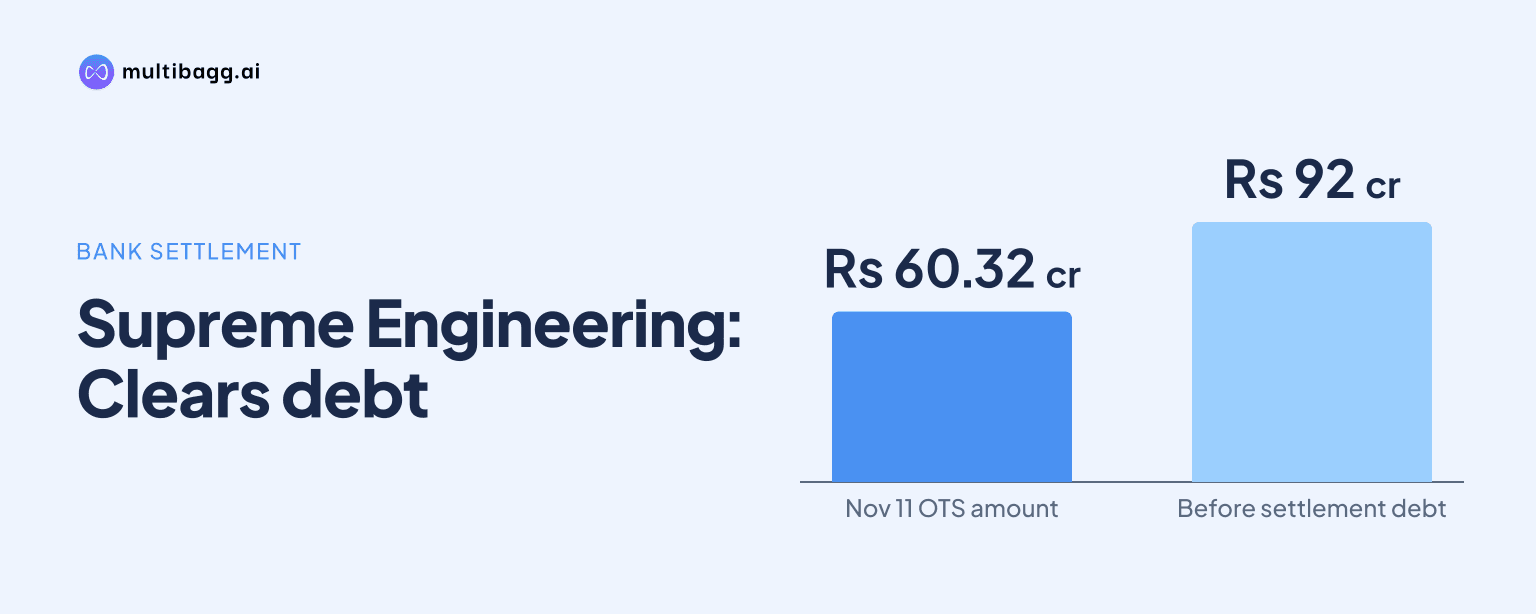
Supreme Engineering Limited paid ₹60.32 crore plus applicable interest to Bank of India on 11 November 2026, completing its one-time settlement and receiving a settlement certificate. The bank also released the properties and guarantees attached to the settled facilities, removing a significant debt and legal overhang for the company.
Know Supreme Engineering inside out
Results, valuation, peers and who's buying, in one view.
What did Supreme Engineering settle with Bank of India?
Supreme Engineering completed the full and final payment under its one-time settlement, or OTS, arrangement with Bank of India. The agreed settlement amount was ₹60.32 crore, with the company also paying applicable interest. Bank of India subsequently issued a settlement certificate confirming the payment.
The settlement covered outstanding credit facilities availed by Supreme Engineering. It also resulted in the release of attached properties and guarantees linked to the settled dues. These releases are significant because they remove encumbrances on assets and obligations that had been tied to the lender's recovery process.
Supreme Engineering's board had approved the OTS on 13 August 2026 after receiving the bank's proposal dated 15 July 2026. Under the approved terms, the amount was to be paid within 90 days of acceptance. The company had initially deposited ₹6.03 crore, equal to 10% of the settlement amount, before paying the balance under the agreed schedule.
How did the debt settlement process unfold?
The settlement followed insolvency and recovery proceedings involving Supreme Engineering and Bank of India. The Mumbai Bench of the National Company Law Tribunal admitted Bank of India's Section 7 petition against the company on 23 June 2026 over a reported default of about ₹117.50 crore.
The company later moved toward a negotiated resolution with its lender. The NCLT approved the withdrawal of the corporate insolvency resolution process on 12 August 2026, a day before Supreme Engineering's board approved the OTS. The settlement was intended to resolve the bank's outstanding dues and address proceedings initiated under the SARFAESI Act, 2002, as well as matters before the NCLT.
The company's earlier disclosures said legal proceedings were expected to be withdrawn or closed once the full settlement amount was received, subject to applicable terms and orders from the relevant authorities. The latest update confirms the full payment, issuance of the settlement certificate, and release of attached assets and guarantees. It does not provide separate details on the status of each legal proceeding.
Got a follow-up? Ask IRIS
Why was the Bank of India OTS important for Supreme Engineering?
The OTS was important because it addressed a large portion of Supreme Engineering's debt burden and a prolonged non-performing asset overhang. The company had reported total debt of ₹92 crore, while the ₹60.32 crore settlement amount represented about 65.6% of that base, based on the reported figures.
The settlement also came against a backdrop of negative net worth and uneven operating performance. Supreme Engineering, which manufactures special products and undertakes heavy engineering work, has been in a restructuring phase after the insolvency proceedings. Its disclosed operating cash flow was ₹1 crore in March 2026, indicating the constrained financial context in which the settlement was arranged.
The payment does not by itself establish that the company is debt-free, as the reported ₹92 crore debt figure may include obligations beyond the Bank of India facilities covered by the OTS. However, it removes the specific liability settled with Bank of India and the related asset attachments and guarantees.
What is the market and operational impact of the settlement?
For investors, the completion of the OTS provides confirmation that Supreme Engineering met the payment obligation approved in August. This differs from an announced settlement, as the company now has a settlement certificate from Bank of India and confirms that the bank has released the associated security and guarantees.
The release of attached properties can improve operational flexibility because those assets are no longer held as security for the settled dues. Similarly, the release of guarantees reduces contingent obligations associated with the specific Bank of India facilities. The company has not disclosed the value or nature of the individual properties and guarantees released.
From an industry perspective, the transaction shows how an OTS can provide an alternative to a prolonged insolvency process when a borrower and lender agree on repayment terms. But Supreme Engineering's future financial position will still depend on its remaining liabilities, working capital position, operating performance, and the formal closure or withdrawal of any pending proceedings where required.
Conclusion
Supreme Engineering has completed a ₹60.32 crore-plus-interest settlement with Bank of India, receiving a settlement certificate and the release of attached properties and guarantees. The payment removes a major lender-specific debt and recovery overhang that followed the company's insolvency-related proceedings in 2026.
Investors will next watch for disclosures on the withdrawal or closure of proceedings under SARFAESI and before the NCLT, where applicable, and for updated debt, net worth, and operating performance in future financial results. These disclosures will show the extent to which the completed OTS improves Supreme Engineering's overall financial position.