










Marico says SETU adds 1-2% structural growth in India
Key highlights
- Marico said the first phase of Project SETU is about 70% complete and has added 1% to 2% of structural extra growth.
- Marico said direct distribution has increased by more than 1.5 times and stockist coverage is nearly 1.8 times the earlier level.
- Marico targets a 3.5% daily sales rhythm and says it has stopped relying on period-end trade loading.
- Marico said it could share prototype results for automated assortment selling over the next six months.
powered by IRIS
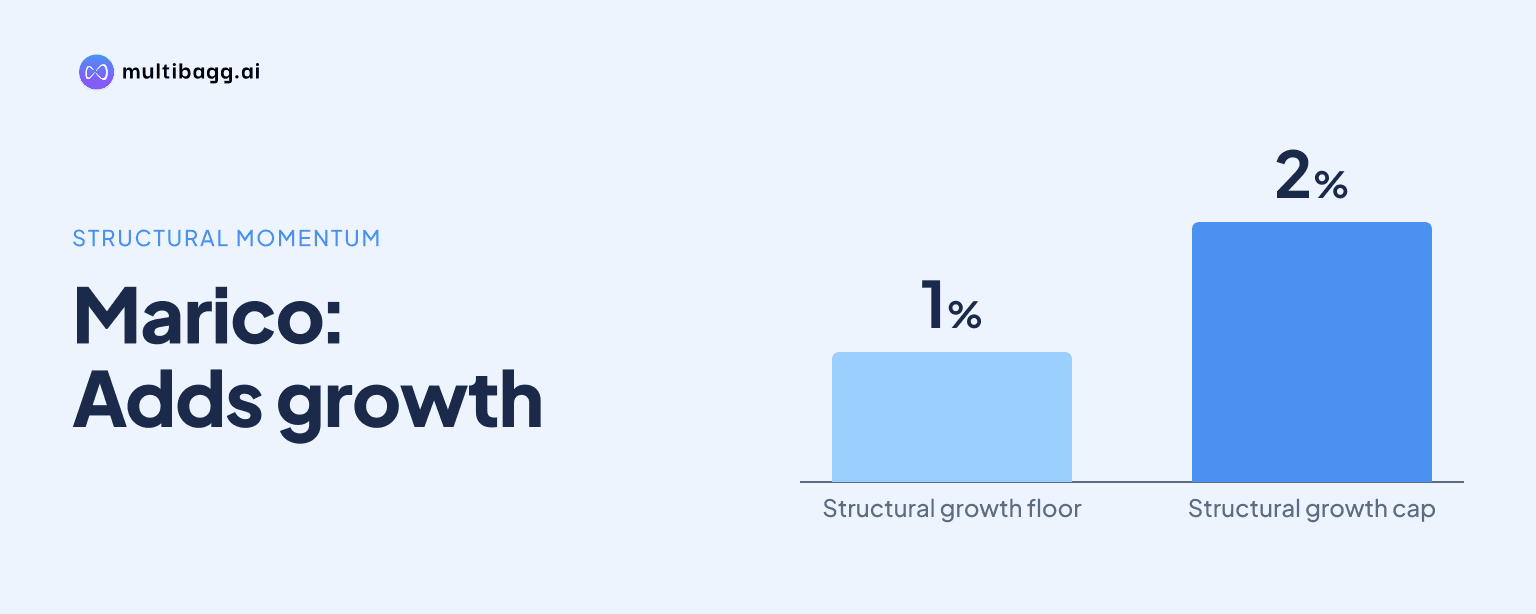
Marico Limited said on November 2, 2026, that Project SETU has added 1% to 2% of structural extra growth, while its first phase is about 70% complete. Marico is now extending the programme from rural distribution into urban premium products, foods, digital brands and technology-enabled assortment selling.
Know Marico inside out
Results, valuation, peers and who's buying, in one view.
How much growth has Project SETU added for Marico?
Marico said Project SETU has conservatively added 1% to 2% of structural extra growth. Management attributed this gain to both broader distribution and improved execution, rather than a temporary sales increase, and said direct distribution has risen by more than 1.5 times under the programme.
The first phase is about 70% complete, according to management, leaving further rural work as well as the urban opportunity. Marico said its premium portfolio, urban distribution and technology-led execution have not yet received the full benefit of SETU, so the disclosed 1% to 2% contribution does not represent the potential outcome of SETU 2.0.
Marico said it had been under-indexed in direct distribution in North and East India. Greater direct reach enables the company to sell second and third brands alongside its leading brands, initially benefiting value-added hair oil brands, or VAHO, including Jasmin, Haircare and Aloe.
What has changed in Marico's distribution execution?
Marico said SETU has expanded both the reach and the quality of its distribution execution. Direct distribution has increased by more than 1.5 times, while the number of stockists has risen to nearly 1.8 times the earlier level, supporting deeper rural coverage including in Maharashtra.
The wider stockist network is beginning to support Parachute as well as the VAHO portfolio. Management said Parachute has benefited where Marico is deepening rural distribution, while its earlier direct-distribution gains were more visible in brands such as Jasmin, Haircare and Aloe.
Marico also said SETU has established a more even sales rhythm, with a target of selling 3.5% every day. Management said it has stopped the month-end and quarter-end sales concentration that previously required additional trade loading to meet reporting-period targets.
This sales rhythm shortened the execution time for Parachute loyalty-pack price reductions. Management said rural implementation of a price drop earlier took four to eight weeks, whereas the latest selective reduction in mid-sized and larger packs reached markets in record time; price-point packs did not receive the added volume benefit.
How does SETU affect Marico's advertising spending?
Marico said reduced period-end trade loading has generated below-the-line, or BTL, savings that it has redirected to above-the-line, or ATL, advertising. Management said some of the increase in advertising and promotion spending is therefore funded by cleaner sales execution, alongside investment in shampoo, almond oil, VAHO and foods.
Management said advertising-to-sales, or A2S, could be about 10% to 10.5% from a next-year perspective. It described this as roughly a 1-percentage-point increase in A2S, while noting that the actual ratio can vary with revenue growth and the inflation or deflation cycle.
The current spending level also reflects new-product development and launches, management said. It added that advertising and promotion spending in the India business should settle into double-digit growth on a steady-state basis, rather than repeat the 30% to 40% increase discussed by an analyst.
The link between SETU and advertising is operational rather than a reported profit target. Marico said it no longer needs extra distributor or trade loads at month-end and quarter-end, which management said frees resources for brand-building investment instead.
Got a follow-up? Ask IRIS
What will Marico target through SETU 2.0?
Marico said SETU 2.0 will target urban distribution, premium products, foods and digital brands, supported by technology and artificial intelligence-enabled execution. Management identified the premium portfolio and urban SETU as the large remaining opportunity after the first phase's direct-distribution and rural expansion.
The company has used digital brands in general trade, or GT, only in limited instances so far. SETU 2.0 is intended to create a sizeable GT business for digital brands, foods and premium personal care through cosmetics, specialty-food and chemist outlets in urban markets.
Management said range selling will be central to this effort. Marico plans to use different assortments, price points and pack sizes to broaden distribution without cannibalising existing channels, applying lessons from its experience selling more than leader brands through direct distribution.
Marico is also developing gamified incentives and automated assortment-selling tools. Management said the objective is to reduce dependence on the person handling the last mile, but it did not provide a SETU 2.0 growth target and said prototype results could be shared over the next six months.
Is Marico using SETU outside India?
Marico said SETU produced a growth impetus in Vietnam during one year of implementation and began rolling out the model in Bangladesh in the quarter discussed on the November 2, 2026 call. Management now describes SETU as a global playbook for GT and other markets, rather than only an India initiative.
Management expects a sequential improvement in Bangladesh to be the main contributor to a marginal improvement in international business growth. Bangladesh is comparing against a high-growth base from the preceding year, while Vietnam and Southeast Asia continue to grow, according to management.
Marico's broader growth framework assumes high single-digit growth in India, mid-teens growth in the international business and about 3% inflation. Management said it has visibility of revenue comfortably above Rs 15,000 crore in FY27, while describing its FY29 target as an aspiration dependent on continued execution and the absence of multiple external disruptions.
Conclusion
Marico's 1% to 2% estimate indicates that Project SETU has produced a measurable structural contribution from expanded direct distribution, nearly 1.8 times stockist coverage and a 3.5% daily sales rhythm. The programme has also shifted distribution benefits from VAHO brands toward deeper rural availability for Parachute, while reducing reliance on period-end trade loading.
The next test is whether SETU 2.0 can establish urban GT distribution for foods, premium personal care and digital brands without channel cannibalisation. Management plans to share prototype results for automated and gamified assortment selling over the next six months, while Bangladesh implementation will provide evidence of whether the Vietnam playbook can be repeated in another international market.