










Marsons reports Rs 8.16 crore first-half operating outflow
Key highlights
- Marsons reported Rs 8.16 crore of net cash used in operating activities for the six months ended September 30, 2026.
- Marsons' profit before tax rose to Rs 25.30 crore from Rs 17.23 crore a year earlier.
- Marsons' inventories increased by Rs 18.19 crore to Rs 76.21 crore at September 30, 2026.
- Marsons generated Rs 2.17 crore from investing activities, including Rs 5.76 crore from investment sales.
powered by IRIS
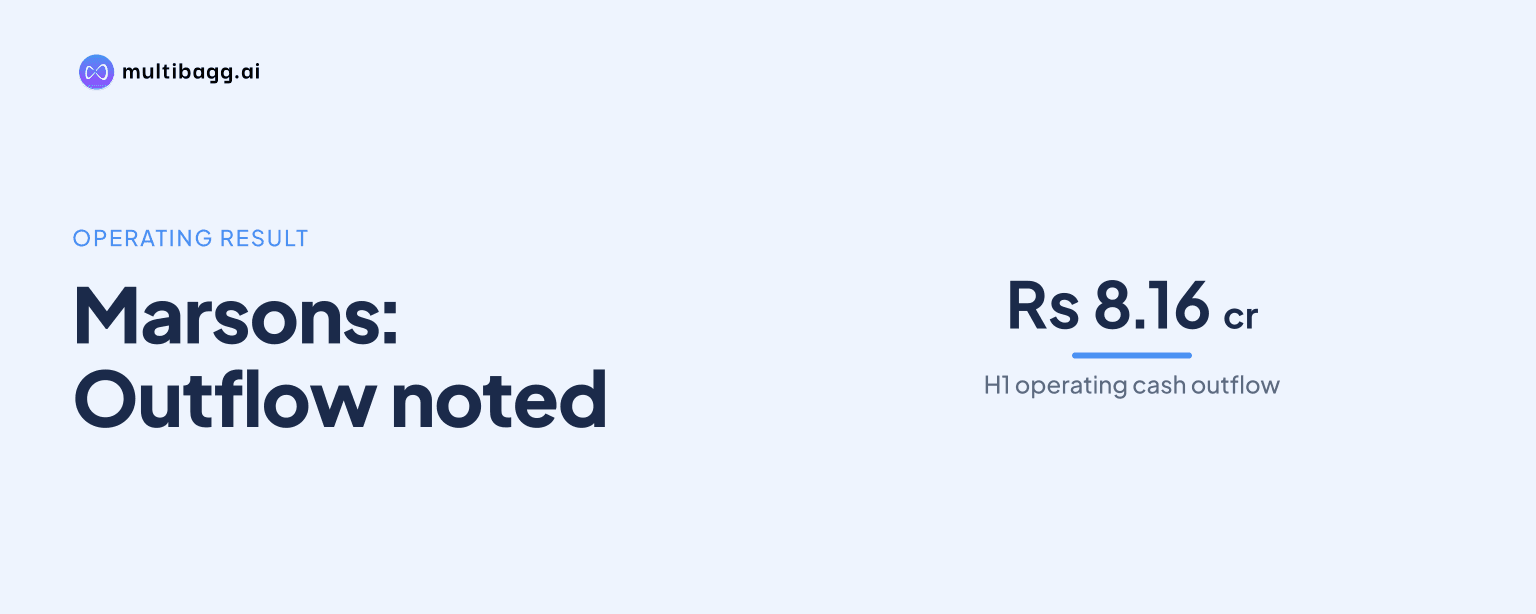
Marsons Limited reported net cash used in operating activities of Rs 8.16 crore for the six months ended September 30, 2026, despite profit before tax of Rs 25.30 crore. Inventory, other loans and advances, and current and non-current liabilities absorbed cash, outweighing Rs 26.29 crore of profit before working-capital changes.
Know Marsons inside out
Results, valuation, peers and who's buying, in one view.
Why did Marsons report negative operating cash flow?
Marsons reported negative operating cash flow because working-capital movements turned Rs 26.29 crore of profit before working-capital changes into an Rs 8.16 crore net operating cash outflow in the six months ended September 30, 2026. The standalone cash-flow statement was prepared using the indirect method under Indian Accounting Standard 7, or Ind AS 7.
Profit before tax was Rs 25.30 crore, while net non-cash and other adjustments added Rs 98.35 lakh. Those adjustments included Rs 52.93 lakh of depreciation, Rs 1.03 crore of interest paid, Rs 44.51 lakh of net gain on changes in the fair value of investments and Rs 9.84 lakh of profit on investment sales.
Working-capital movements then used a net Rs 30.61 crore. A Rs 17.18 crore movement in trade and other receivables provided cash, but this was outweighed by Rs 18.19 crore used by inventories, Rs 14.20 crore used by other loans and advances, and Rs 16.39 crore used by current and non-current liabilities.
Cash generated from operating activities was therefore negative Rs 4.32 crore before taxes. Direct taxes paid, net of refunds, were Rs 3.84 crore, taking the reported net cash used in operating activities to Rs 8.16 crore. The filing does not provide a management explanation for the individual movements in inventory, loans and advances, or liabilities.
Did Marsons' first-half profit increase despite the cash outflow?
Yes, Marsons' profit before tax increased to Rs 25.30 crore in the six months ended September 30, 2026, from Rs 17.23 crore in the corresponding six months ended September 30, 2025. Revenue from operations increased to Rs 145.82 crore from Rs 106.83 crore over the same periods.
Total income rose to Rs 146.76 crore in the September 2026 half year from Rs 108.76 crore a year earlier. Total expenses also increased, reaching Rs 121.46 crore from Rs 91.63 crore, leaving a higher reported pre-tax profit despite the operating cash deficit.
Cost of materials consumed was Rs 105.62 crore in the six-month period, while changes in inventories of finished goods, work in progress and stock in trade were Rs 8.58 crore. The results therefore show that the accounting profit increase was not matched by positive operating cash generation in the same period.
Marsons has one reportable segment, identified in the filing as the sale and distribution of power transformers and allied products and services. Since no segment-level disclosure was made under Ind AS 108, the filing does not split profit or operating cash flow between product lines or activities.
Got a follow-up? Ask IRIS
Which balance-sheet movements accompanied Marsons' cash outflow?
Marsons' inventories increased to Rs 76.21 crore at September 30, 2026, from Rs 58.01 crore at March 31, 2026. The Rs 18.19 crore balance-sheet increase corresponds to the inventory cash use recorded in the standalone cash-flow statement for the half year.
Other current assets increased to Rs 30.57 crore at September 30, 2026 from Rs 15.61 crore at March 31, 2026. Separately, the cash-flow statement reported Rs 14.20 crore used by the net movement in other loans and advances, but the filing does not provide a line-by-line reconciliation to each balance-sheet account.
Trade receivables declined to Rs 90.11 crore from Rs 107.29 crore during the six months, consistent with the Rs 17.18 crore cash contribution from trade and other receivables. This inflow partly offset the inventory, advances and liabilities movements, but did not prevent operating cash from turning negative.
Trade payables fell to Rs 43.19 crore at September 30, 2026 from Rs 56.05 crore at March 31, 2026. Other current liabilities also declined to Rs 13.87 crore from Rs 16.40 crore, alongside the Rs 16.39 crore cash outflow attributed to current and non-current liabilities in the cash-flow statement.
How did investing and financing flows change Marsons' cash balance?
Marsons generated Rs 2.17 crore from investing activities in the six months ended September 30, 2026. Investment sales brought in Rs 5.76 crore, while investment purchases used Rs 3.72 crore, purchases of property, plant, equipment and intangibles used Rs 46.55 lakh, and asset sales generated Rs 57 lakh.
Interest received added Rs 2.77 lakh to investing cash flow during the half year. The investing surplus partly offset the operating cash deficit, but it was not sufficient to prevent an overall reduction in cash and cash equivalents.
Financing activities used Rs 67.32 lakh in the period. Marsons received Rs 45.04 lakh from long-term borrowings, while interest paid was Rs 1.03 crore and short-term borrowings declined by Rs 9.82 lakh from the March 31, 2026 balance.
Net cash and cash equivalents declined by Rs 6.66 crore from opening cash and cash equivalents of Rs 7.53 crore. The September 30, 2026 closing cash and cash-equivalent balance was Rs 86.67 lakh, which is also shown in the standalone balance sheet.
Conclusion
Marsons' September 2026 half-year filing shows a difference between reported profitability and cash generation. Revenue rose to Rs 145.82 crore and profit before tax rose to Rs 25.30 crore, but a combined Rs 48.78 crore of cash use from inventories, other loans and advances, and liabilities led to an Rs 8.16 crore operating cash outflow after taxes.
What to watch next is whether Marsons provides greater detail on the movements in inventory, advances and liabilities that drove the operating cash deficit. The September 30, 2026 balance sheet recorded inventories of Rs 76.21 crore and other current assets of Rs 30.57 crore, while investment sales supplied Rs 5.76 crore of cash in the half year.