










Marsons Ltd Q2 Net Profit Rises 44.6% to ₹13.3 Crore
Key highlights
- Marsons reported Q2 FY27 net profit of ₹13.3 crore, up 44.6% from ₹9.2 crore a year earlier.
- Revenue from operations rose 61.5% year on year to ₹96.6 crore in Q2 FY27.
- Operating margin improved to 18.5% from 15.2% in Q2 FY26.
- Marsons declared a first FY27 interim dividend of ₹0.05 per share, with a November 20, 2026 record date.
powered by IRIS
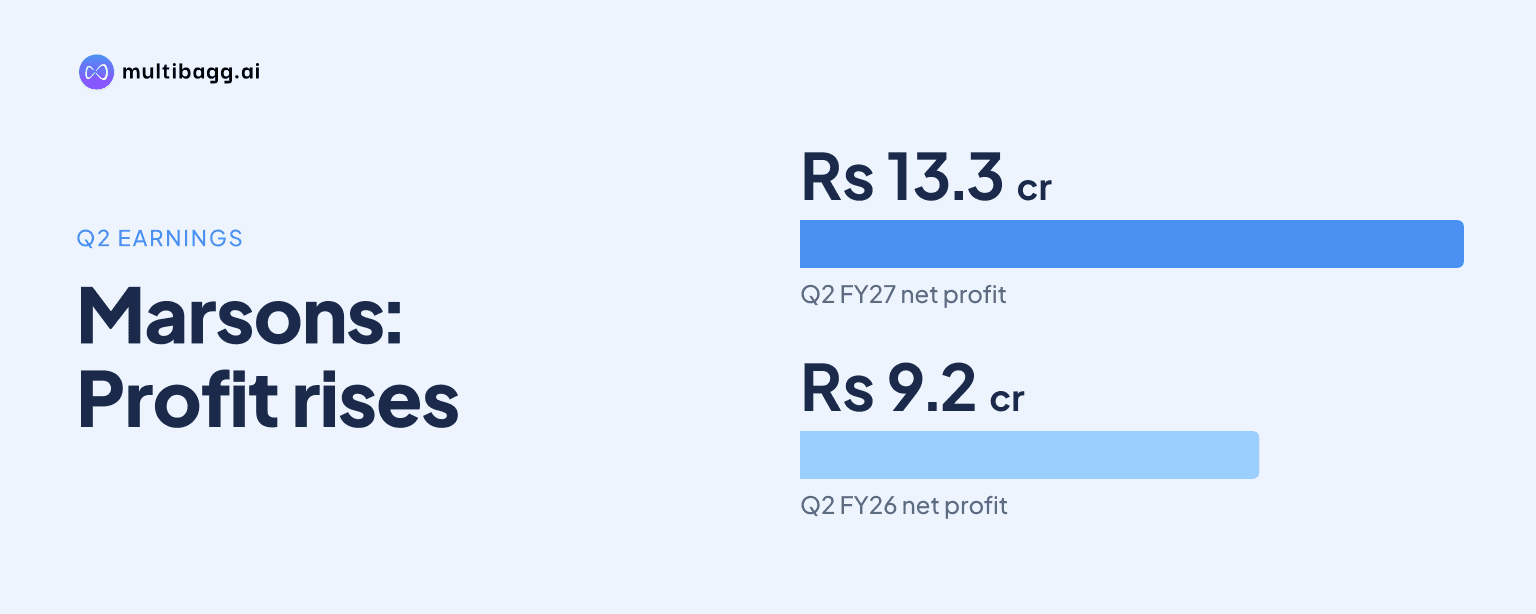
Marsons Ltd reported Q2 FY27 net profit of ₹13.3 crore, up 44.6% year on year, supported by revenue from operations of ₹96.6 crore, which rose 61.5% from Q2 FY26. The company also declared its first interim dividend for FY27 at ₹0.05 per equity share.
Know Marsons inside out
Results, valuation, peers and who's buying, in one view.
What did Marsons report for Q2 FY27?
Marsons reported a strong increase in revenue and profit for the quarter ended September 30, 2026. Revenue from operations stood at ₹96.6 crore, compared with ₹59.8 crore in Q2 FY26 and ₹49.3 crore in Q1 FY27. Total income was ₹96.7 crore, including other income of ₹0.2 crore.
Net profit reached ₹13.3 crore, against ₹9.2 crore a year earlier and ₹5.9 crore in the preceding quarter. The reported year-on-year growth in net profit was 44.6%, while sequential growth was 125.4%. Profit before tax rose to ₹17.9 crore from ₹9.2 crore in Q2 FY26 and ₹7.4 crore in Q1 FY27.
The quarterly numbers were approved at the board meeting held on November 13, 2026, which concluded at 4:00 p.m. The company had earlier informed the NSE on November 5 that its board would consider unaudited financial results for the September quarter and an interim dividend.
How did margins change during the September quarter?
Marsons reported an operating margin of 18.5% in Q2 FY27, compared with 15.2% in the corresponding quarter of FY26 and 14.8% in Q1 FY27. The 3.3 percentage-point year-on-year improvement accompanied the increase in revenue and profit during the quarter.
Operating profit growth was reported at 113.3% year on year and 164.2% quarter on quarter. The results data also indicated that the quarter did not include exceptional items, meaning profit before exceptional items and tax was the same as profit before tax at ₹17.9 crore.
The margin data is relevant because Marsons operates in electrical equipment and energy transition, with exposure to transformers, switchgear and grid equipment. In such businesses, the conversion of higher revenue into operating profit is closely tracked alongside topline growth, particularly when quarterly sales change substantially.
What interim dividend has Marsons declared?
Marsons declared its first interim dividend for FY27 at ₹0.05, or 5 paise, per fully paid-up equity share of face value ₹1. The dividend represents 5% of the face value and applies to 17,21,00,000 equity shares, according to the board approval.
The record date for determining dividend entitlement is Friday, November 20, 2026. The company said the dividend payment will be completed on or before December 13, 2026, subject to eligibility based on holdings as of the record date.
The declaration follows a quarter in which revenue from operations nearly doubled from ₹49.3 crore in Q1 FY27 to ₹96.6 crore. For shareholders, the corporate action adds a cash-return component to the quarterly update, while the reported operating and net-profit figures remain the central measures of the company’s business performance.
Got a follow-up? Ask IRIS
How is Marsons using its preferential issue proceeds?
Marsons disclosed cumulative utilisation of ₹74.37 crore from ₹80.25 crore raised through a preferential issue. The company stated that the funds were used for working capital and general corporate growth purposes.
This leaves ₹5.88 crore of the disclosed preferential-issue proceeds not included in the cumulative utilisation figure. The update provides context for the company’s capital deployment while revenue from operations increased to ₹96.6 crore in the September quarter.
Working-capital requirements can be material for businesses supplying electrical and grid equipment because operations involve procurement, production and customer receivables. Marsons has not provided further project-level or customer-level detail in the supplied information, so the reported use of proceeds should be viewed within the stated categories of working capital and corporate growth.
Why do the Q2 results matter to investors?
The Q2 results matter because Marsons delivered higher revenue, an improved operating margin and stronger profit in the same quarter. Revenue growth of 61.5% year on year was accompanied by net profit growth of 44.6%, while operating margin improved to 18.5% from 15.2%.
The sequential comparison was also notable. Revenue from operations rose from ₹49.3 crore in Q1 FY27 to ₹96.6 crore in Q2 FY27, while net profit increased from ₹5.9 crore to ₹13.3 crore. These comparisons describe the reported quarterly movement but do not establish a full-year trend on their own.
For the broader electrical equipment and energy-transition sector, the results add a company-specific data point on the financial performance of a listed manufacturer with exposure to transformers, switchgear and grid equipment. Investors can assess future disclosures for whether revenue scale, profitability and use of capital continue to align with the September-quarter figures.
Conclusion
Marsons recorded Q2 FY27 revenue from operations of ₹96.6 crore and net profit of ₹13.3 crore, alongside an operating margin of 18.5%. The company’s first interim dividend of ₹0.05 per share follows a quarter marked by year-on-year growth in both sales and profit.
The next disclosed dates are November 20, 2026, as the dividend record date, and December 13, 2026, as the latest scheduled date for payment. Investors may also monitor subsequent financial disclosures for updates on the balance of preferential-issue proceeds and the company’s reported working-capital and corporate-growth use of funds.