










Medi Assist says bundles could lift claim revenue 5-10 times
Key highlights
- Medi Assist said higher-value technology bundles could potentially generate five to 10 times current pure SaaS revenue per claim.
- Medi Assist priced the base MAtrix system-of-record platform at about 100 rupees to 120 rupees per claim.
- Most reported technology revenue still comes from pure SaaS claim processing rather than higher-value add-ons.
- Medi Assist reported a Q2 EBITDA margin of 20.4% and maintained a 22% to 23% steady-state core-business margin view.
powered by IRIS
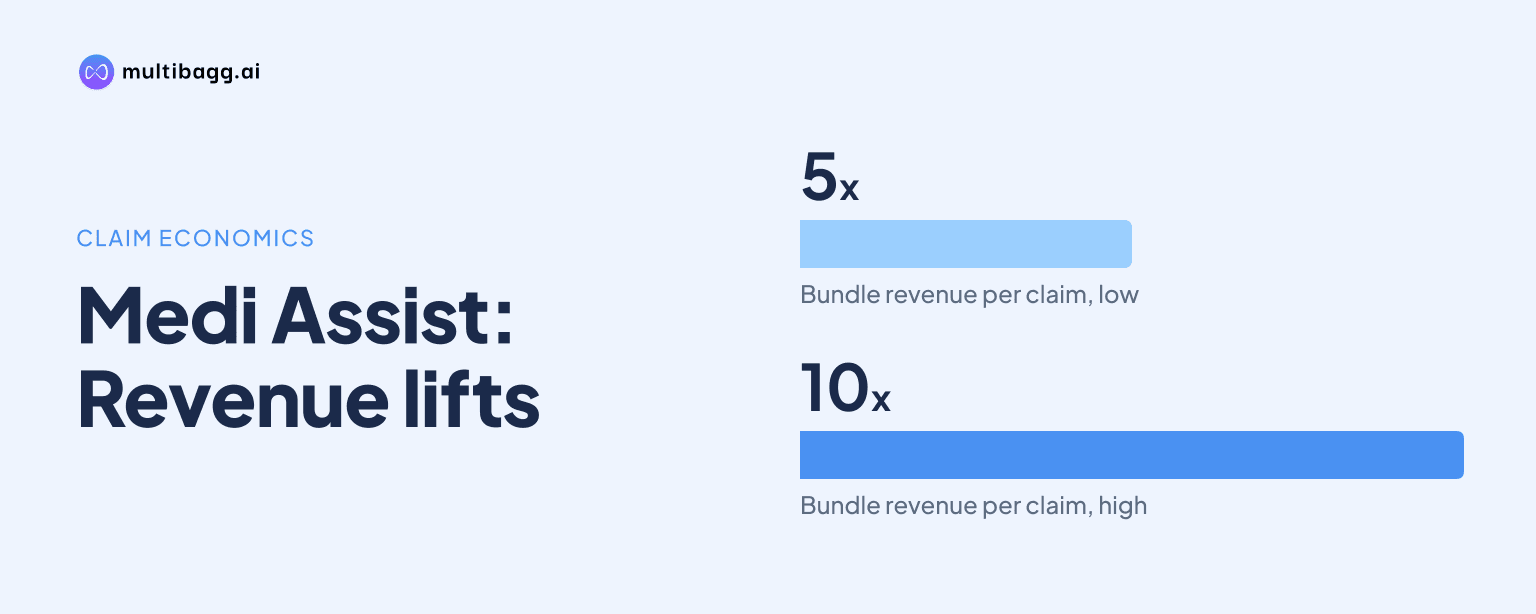
Medi Assist said on its Q2 earnings call that contracted intelligent-adjudication, network and fraud-control bundles could generate five to 10 times the revenue per claim of its current pure software-as-a-service, or SaaS, platform. Most technology revenue reported so far still comes from basic claim processing through the MAtrix platform, management said.
Know Medi Assist Healthcare Services inside out
Results, valuation, peers and who's buying, in one view.
What does Medi Assist currently earn from its technology platform?
Medi Assist currently derives the bulk of reported technology revenue from its pure SaaS platform, management said. The MAtrix platform acts as a system of record through which a claim passes, enforcing policy terms and tariffs while allowing an insurer to remain customer-facing and retain ownership of the customer relationship.
Management described the base MAtrix offering as about 100 rupees to 120 rupees per claim. That base layer includes policy configuration, enforcement of past claim history and an audit trail that can explain claim decisions to members, regulators and other stakeholders. Medi Assist said this system-of-record capability accounts for most technology revenue currently reported.
The platform model differs from Medi Assist's earlier third-party administrator, or TPA, model. Less than two years ago, management said, insurers that wanted its services had to hand over customers for end-to-end management. MAtrix now enables an insurer to retain the front-end customer role while using selected Medi Assist claims, records and operating capabilities.
Why could Medi Assist earn 5-10 times more per claim?
Medi Assist said its higher-value bundles could potentially earn five to 10 times the current pure SaaS revenue per claim because they add claims-control and operating functions to basic processing. Management said contracts for these offerings are starting to take effect, although much of the associated revenue is not yet included in reported technology figures.
The higher-value products include intelligent claims adjudication, network as a service, and fraud, waste and abuse controls. They are add-ons to the MAtrix platform rather than replacements for the basic claim-processing layer. Management's five-to-10-times comparison concerns potential revenue per claim against the current pure SaaS construct, not a forecast for total technology revenue.
The present revenue mix is therefore materially different from the opportunity management outlined. Pure SaaS platform claims make up the bulk of reported technology revenue, while add-on contracts are only slowly beginning to accrue. If those contracts move into reported revenue, the average revenue per claim could increase without an equivalent increase in claims processed on MAtrix.
Which insurance problems do Medi Assist's bundles address?
Medi Assist said the bundles address policy complexity, claims control, fraud and member experience rather than simply claim routing. Its intelligent-adjudication capability is designed to interpret policies and context, handle complex terms and benefits, and preserve an explainable record that meets regulatory requirements for claims decisions.
Management said insurers need to balance claims control with customer experience. Over the previous four to six quarters, Medi Assist said it had built artificial-intelligence, or AI, capabilities for claims-control work while seeking to improve customer satisfaction. It did not disclose a separate revenue number for the AI capabilities, but said they can be offered independently of the TPA model.
Network services and fraud, waste and abuse controls extend the platform into claims operations. In its group business, Medi Assist cited work intended to let employees and dependants leave hospitals without a bill and to provide financial certainty before admission. Those mechanisms link technology monetisation to hospital admission, discharge and claim-management processes.
Got a follow-up? Ask IRIS
How does the platform model expand Medi Assist's market?
Medi Assist is focused first on retail insurance, where the platform can serve insurers that want to retain the customer-facing relationship. Management said some insurers want to own customer experience and differentiate through it, but may not want to conduct every underlying claims, policy-record and adjudication function themselves.
MAtrix offers several levels of participation in that arrangement. At the base level, the system-of-record service is priced at about 100 rupees to 120 rupees per claim. At higher levels, Medi Assist can provide intelligent adjudication, network services or fraud controls, which management said could potentially produce five to 10 times the per-claim revenue of pure SaaS.
Management also sees a hybrid-model opening in group insurance, including non-employer and employee models. It said new insurers had been onboarded to the platform business and implementations were in progress before revenue had begun fully accruing. During the call, an analyst referred to three clients already onboarded and four expected to be onboarded in H2; management did not disclose their claim volumes.
The group business provides a wider operating context but is distinct from the platform model. Medi Assist said it manages more than 34% of India's group premiums, including bank assurance and other products, and cited a blended TPA fee of 2.7% across group and retail. Platform contracts can allow an insurer to use individual services without outsourcing the entire customer relationship under a TPA arrangement.
What must happen for Medi Assist's higher monetisation to appear?
The immediate test is whether contracted add-ons move from implementation into reported revenue. Management said the services are contracted and starting to kick in, but also said pure SaaS remains the bulk of reported technology revenue. That means the stated five-to-10-times potential is not yet the reported average yield of the technology business.
Insurer adoption will depend on the value of the operational services. Management said insurers need better claim quality, claims control and customer experience, and that some servicing tasks could be handled through either the platform or TPA model. Medi Assist's proposition is that insurers can outsource selected claims functions while retaining their direct relationship with policyholders.
The Q2 margin context also reflects the investment phase. Medi Assist reported an earnings before interest, tax, depreciation and amortisation, or EBITDA, margin of 20.4% for the quarter, which management said absorbed technology and international-business investments as well as customer implementations. Management maintained its view that steady-state core-business margin can be 22% to 23%, but gave no technology-revenue guidance or date for add-ons to become material.
Conclusion
Medi Assist's disclosure shows that the technology business is currently monetised mainly through a lower-priced SaaS claim-processing layer, while intelligent adjudication, network services and fraud controls are intended to raise revenue per claim. The potential five-to-10-times uplift is a comparison with the base platform fee of about 100 rupees to 120 rupees per claim, not evidence that the whole technology segment has already reached that level.
The next item to watch is the pace at which contracted bundles begin appearing in reported technology revenue as implementations progress. Management also said it expects to return to its historical group retention rates within three to four quarters, making that period relevant for assessing how its hybrid platform and TPA models perform across retail and group cohorts.