










Medi Assist Expects 93-94% Retention Recovery in Four Quarters
Key highlights
- Medi Assist reported H1 FY27 group-business retention of about 90.5% and expects 93-94% within three to four quarters.
- Medi Assist said it replaced about 80% of retention losses through new-business additions.
- Medi Assist H1 FY27 group-business revenue rose 13.7% year on year to Rs 334.7 crore.
- Medi Assist Q2 FY27 EBITDA margin rose 330 basis points year on year to 20.4%.
powered by IRIS
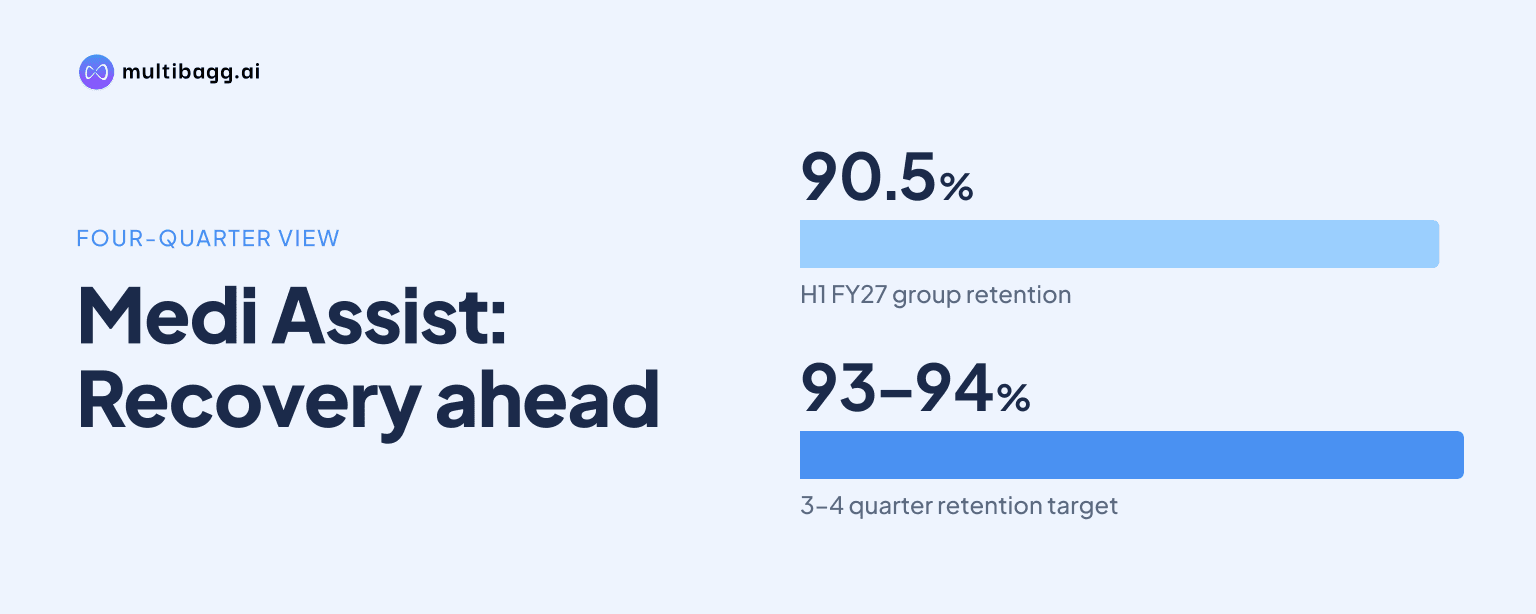
Medi Assist Healthcare Services Limited expects group-business retention to return to 93-94% within three to four quarters after first-half, or H1, FY27 retention was about 90.5%. Management attributed the decline to churn in Paramount’s acquired portfolio and a cyber incident, while saying all corporate accounts have now migrated to Medi Assist.
Know Medi Assist Healthcare Services inside out
Results, valuation, peers and who's buying, in one view.
Why did Medi Assist group-business retention fall?
Medi Assist said group retention declined from its historical 93-94% range because of churn at the tail end of the Paramount portfolio and a cyber incident in Paramount’s systems in December. The incident affected some renewals between January and April in the erstwhile Paramount book, while H1 FY27 retention of about 90.5% marginally improved quarter on quarter.
Management said the churn was not in the core customer constituency where Medi Assist has historically been strong. It expects retention to recover as the acquired portfolio operates on the Medi Assist platform, with the new customer base now becoming the basis for future renewals over the next three to four quarters.
The reported revenue effect may last longer than the underlying customer loss because Medi Assist recognises premiums, including instalment premiums, over multiple quarters on a 1/365 basis. Management said depressed retention could remain visible in reported figures for another two to three quarters, even after customer additions are made.
Medi Assist said it replaced about 80% of retention losses through new-business additions. However, management said the timing of revenue recognition delays the contribution from these accounts, so it expects both retention and revenue growth to normalise over the same three-to-four-quarter period.
What has Medi Assist completed in the Paramount integration?
Medi Assist said the Paramount integration is complete: no standalone Paramount corporate account remains, 100% of corporates are served by Medi Assist, and 100% of claims run on its Matrix claims system. Management said the December cyber incident delayed the integration by about one quarter.
The company consolidated systems, processes, call centres, people and officers into one operating organisation. Management said headcount was more than 800 lower than at the time of the Paramount acquisition, reflecting consolidation and a less people-intensive operating structure.
Medi Assist reported Q2 FY27 earnings before interest, tax, depreciation and amortisation, or EBITDA, of Rs 49.2 crore, up 23.9% year on year, with a 20.4% margin. Management attributed the margin recovery partly to completing the Paramount integration, lower people costs, rationalisation and artificial-intelligence tools used for the Paramount plan.
Management said the Q2 FY27 margin absorbed investment in the technology and international businesses, including customer implementation work that has not yet contributed fully to revenue. It reiterated that the core business has a 22-23% steady-state EBITDA margin objective, which management described as a continuing focus area.
Got a follow-up? Ask IRIS
When will Medi Assist revenue growth reflect premium growth?
Medi Assist expects premium growth to translate into accounting revenue with a two-to-three-quarter lag because of its 1/365 recognition method. Q2 FY27 operating revenue, excluding other income, was Rs 241.5 crore, up 3.9% year on year, while Indian third-party administrator, or TPA, revenue increased 1.2% to Rs 219.6 crore.
Management said Q2 Indian TPA revenue growth reflected retention losses in the first quarter and the deferred recognition of associated instalment premiums. It said the company continues to grow premium share faster than the market, but the accounting effect of new contracts is not immediate.
Group-business revenue was Rs 334.7 crore in H1 FY27, up 13.7% year on year. Medi Assist said its group premiums grew more than 21% in H1, compared with 15.8% growth in industry group premiums reported by the General Insurance Council, while cautioning that its employer-employee focus differs from the broader industry category.
Contract liability rose to Rs 321.7 crore on September 26 from Rs 280.2 crore at the end of FY26. Management described the Rs 41.5 crore increase as revenue associated with contracts already won that had not yet entered the profit and loss account, and said monthly revenue size had risen by nearly Rs 50 crore from Q1 last year to Q2 FY27.
What could support Medi Assist retention and same-store growth?
Medi Assist expects same-store growth in retained group accounts to remain around 8-9%, compared with a 13-14% steady-state rate over the previous three years. Management said benefit expansion and medical-inflation adjustments are now the principal drivers, as employee headcount growth remains slower in information technology and information-technology-enabled services, or IT-ITeS.
Historically, management said roughly half of same-store growth came from an increase in employees and dependants, with the balance arising from inflation adjustments and benefit expansion. It expects other sectors to partly offset weaker IT-ITeS hiring, but said there could be a timing lag before those sectors match IT-ITeS’s contribution to employee headcount.
Medi Assist serves more than 11,000 corporates across more than 25 sectors and said manufacturing, consumer goods, oil and gas and other sectors continue to add employees. Group business accounts for about 70% of revenue, while management cited a 34.1% market share in group premiums.
Management also plans to address group segments where Medi Assist currently has less presence, including product platforms such as bank assurance, through its technology platform and hybrid model. It said this work is at an early stage and is intended to extend the company’s reach beyond employer-employee group business.
Medi Assist cited claims and service tools intended to provide employees financial certainty before hospital admission and enable discharge without waiting for a bill. The company processed more than 7 million claims in H1 FY27, while its artificial-intelligence platforms handled more than 1 million claims a month, according to management.
Conclusion
Medi Assist’s path back to 93-94% group retention depends on the completed Paramount integration, the migration of all corporate accounts to one claims system and the conversion of replacement business into reported revenue. H1 FY27 retention of about 90.5% and Q2 Indian TPA revenue growth of 1.2% show the near-term effect of churn and accounting timing, while group revenue grew 13.7% in H1.
The next measures to watch are whether retention returns to management’s 93-94% target within three to four quarters and whether the two-to-three-quarter revenue-recognition lag begins to lift Indian TPA revenue growth. Management’s plan to pursue bank assurance and other group product platforms through a hybrid model is also unresolved, as it said those efforts remain at an early stage.