










Mindteck standalone profit falls 30% as revenue declines
Key highlights
- Mindteck’s standalone September-quarter profit after tax fell to Rs 3.78 crore from Rs 5.38 crore a year earlier.
- Standalone revenue from operations declined to Rs 31.91 crore from Rs 39.15 crore in the September quarter.
- Six-month standalone operating cash flow changed to an outflow of Rs 61 lakh from an inflow of Rs 3.93 crore.
- Consolidated September-quarter revenue increased to Rs 105.50 crore from Rs 101.63 crore.
powered by IRIS
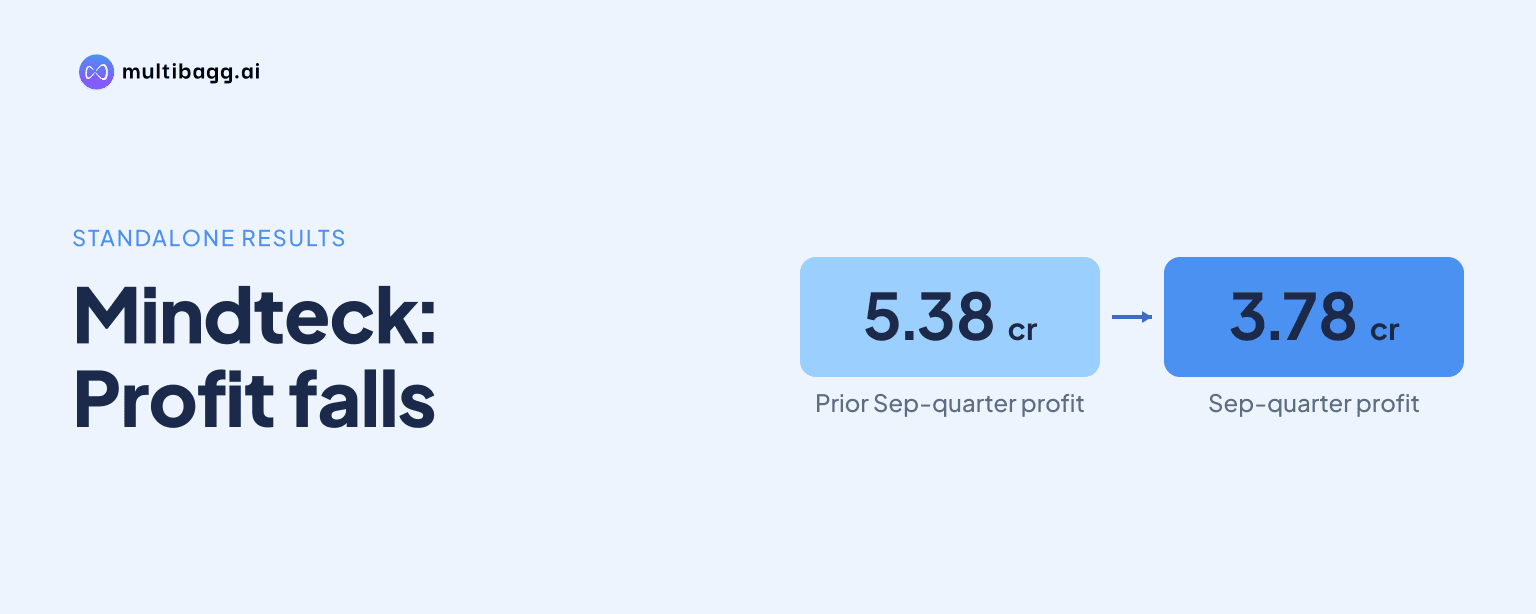
Mindteck (India) Limited reported standalone profit after tax of Rs 3.78 crore for the quarter ended September 30, 2026, down 30% from Rs 5.38 crore a year earlier, as revenue from operations declined 18% to Rs 31.91 crore. For the six months, operating cash flow moved to an outflow of Rs 61 lakh from an inflow of Rs 3.93 crore.
Know Mindteck (India) inside out
Results, valuation, peers and who's buying, in one view.
Why did Mindteck’s standalone September-quarter profit fall?
Mindteck’s standalone profit fell because the decline in income exceeded the reduction in expenses. Revenue from operations dropped by Rs 7.24 crore year on year to Rs 31.91 crore, while total income, including Rs 1.94 crore of other income, declined by Rs 7.14 crore to Rs 33.85 crore. Profit before tax consequently fell to Rs 5.11 crore from Rs 7.63 crore in the quarter ended September 30, 2025.
Profit after tax was Rs 3.78 crore, compared with Rs 5.38 crore in the prior-year quarter. Tax expense declined to Rs 1.33 crore from Rs 2.25 crore, but that reduction did not offset the Rs 2.52 crore fall in pre-tax profit. Basic and diluted earnings per share, which are not annualised for interim periods, both declined to Rs 1.18 from Rs 1.68.
The sequential movement was narrower than the year-on-year decline. September-quarter revenue was Rs 31.91 crore, compared with Rs 33.93 crore in the June 30, 2026 quarter, while profit after tax was Rs 3.78 crore against Rs 3.84 crore. Profit before tax was broadly unchanged at Rs 5.11 crore in September and Rs 5.10 crore in June.
How did Mindteck’s first-half standalone performance change?
Mindteck’s standalone profit after tax for the six months ended September 30, 2026 fell to Rs 7.62 crore from Rs 10.04 crore in the corresponding previous period. Revenue from operations decreased by Rs 8.46 crore to Rs 65.84 crore, and total income declined to Rs 69.61 crore from Rs 78.57 crore.
Pre-tax profit declined to Rs 10.21 crore from Rs 13.81 crore. Employee benefits expense reduced by Rs 2.42 crore to Rs 48.71 crore and technical subcontractor costs fell by Rs 2.10 crore to Rs 1.29 crore. Those expense reductions were smaller than the Rs 8.96 crore fall in total income, resulting in the lower pre-tax result.
Other income was Rs 3.77 crore in the six-month period, compared with Rs 4.27 crore a year earlier. This included Rs 19 lakh of interest income on a fixed deposit held by the Mindteck Employees Welfare Trust, compared with Rs 21 lakh in the prior-year half. Mindteck said the trust’s financials have been merged into its standalone statements from November 12, 2024, and the trust’s income is designated for employee benefit.
Why did Mindteck’s operating cash flow turn negative?
Mindteck used Rs 61 lakh in operating activities during the six months ended September 30, 2026, compared with net operating cash generation of Rs 3.93 crore a year earlier. The cash-flow change occurred despite Rs 10.21 crore of pre-tax profit because working-capital movements and tax payments reduced cash conversion.
Trade receivables increased by Rs 5.04 crore in the 2026 half year, while liabilities and provisions decreased by Rs 3.90 crore. In the previous corresponding half, receivables had increased by Rs 6.70 crore and liabilities and provisions had decreased by Rs 1.42 crore. Net cash from operating activities before taxes was therefore Rs 78 lakh, down from Rs 8 crore, and net income taxes paid were Rs 1.39 crore.
Cash and cash equivalents nevertheless rose by Rs 8.04 crore during the half year to Rs 31.04 crore at September 30, 2026, from Rs 23 crore at March 31, 2026. Investing activities generated Rs 13.85 crore, including a Rs 9.75 crore net movement in fixed deposits and other bank balances and Rs 4.34 crore of interest received. Financing activities used Rs 5.20 crore, including Rs 3.09 crore of dividends and Rs 1.95 crore of lease-principal repayments.
Got a follow-up? Ask IRIS
How did Mindteck’s standalone results compare with consolidated results?
Mindteck’s standalone revenue declined while consolidated revenue increased in the September quarter. Standalone revenue fell to Rs 31.91 crore from Rs 39.15 crore a year earlier, whereas consolidated revenue rose to Rs 105.50 crore from Rs 101.63 crore. Consolidated profit after tax was Rs 7.48 crore, marginally below Rs 7.56 crore in the prior-year quarter.
The consolidated geographical disclosure shows that India revenue fell to Rs 16.27 crore from Rs 20.44 crore in the September quarter. United States revenue rose to Rs 41.36 crore from Rs 37.80 crore, while rest-of-world revenue increased to Rs 47.87 crore from Rs 43.39 crore. The standalone financial statements do not provide segment information because Mindteck presents it in the consolidated results under Indian Accounting Standard 108.
Mindteck’s standalone total assets were Rs 238.78 crore at September 30, 2026, compared with Rs 240.29 crore at March 31, 2026. Trade receivables increased to Rs 59.99 crore from Rs 54.61 crore, consistent with the Rs 5.04 crore cash-flow increase during the half year. Total equity rose to Rs 209.68 crore from Rs 204.29 crore, while total liabilities declined to Rs 29.10 crore from Rs 36 crore.
What employee-benefit and option disclosures did Mindteck make?
Mindteck’s Nomination and Remuneration Committee granted 2,50,000 options under the Mindteck Employee Stock Option Scheme 2014 to key managerial personnel. The grant price was Rs 133.63, which the company described as the previous day’s closing price on the National Stock Exchange.
Mindteck had recorded a Rs 5.30 crore exceptional charge in the year ended March 31, 2026 for the impact of new Labour Codes. The charge reflected higher gratuity liability for past service and higher leave liability after the government notified the Labour Codes on November 21, 2025. No exceptional item was recorded in the September 2026 quarter or six-month period.
Conclusion
Mindteck’s standalone September-quarter outcome combined lower revenue, pre-tax profit and net profit with a first-half shift to negative operating cash flow. The consolidated comparison shows that higher United States and rest-of-world revenue supported group revenue growth even as India revenue and the parent-only revenue measure declined.
Next, Mindteck said it will continue monitoring developments related to the Labour Codes and evaluate any further effect on employee-benefit liability measurement if applicable. The company had already recorded the Rs 5.30 crore non-recurring impact in the year ended March 31, 2026, while its September 30, 2026 standalone receivables balance stood at Rs 59.99 crore.