










Mobavenue says 97%+ of FY26 revenue was outcome-based advertising
Key highlights
- More than 97% of Mobavenue’s FY26 revenue came from outcome-based advertising.
- Direct clients contributed 73.9% of Mobavenue’s FY26 revenue.
- Mobavenue says its Neural Engine reads about 1.4 billion signals each day.
- Management’s Rule of 50 targets revenue growth above 30% and EBITDA margin of at least 20%.
powered by IRIS
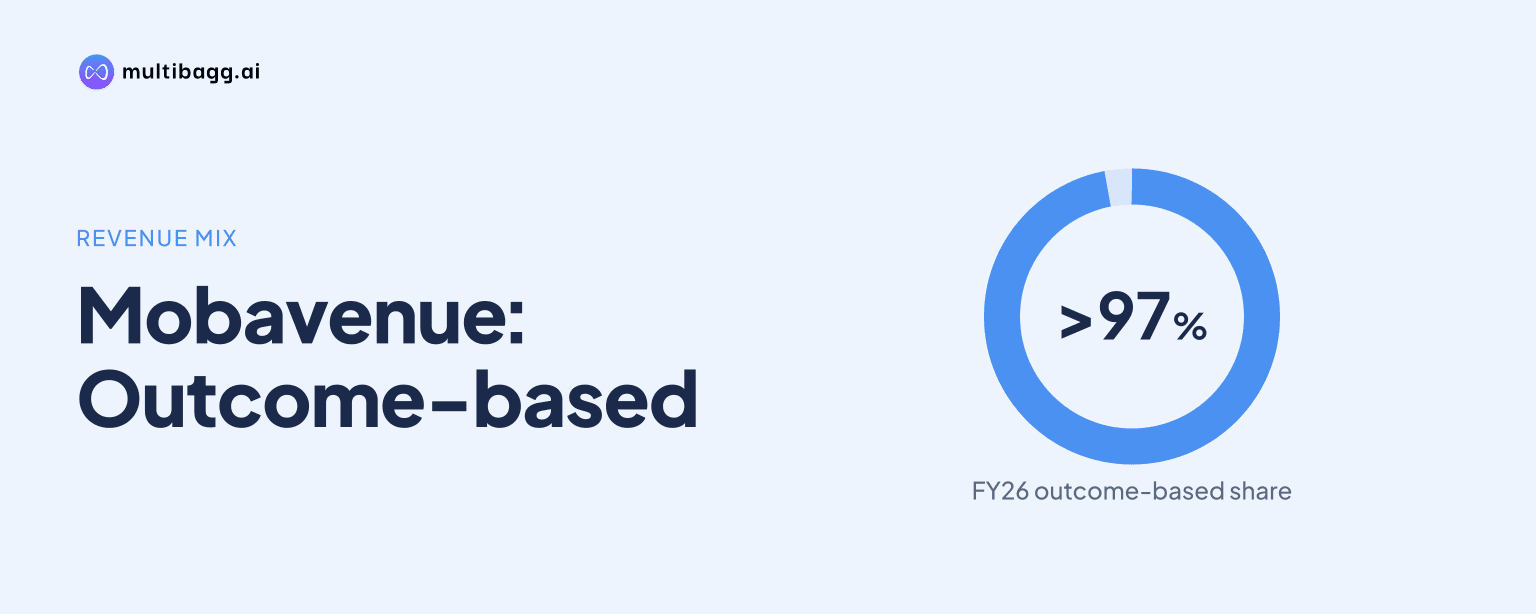
Mobavenue says more than 97% of FY26 revenue came from outcome-based advertising, in which clients pay for verified actions rather than media exposure. Management plans to extend this model through expansion beyond 12 countries served in Q1 FY27, premium advertising formats and autonomous AI tools, while targeting revenue growth above 30% and EBITDA margin of at least 20%.
Know Mobavenue AI Tech inside out
Results, valuation, peers and who's buying, in one view.
How does Mobavenue’s outcome-based advertising model work?
Mobavenue’s outcome-based model begins with a client selecting a measurable campaign goal, such as a visit, registration, app install, lead, add-to-cart action, purchase or returning customer. Mobavenue then runs the campaign through its platforms and bills the client only for verified results delivered, rather than charging licence fees or billing simply for advertising impressions.
The model places Mobavenue between advertisers and the open digital ecosystem, including apps, websites, connected television, phone makers and advertising exchanges. Its Neural Engine reads about 1.4 billion signals a day to identify prospective consumers and buy advertising inventory in real time; another presentation page describes the engine as analysing more than 1.3 billion consumer signals.
Mobavenue’s A3 framework covers awareness, acquisition and activation rather than focusing only on new-user campaigns. It also offers DiscvrX for phone-maker and contextual discovery, OrbitX for search and social campaigns, PiiX for Apple Search Ads intelligence, and AmplifiX for partner and affiliate marketing. A demand-side platform, or DSP, is technology that automatically buys advertising space for advertisers.
Why is outcome-based advertising central to Mobavenue’s FY26 revenue?
Outcome-based advertising is Mobavenue’s principal commercial model because it generated more than 97% of FY26 revenue. The presentation does not explain the revenue sources within the remaining share, but it says pricing changes according to each client’s chosen outcome and the channel used, linking Mobavenue’s revenue to campaign actions including installs, leads and purchases.
Direct clients contributed 73.9% of Mobavenue’s FY26 revenue, making direct-to-brand sales its larger route to market. Mobavenue also sells through agencies and partners, and its client list covers banking and insurance, retail, consumer goods, securities, commerce, financial technology, travel and entertainment; the presentation does not disclose revenue by named client or industry.
The stated operating mechanism is real-time prediction and bidding rather than a fixed media placement. Mobavenue says its A2 acquisition offering can block fake installs, while its technology makes each bid decision in under 15 milliseconds. These features support a model in which clients define the result before a campaign starts and payment follows verified delivery of that result.
Got a follow-up? Ask IRIS
What advertising market is Mobavenue pursuing?
Mobavenue is targeting India’s fragmented open digital advertising ecosystem, within a national advertising market projected at Rs 2,01,891 crore in 2026. The presentation estimates that digital will account for 68.1% of that market, or about Rs 1,37,000 crore, while total Indian advertising spending will grow 9.7% year on year and add Rs 17,844 crore during 2026.
Mobavenue distinguishes the open ecosystem from Meta and Google, which it describes as walled gardens where advertising is purchased inside each company’s own platforms. The open market includes numerous apps, websites, games and television screens, and Mobavenue identifies limited transparency, fragmented buying, inventory bias, low efficiency and poor targeting as advertiser problems within this environment.
Programmatic advertising accounted for 42% of India’s digital advertising spend in 2025, compared with 10% in 2016, according to the presentation’s cited market data. Globally, more than 80% of digital advertising is transacted programmatically. Mobavenue’s strategy is to use its AI layer and A3 platform set to unify media buying and creative delivery across these open-internet channels.
How does Mobavenue plan to pursue its Rule of 50?
Mobavenue defines its Rule of 50 as management’s strategy to achieve annual revenue growth above 30% while maintaining an earnings before interest, tax, depreciation and amortisation, or EBITDA, margin of 20% or more. The target combines growth and profitability objectives, rather than representing a forecast for a specified financial year.
The FY26 income statement reported revenue from operations of Rs 218.5 crore and EBITDA of Rs 45.4 crore, equal to a 20.8% EBITDA margin. FY25 revenue from operations was Rs 86.7 crore and EBITDA was Rs 14.3 crore, but FY25 covered seven months from September 2024 to March 2025, versus 12 months in FY26, so the two periods are not directly comparable.
Management’s four disclosed growth engines are deeper selling in India and emerging markets, international expansion, premium advertising formats and more autonomous AI campaign operations. Mobavenue served 12 countries in Q1 FY27 and identified Asia, the United Kingdom and the United States for expansion. Its premium-format plan includes connected television, streaming, digital out-of-home advertising, commerce media, creator media, Apple advertising and supply monetisation.
Mobavenue says campaigns can currently go live in minutes rather than days, and its next planned step is AI agents that can plan, run and optimise campaigns independently. The presentation identifies agentic AI, automated planning and self-optimising campaigns as development areas, but does not provide a launch date, revenue target or productivity metric for these tools.
Conclusion
Mobavenue’s stated strategy rests on a commercial model that produced more than 97% of FY26 revenue through payments for verified advertising outcomes. Its 73.9% direct-client revenue share, A3 platform coverage and real-time signal analysis are intended to support this model across a digital advertising market where programmatic buying represented 42% of India’s digital spend in 2025, up from 10% in 2016.
The next measures to watch are progress towards management’s Rule of 50 objectives of revenue growth above 30% and EBITDA margin of at least 20%, alongside expansion beyond the 12 countries served in Q1 FY27. Management’s plan also makes the adoption of connected television, streaming, commerce media and autonomous AI campaign tools relevant, although it has not disclosed revenue milestones or launch dates for those initiatives.