








Monomark Engineering (India) Limited IPO values FY26 earnings at 16.93x
MAX Plan at ₹4,999/yr

Find your next multibaggerBe a Pro Investor
Research stocks and track your picks on the go. Download the app.
Key highlights
- Monomark's IPO is a ₹175.50 crore fresh issue with no offer-for-sale component.
- FY26 revenue was ₹561.89 crore and profit after tax was ₹25.90 crore, implying a 4.61% PAT margin.
- The IPO is valued at 15.63x to 16.93x FY26 earnings before dilution and 22.22x to 24.07x after dilution.
- The stated order book is ₹1,761.92 crore, while the top five customers reportedly account for 91% of revenue.
powered by IRIS
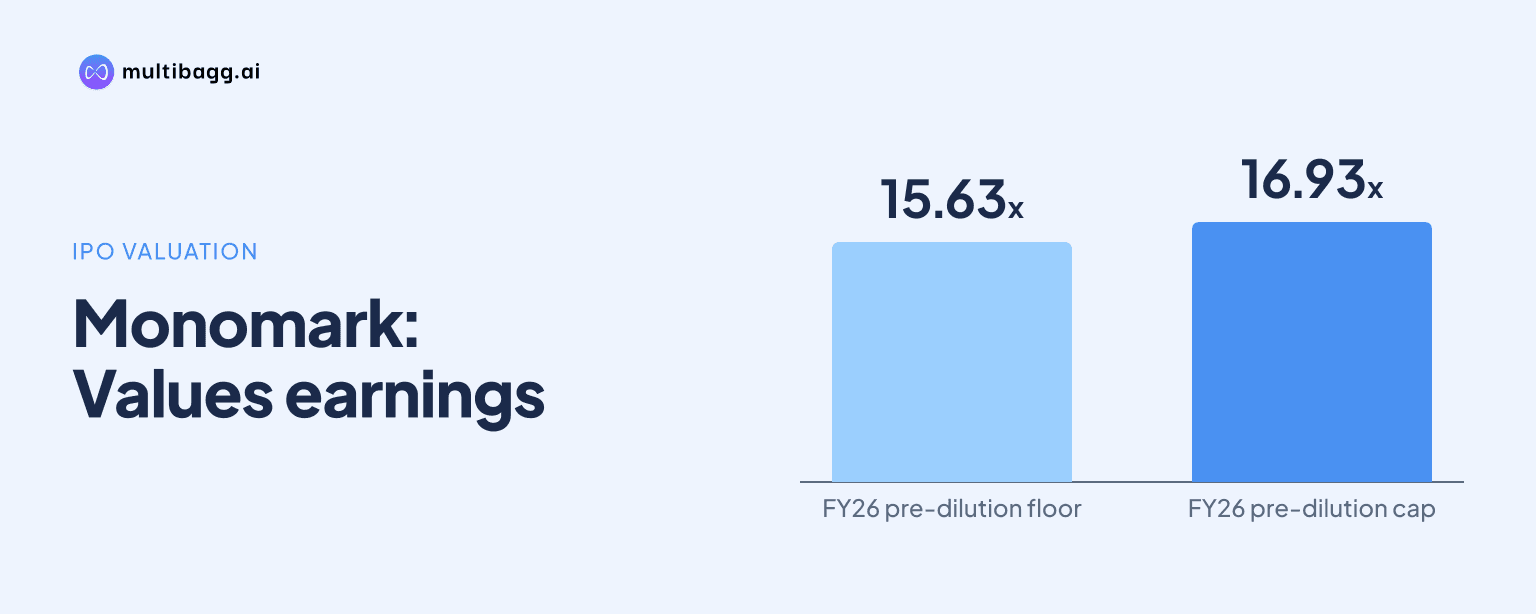
For FY26, Monomark Engineering (India) Limited's IPO values earnings at up to 16.93 times on the offer-document EPS basis, while revenue rose to ₹561.89 crore and profit reached ₹25.90 crore, leaving investors to weigh growth against margins below 5%, cash conversion and customer concentration.
What are Monomark's IPO terms?
Monomark is offering a ₹175.50 crore fresh issue of 2.70 crore equity shares at a price band of ₹60 to ₹65 per share. There is no offer for sale in the issue, meaning the stated offer consists entirely of newly issued shares. The shares have a face value of ₹10 each and are proposed to list on the BSE and NSE main boards.
The issue is scheduled to open on 2 December 2026 and close on 4 December 2026. The lot size is 225 shares, taking the minimum retail application to ₹14,625 at the upper price band. The available timetable indicates expected allotment on 7 December and expected listing on 9 December, though such dates remain subject to the IPO process.
How fast did Monomark's financial performance grow?
Monomark's revenue increased from ₹389.86 crore in FY24 to ₹561.89 crore in FY26, while profit grew from ₹14.83 crore to ₹25.90 crore over the same period. The figures indicate revenue and profit expansion, but the available reviews also point to net profit margins remaining below 5%.
Thin profitability matters in an industrial services business because changes in execution, collections or costs can have a meaningful effect on reported earnings. The FY26 profit margin, calculated from the provided revenue and profit figures, was about 4.6%. Reviews have also flagged weaker cash conversion relative to accounting profit as an issue that warrants attention.
How is Monomark's IPO valuation calculated?
Monomark's pre-issue valuation is 15.63 to 16.93 times FY26 earnings across the ₹60 to ₹65 price band, based on diluted FY26 EPS of ₹3.84 stated in the offer-related material. At the upper band, the post-issue market capitalisation is ₹624.27 crore.
A separate post-issue calculation, using EPS of ₹2.70 after dilution, places the valuation at 22.22 to 24.07 times FY26 earnings. The difference is important: the lower multiple uses pre-issue earnings per share, whereas the higher range reflects the expanded post-issue share base. Investors should therefore identify which EPS basis is being used before comparing the IPO with listed companies.
The context lists P/E multiples of 48.66 for Thermax, 18.79 for Power Mech Projects, 44.24 for Thejo Engineering and 5.99 for ANI Integrated Services. Those figures provide reference points, but they do not by themselves establish whether Monomark is cheap or expensive because business mix, margins, scale and financial risks differ among companies.
Got a follow-up? Ask IRIS
What risks should investors assess before applying for Monomark's IPO?
Monomark's key disclosed concerns are thin margins, weaker cash conversion, dependence on operations and maintenance work, and customer concentration. One review cited the top five clients as accounting for 91% of revenue and said Hindustan Zinc contributed more than 35%, exposing the business to a material reliance on a limited customer group.
The available discussion also identifies sector cyclicality, collections and high attrition as factors to monitor. For a company with a margin below 5%, a delay in customer payments or a change in project economics may affect cash generation and profitability more sharply than for a business with wider margins. These issues explain why some reviews describe the offer as selective rather than suitable for conservative investors.
What could drive interest in Monomark after the issue opens?
Monomark's reported repeat-order ratio of 87% and order book of ₹1,761.92 crore are the principal operating indicators cited as support for future activity. Repeat maintenance work may provide some continuity of business, while the order book offers visibility into the pipeline described in the reviews.
For investors focused on potential listing performance, the discussion around the issue repeatedly points to qualified institutional buyer demand, including day two and day three subscription trends, as a factor to track. Unofficial grey market premium references should be treated cautiously, as the supplied context notes that such quotations are not reliable indicators of listing performance. Anchor investor quality and final subscription data may offer more relevant signals before the expected 9 December listing.
Conclusion
Monomark combines FY24-to-FY26 revenue and profit growth with a ₹175.50 crore all-fresh IPO, but its valuation requires careful reading. The offer is priced at 15.63 to 16.93 times FY26 EPS before dilution and 22.22 to 24.07 times on the cited post-issue EPS basis, while low margins and cash conversion concerns limit the comfort that headline growth alone can provide.
The next items to watch are subscription trends among qualified institutional buyers, anchor investor participation and the expected allotment and listing schedule. Longer-term assessment will depend on whether Monomark can convert its stated ₹1,761.92 crore order book and repeat work into sustained margins, collections and lower reliance on a concentrated client base.

