










Motherson Sumi Wiring India Q2 profit rises 35% on demand
Key highlights
- MSUMI's Q2 FY27 revenue increased 47% year-on-year to ₹4,053.83 crore.
- Profit for the period rose 35% year-on-year to ₹223.37 crore in Q2 FY27.
- EBITDA margin improved to 9.2% in Q2 FY27 from 7.6% in Q1 FY27.
- MSUMI said passenger vehicle volumes increased 25% year-on-year during the quarter.
powered by IRIS
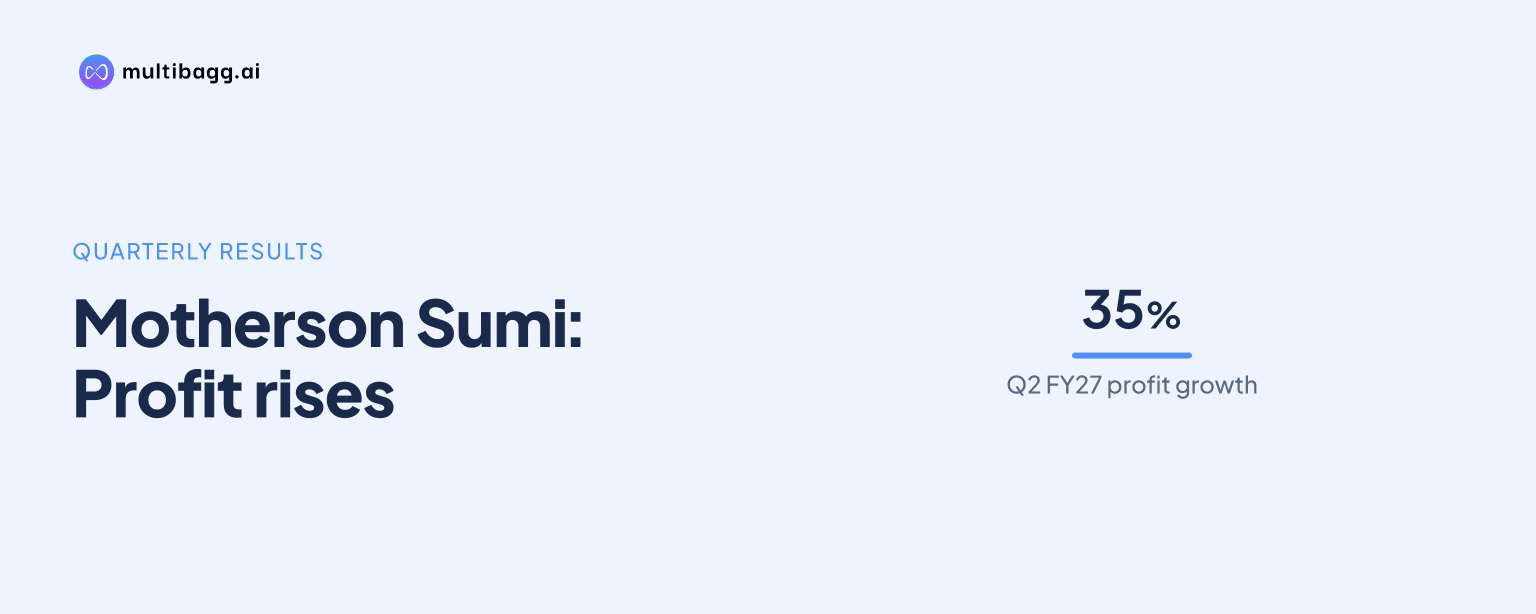
Motherson Sumi Wiring India Limited reported a 35% year-on-year increase in Q2 FY27 profit to ₹223.37 crore, while revenue rose 47% to ₹4,053.83 crore, supported by customer volumes, new programme launches and greenfield plant contributions. The earnings update was followed by a surge in MSUMI shares, according to the provided report.
Know Motherson Sumi Wiring India inside out
Results, valuation, peers and who's buying, in one view.
Why did MSUMI report higher Q2 FY27 profit?
MSUMI reported higher Q2 FY27 profit as sales growth from customer volumes, new programme launches and recently added manufacturing capacity outweighed operational cost pressures. The company said premiumisation in passenger vehicles and higher wiring content per vehicle also supported demand for its products.
Chairman Vivek Chaand Sehgal said revenue growth was supported by higher customer volumes, new programme launches and contributions from greenfield plants. The company has invested in additional capacity to meet customer requirements, while continuing to manage quality-related headwinds and improve operating performance.
The passenger vehicle industry remained an important driver. Management said passenger vehicle volumes rose 25% year-on-year and 14% sequentially during the quarter. MSUMI supplies wiring harnesses and related electrical distribution systems, making its sales linked to vehicle production volumes and the electrical content of new models.
The company also cited new electric vehicle and internal-combustion-engine model wins as factors behind growth. These launches, along with a shift towards more premium vehicles, can raise wiring-system content per vehicle. MSUMI did not provide a separate revenue contribution from individual customers, models or vehicle categories.
What were MSUMI's key Q2 FY27 financial numbers?
MSUMI recorded revenue of ₹4,053.83 crore in Q2 FY27, up 47% year-on-year and 19% quarter-on-quarter, while profit for the period rose 35% year-on-year to ₹223.37 crore. EBITDA increased 34% year-on-year to ₹374 crore, and the EBITDA margin improved to 9.2% from 7.6% in Q1 FY27.
The company said reported revenue growth included the effect of copper inflation. Revenue excluding copper inflation grew 35% year-on-year, while copper inflation contributed 12 percentage points to reported revenue growth. Copper is generally passed through to customers, although the recovery occurs with a time lag.
For the first half of FY27, revenue rose 42% year-on-year to ₹7,461.09 crore. EBITDA increased 21% to ₹632 crore, while profit for the period rose 20% to ₹368.69 crore. Total income for the half year was ₹7,467.61 crore and total expenses were ₹6,972.90 crore.
Got a follow-up? Ask IRIS
How did greenfield plants and operating efficiency affect margins?
MSUMI said its three greenfield plants contributed meaningfully to revenue growth and have now reached optimal utilisation levels. Their ramp-up helped the company support higher customer volumes, while the larger revenue base improved the absorption of costs incurred during the facilities' initial operating phase.
Management said EBITDA margin improved to 9.2% through operational efficiencies. The sequential margin expansion from 7.6% in Q1 FY27 was significant because the company continued to face higher input and labour costs during the quarter.
Copper prices increased about 6% sequentially and 54% year-on-year, according to management. MSUMI described copper as a pass-through item for most customers, typically with a recovery lag of around three months. During the call, management indicated that recovery of copper-related costs should become visible in the following quarter.
Minimum-wage revisions and other inflationary pressures also affected costs. Unlike copper, wage recovery is not an indexed pass-through arrangement. Management said it was discussing these costs with customers and would seek recovery, but did not state a confirmed amount or timeline for any settlement.
What is MSUMI's outlook and what does it mean for investors?
MSUMI said the operating backdrop remains favourable because of healthy passenger vehicle demand, premiumisation, higher content per new vehicle and model launches. However, management cautioned that the second half of FY27 will be compared with a higher base following a GST reduction implemented in the previous year.
Management noted that the third quarter is normally supported by the festive season and said it hoped the momentum following the GST cut would continue. It did not provide a formal revenue, margin or profit forecast. Investors therefore have confirmed quarterly results and management commentary, rather than numerical guidance for the rest of FY27.
The earnings update matters for shareholders because it shows the interaction between industry volumes, new capacity and commodity-cost recovery. Reported revenue benefited partly from higher copper prices, but the company said underlying revenue excluding copper inflation still grew 35% year-on-year. The 9.2% EBITDA margin also indicates that the company improved operational performance during the quarter.
MSUMI said annual capital expenditure for the current year would be broadly in line with the previous year at approximately ₹200 crore. The three greenfield sites are now treated alongside regular plants for overall capacity utilisation calculations. Their operating progress and the pace of cost recovery remain relevant factors for assessing future quarterly margins.
Conclusion
MSUMI delivered a stronger Q2 FY27, with revenue of ₹4,053.83 crore and profit of ₹223.37 crore, as vehicle demand, programme launches and greenfield capacity supported growth. Improved operating efficiency lifted the EBITDA margin to 9.2%, even as the company faced elevated copper prices, wage revisions and other inflationary costs.
The next factors to watch are the recovery of copper and wage-related costs from customers, festive-season demand in Q3 and the comparison with the higher second-half base after the prior GST reduction. Management has also indicated capital expenditure of about ₹200 crore for the year, while maintaining capacity in line with customer requirements.