










Mufin targets 10.5% borrowing cost by March 2027 from 11.96%
Key highlights
- Mufin reported an 11.96% cost of borrowings in Q2 FY27, 116 basis points below September 2025.
- Management targets a 10.50% cost of borrowings by March 2027.
- NCDs rose to 30.9% of Mufin borrowings in September 2026 from 20.2% in March 2026.
- Total borrowings reached Rs 1,745.71 crore in September 2026, with more than 35 lenders.
powered by IRIS
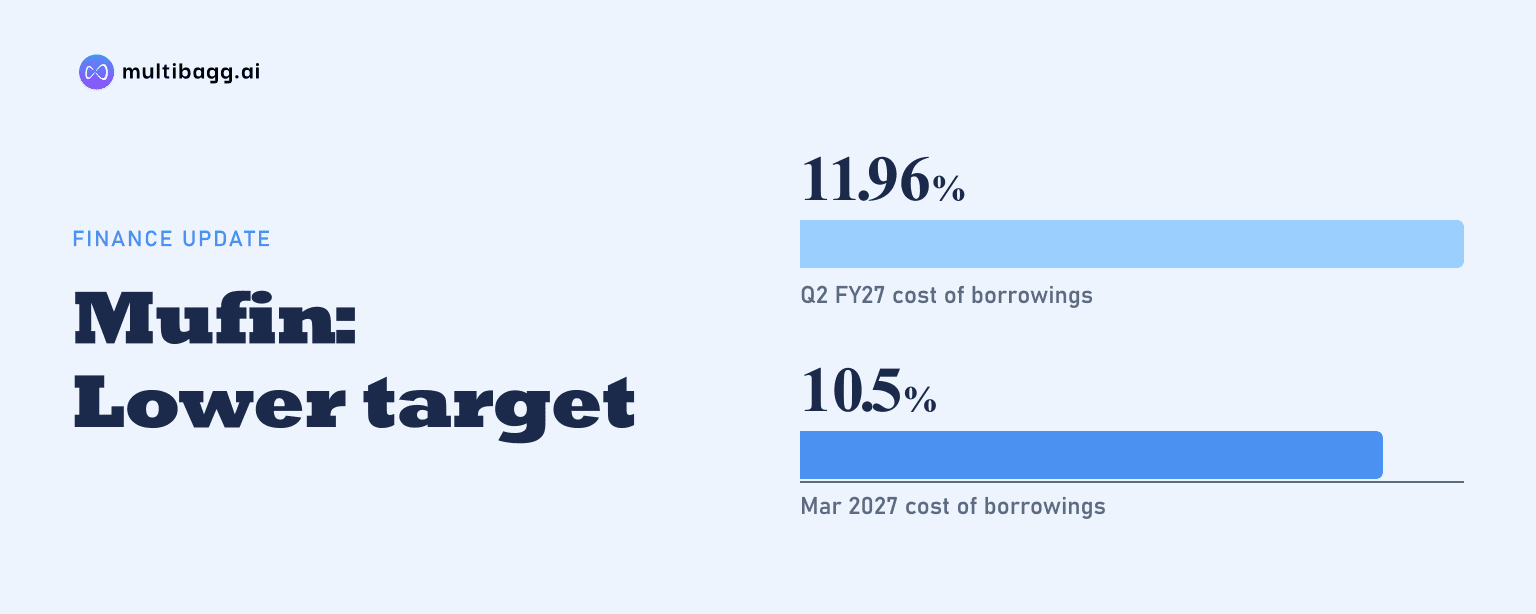
Mufin Green Finance Limited targets a 10.5% cost of borrowings by March 2027, after reporting 11.96% in Q2 FY27 ended September 2026, 116 basis points below September 2025. Mufin’s plan is based on allowing high-cost facilities to run off, adding bank lenders and increasing the role of non-convertible debentures, or NCDs.
Know Mufin Green Finance inside out
Results, valuation, peers and who's buying, in one view.
Why is Mufin targeting a 10.5% borrowing cost by March 2027?
Mufin is targeting a 10.5% cost of borrowings by March 2027, according to management’s Q2 FY27 outlook. The target is 146 basis points below the 11.96% reported in September 2026. One basis point equals one-hundredth of a percentage point, making the indicated reduction from the September level 1.46 percentage points.
Management identifies the runoff of older high-cost lines and tighter pricing from new lenders as the mechanisms for reaching the target. Mufin said its A− rating was maintained and that an upgrade to A Stable is expected. The expected upgrade is management’s view rather than a confirmed rating action, and the presentation does not quantify the amount of expensive debt yet to run off.
The presentation separately labels the March 2027 figure as a management outlook of 10.50%, while another section describes the path as taking cost below 10.5%. Mufin does not provide a numerical target lower than 10.50%, an outlook beyond March 2027, or a schedule for replacing each high-cost facility.
How has Mufin’s borrowing cost changed since September 2025?
Mufin’s reported cost of borrowings declined to 11.96% in September 2026 from 13.12% in September 2025. The 116-basis-point reduction included a 97-basis-point fall to 12.15% in March 2026, followed by a further 19-basis-point decline by September 2026. These three reported dates establish the direction of the funding-cost trend before the March 2027 target.
Mufin said one-time prepayment charges on high-cost loans pushed its Q2 FY27 cost of borrowings to 11.96%. It nevertheless stated that the underlying trend continued to decline. The presentation does not disclose the rupee value of the charges, the facilities prepaid or a borrowing-cost figure excluding the one-time expense.
The March 2027 outlook is therefore a management target, not a reported result. Its delivery depends on the pace at which old facilities run off and the rates available on replacement funding. Mufin does not disclose the pricing, maturity or security terms of those replacement facilities in the presentation.
Got a follow-up? Ask IRIS
What borrowing-mix changes support Mufin’s funding plan?
Mufin increased NCDs to 30.9% of borrowings in September 2026 from 20.2% in March 2026, a 10.7-percentage-point increase. Mufin describes this shift as deeper access to capital markets. The quarterly borrowing-mix table rounds the same NCD shares to 31% in September 2026 and 20% in March 2026.
Mufin reduced the share of non-banking financial companies, financial institutions and other lenders to 8.4% in September 2026 from 18.1% in March 2026. That was a 9.7-percentage-point decline, while development financial institutions represented 34% in September 2026 against 37% in March 2026. Public-sector banks accounted for 16%, up from 15%, and private banks represented 11%, up from 10%.
Mufin said no lender category exceeded 34% of borrowings in September 2026. Compared with March 2026, the mix had a larger NCD component and a smaller NBFCs, financial institutions and others component. The presentation does not state NCD coupon rates, investor types or maturities, so it does not quantify the direct contribution of NCDs to the 10.50% target.
How did Mufin expand lenders and borrowings in September 2026?
Mufin reported total borrowings of Rs 1,745.71 crore in September 2026, up from Rs 1,550.99 crore in June 2026. The Rs 194.72 crore increase was 12.6% quarter on quarter, while the lender count rose from more than 32 to more than 35. Mufin presents the expansion alongside the broader change in its liability mix.
The new bank facilities specifically identified for September 2026 were a Rs 24.55 crore term loan from IDBI Bank and a Rs 9.79 crore term loan from South Indian Bank. Together, these named facilities total Rs 34.34 crore. They are examples of the bank relationships cited in Mufin’s plan to secure tighter-priced funding, although their interest rates and tenors were not disclosed.
The Rs 194.72 crore increase in borrowings between June and September 2026 exceeded the Rs 34.34 crore total of the two named bank loans. The presentation therefore identifies only part of the funding behind the quarter-on-quarter borrowing increase. It does not specify whether the remainder came from NCDs, development-finance facilities, other bank loans or another funding source.
Conclusion
Mufin’s disclosed strategy combines a stated March 2027 funding-cost target with a changed borrowing mix and a wider lender base. Its cost of borrowings fell from 13.12% in September 2025 to 11.96% in September 2026, while NCDs increased from 20.2% to 30.9% of borrowings and the NBFCs, financial institutions and others category declined from 18.1% to 8.4% between March and September 2026.
The next stated milestone is management’s 10.50% outlook for March 2027. The presentation indicates that progress will depend on the runoff of costly debt, the pricing of new lenders and the expected A Stable rating upgrade, while leaving the amount of remaining high-cost debt and the terms of new facilities unresolved.