










Muthoot Capital approval rate nears 75% with in-house tools
Key highlights
- Muthoot Capital said approval rates increased from 45%-50% to above 70%, close to 75%, after in-house scorecards were introduced.
- Muthoot Capital’s AUM reached ₹3,530 crore at September-end, up 25% year on year.
- October fresh business was ₹306 crore, Muthoot Capital’s highest October and first month above ₹300 crore.
- Forward flow into NPA declined to 0.50% from 0.85% a year earlier and 0.67% in the first quarter.
powered by IRIS
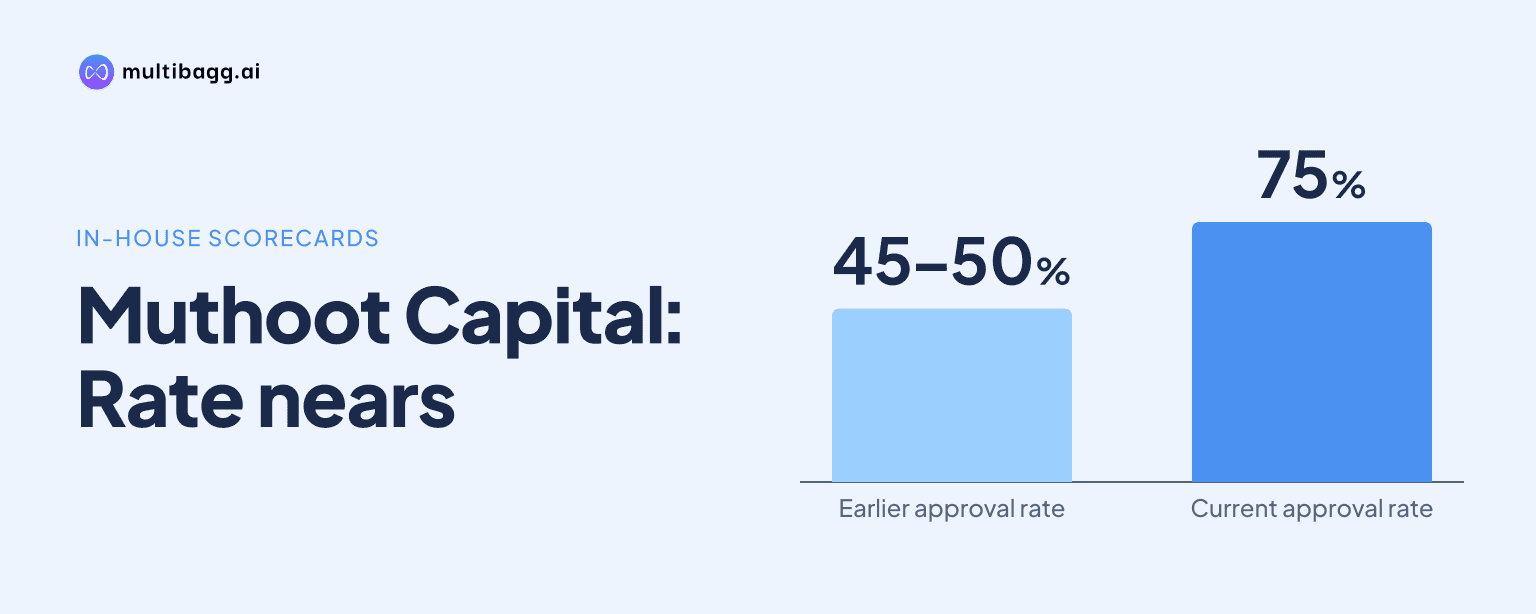
Muthoot Capital Services Limited said its in-house origination scorecard increased loan approval rates from 45%-50% to above 70% and close to 75%, as assets under management reached ₹3,530 crore at September-end. Management linked the underwriting change to recent disbursement momentum and is targeting an AUM exit near ₹4,200 crore for FY27.
Know Muthoot Capital Services inside out
Results, valuation, peers and who's buying, in one view.
How did Muthoot Capital raise approval rates to nearly 75%?
Muthoot Capital raised approval rates by bringing its two-wheeler business rules engines and scorecards in house through its data-science team. Management said approvals had previously hovered between 45% and 50%, before the new origination scorecard lifted them above 70% and closer to 75%.
The in-house system replaced a vendor-led process for policy changes. Management said a change to a business rules engine, or BRE, earlier required a vendor request, commercial discussion and internal approval, delaying its time to market. It said the internally built two-wheeler scorecards offered better risk separation than the vendor-built versions.
Management attributed higher approvals to market-share gains in recent months. October fresh business reached ₹306 crore, the company's highest October figure and its first month above ₹300 crore, even as management said overall vehicle sales fell to about 20 lakh units from about 30 lakh units in October of the prior year because festival timing differed.
Which products will receive Muthoot Capital’s in-house scorecards next?
Muthoot Capital plans to bring commercial-vehicle and used-car BREs and scorecards in house by December. The migration would extend the approach already used in two-wheelers to businesses that management is seeking to scale alongside its established two-wheeler lending operation.
Those newer segments remain smaller than two-wheelers but are expanding. Management said commercial-vehicle and construction-equipment disbursements increased by more than 100% in the first half, while used-car financing also increased significantly from a small base. At September-end, the two-wheeler standalone book was ₹2,656 crore, compared with ₹350 crore for commercial vehicles and construction equipment and ₹215 crore for used cars.
Asset-quality ratios differed between the segments. The two-wheeler book had gross non-performing assets, or GNPA, of ₹135 crore, while used cars had GNPA of about ₹4 crore and commercial vehicles and construction equipment had GNPA close to ₹3 crore. Management said cars and commercial vehicles should account for more than 50%, or close to 60%, of the overall book in the next two years.
Is Muthoot Capital’s underwriting technology supporting loan-book growth?
Muthoot Capital said the scorecard intervention is supporting disbursement momentum, although it did not quantify technology’s separate contribution to growth. Fresh business was ₹677 crore in the reported quarter, cumulative first-half disbursements exceeded ₹1,200 crore, and AUM rose 25% year on year to ₹3,530 crore at September-end.
The expansion has occurred while the company reduces co-lending. Its co-lending book declined 52% year on year to ₹382 crore from ₹791 crore after its remaining active partner arrangement closed in the first quarter. Management said the reported quarter was the first in 48 months in which all business was sourced through Muthoot Capital rather than through co-lending or co-originated partner arrangements.
The retreat from co-lending has also changed the yield mix, according to management. It said its internal two-wheeler book has historically yielded about 21.5%-22%, while the larger earlier co-lending share reduced the blended yield. Of the approximately ₹3,500 crore loan book, management identified about ₹400 crore as lower yielding and expected that amount to fall to around ₹200 crore by March through run-off.
Got a follow-up? Ask IRIS
Can Muthoot Capital reach its ₹4,200 crore FY27 AUM target?
Management said Muthoot Capital is focused on exiting FY27 with AUM near ₹4,200 crore, compared with ₹3,530 crore at September-end. It expects fresh business above ₹400 crore in November and subsequent months after October's ₹306 crore, and said the funding required for that plan had been arranged.
Borrowings were ₹3,354 crore at September-end, with an overall borrowing cost of 9.52%. During the quarter, Muthoot Capital raised ₹1,003 crore incrementally, comprising ₹400 crore of non-convertible debentures, or NCDs, ₹353 crore of pass-through certificates and securitisation, ₹200 crore of bank loans, and ₹85 crore of fresh fixed deposits.
Deposits are another funding channel in the plan. The fixed-deposit book was ₹155 crore, up about 250% year on year, following the launch of an online fixed-deposit platform early in the year. Management said its AA rating allowed nationwide deposit mobilisation after it had previously been restricted to accepting deposits in Kerala, and said the average deposit ticket was below ₹5 lakh.
What does faster approval mean for Muthoot Capital’s credit quality?
Muthoot Capital said it is using the underwriting redesign to improve risk separation rather than pursue growth without credit controls. Its GNPA ratio was 4.61% at September-end, compared with 5.76% a year earlier on a comparable basis, while net NPA was 2.75% and the provision coverage ratio was unchanged at 50% for three quarters.
Fresh stress formation declined during the reported quarter. Forward flow into NPA was 0.50% of standard AUM, compared with 0.85% in the year-earlier period and 0.67% in the first quarter. However, impairment expense was ₹21.44 crore, ₹7 crore above management's plan, which it attributed to the need to recover older NPAs even as new NPA formation reduced.
Collections remain part of the company’s risk-control process. Instalment receipts totalled ₹703 crore during the quarter, including ₹295 crore, or 42%, through bank and electronic modes and ₹285 crore, or 41%, through the National Automated Clearing House, or NACH. Management said 83% of receipts came through these non-cash routes and reiterated that it would not pursue growth at the expense of asset quality, collections, operating costs or capital efficiency.
Conclusion
Muthoot Capital’s higher approval rate is tied directly to its shift from vendor-managed underwriting tools to internally built scorecards and BREs. The change coincided with ₹677 crore of quarterly fresh business, ₹3,530 crore of September-end AUM and a 0.50% forward flow into NPA, below both the first quarter and the year-earlier period.
The next milestones are the planned December migration of used-car and commercial-vehicle scorecards, monthly fresh business above ₹400 crore, and progress toward the ₹4,200 crore FY27 AUM exit target. Management also needs to show whether recoveries from older NPAs can reduce impairment expense from ₹21.44 crore while the loan book expands.