










NATCO says pricing keeps semaglutide business unprofitable
Key highlights
- NATCO estimates its India semaglutide volume share at 5% to 6%, versus about 3% by value.
- NATCO said semaglutide is unprofitable now and does not expect near-term profits because of aggressive generic pricing.
- NATCO estimates monthly semaglutide sales of Rs 1.5 crore to Rs 2 crore, led by vials at Rs 1.2 crore to Rs 1.5 crore.
- NATCO said semaglutide contributes about Rs 6 crore to Rs 7 crore to its domestic business.
powered by IRIS
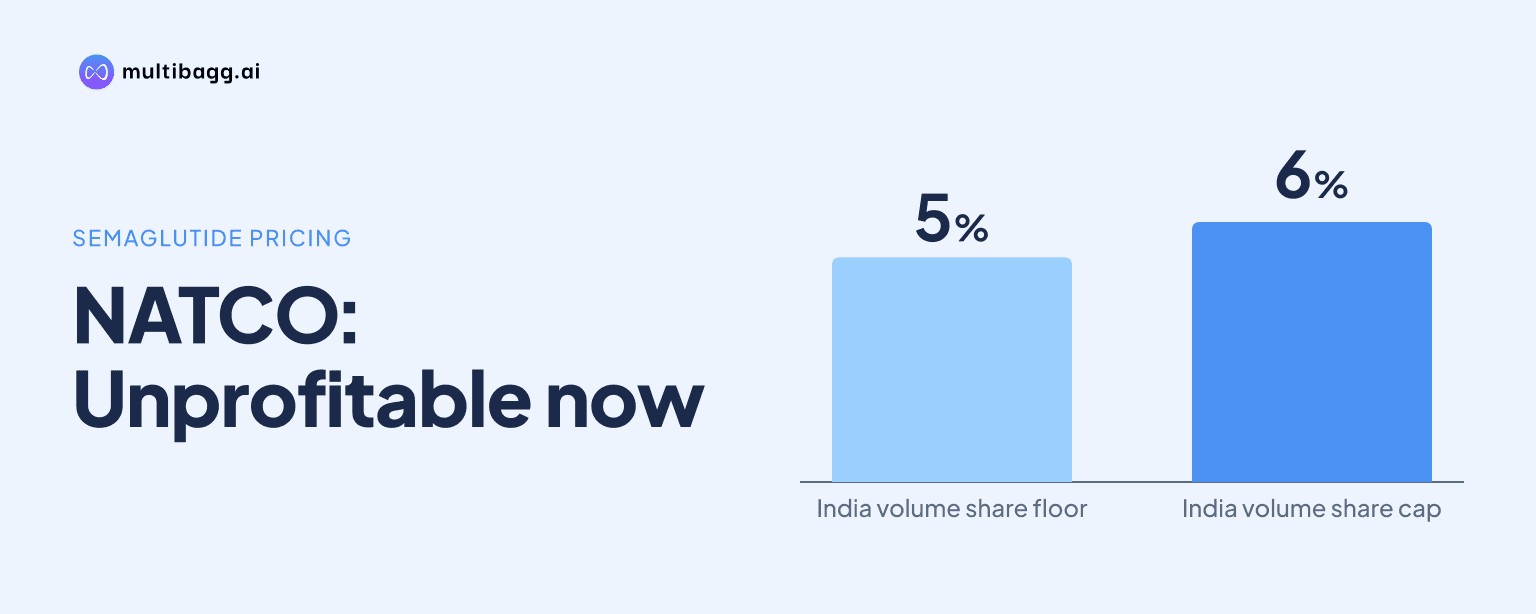
In the quarter under discussion, NATCO Pharma Limited said its India semaglutide business remained unprofitable despite an estimated 5% to 6% volume share, as generic rivals competed aggressively on price. Management said it aims to retain that share as the market expands over the next two to three years, but does not expect near-term profit.
Know Natco Pharma inside out
Results, valuation, peers and who's buying, in one view.
How much semaglutide market share has NATCO gained in India?
NATCO estimates that it has about 5% to 6% of India semaglutide volumes but only about 3% of market value. Vice Chairman and Chief Executive Officer Rajeev Nannapaneni described both measures as approximate, educated estimates rather than formally reported market-share data. The gap shows that volume participation has not translated proportionately into value share in a market where management said pricing has been poor.
NATCO's sales indicate that vials account for most semaglutide revenue and likely more of its volume. Management said the semaglutide brand generates about Rs 1.5 crore to Rs 2 crore a month, depending on the month. Pens contribute about Rs 40 lakh to Rs 50 lakh monthly, while vials contribute roughly Rs 1.2 crore to Rs 1.5 crore. NATCO said vials are cheaper than pens, which is why they generate more volume.
The split also shows that semaglutide is a meaningful but limited component of NATCO's domestic base. Management estimated the underlying domestic business at Rs 130 crore to Rs 135 crore per quarter, compared with Rs 145 crore in the quarter under discussion. The higher quarterly figure included semaglutide inventory stocking by partners that management said would not repeat.
Why is NATCO's semaglutide business unprofitable?
NATCO's semaglutide business is unprofitable because generic entrants are competing aggressively for market share through pricing. Nannapaneni said pricing has been really bad as companies seek share, and answered directly that NATCO does not currently make a profit from the product. He also said he does not see profits arriving in the near future.
The commercial issue is not a lack of market entry: NATCO has made what management called a dent and reached the estimated 5% to 6% volume share. Instead, the company is accepting current pricing pressure while seeking to preserve its market position. Management's hypothesis is that a company holding a 5% to 6% share can benefit as the overall semaglutide market grows over the next two to three years.
NATCO did not provide a patient-month realization figure or quantify the price decline following new generic entries. It therefore remains unclear from the call how much of the pressure comes from lower per-patient revenue, higher trade costs, or the mix between cheaper vials and pens. What management did disclose is that the value share, at about 3%, trails the estimated volume share of 5% to 6%.
Got a follow-up? Ask IRIS
How do vials and pens affect NATCO's semaglutide sales mix?
NATCO's vial sales exceed pen sales, with management estimating monthly vial revenue of Rs 1.2 crore to Rs 1.5 crore against pen revenue of Rs 40 lakh to Rs 50 lakh. Total brand revenue of Rs 1.5 crore to Rs 2 crore a month means the vial format supplies the majority of sales in most months. Management did not provide a percentage split, saying it could not recall that measure.
The vial format is cheaper, according to management, and NATCO linked the lower price to higher volume. That product mix is consistent with the company's estimated 5% to 6% volume share being larger than its approximately 3% value share, although NATCO did not publish format-level volumes or realizations. The call therefore establishes the direction of the mix but not the revenue or margin earned on an individual vial or pen.
Semaglutide has also contributed to the domestic business increase, even though it is not the only driver. In a separate response, management said semaglutide was contributing about Rs 6 crore to Rs 7 crore, while Risdiplam had also performed well. NATCO said its domestic base had improved by about 20%, with the quarterly underlying base now estimated at Rs 130 crore to Rs 135 crore versus about Rs 100 crore to Rs 110 crore per quarter in the prior year.
What is NATCO's strategy while semaglutide pricing remains low?
NATCO's strategy is to retain its estimated 5% to 6% semaglutide volume share until the market becomes larger, rather than expect immediate profitability. Management said this is the working hypothesis across competitors: remain in the market, preserve share, and benefit if the market expands over a two-to-three-year period. That is a management expectation, not a profit forecast.
The company is also focusing its semaglutide efforts on the United States and regulated markets rather than the rest of the world, based on the terms of its contract. NATCO said it is responding to regulatory queries on its United States filing but gave no view on approval timing or outcome. Management consequently provided no launch date, revenue estimate, or profitability target for a United States semaglutide opportunity.
Within India, NATCO is treating the current domestic run rate cautiously because of the quarter's stocking effect. The Rs 145 crore domestic result included semaglutide quantities supplied to partners that management said were not repeatable, while its normalized estimate was Rs 130 crore to Rs 135 crore. That distinction limits the extent to which the reported quarter can be used to judge sustainable domestic sales or semaglutide demand.
Conclusion
NATCO has established an estimated 5% to 6% volume position in India semaglutide, but its roughly 3% value share and management's comments on aggressive pricing explain why the business does not currently earn a profit. Vials, at Rs 1.2 crore to Rs 1.5 crore of monthly sales, lead the product mix over pens at Rs 40 lakh to Rs 50 lakh, while semaglutide remains one contributor to a domestic base that management estimates at Rs 130 crore to Rs 135 crore per quarter.
The next issue to watch is whether NATCO can retain its estimated 5% to 6% volume share as the India market develops over management's stated two-to-three-year horizon. Investors can also monitor whether the company's United States filing advances beyond the regulatory queries NATCO is answering, and whether domestic revenue remains near the Rs 130 crore to Rs 135 crore underlying quarterly base after the reported semaglutide stocking effect unwinds.