










Navneet Education Ltd Declares ₹1.50 Interim Dividend for FY26
Key highlights
- Navneet Education Ltd declared a ₹1.50 per share second interim dividend, equal to 75% of face value, for FY 2025-26.
- The record date and ex-dividend date for the ₹1.50 payout were both 3 June 2026.
- Navneet Education Ltd said the second interim dividend would be paid on or before 19 June 2026.
- The supplied three-month return data shows a 6.06% price return, 2.12% dividend return and 8.18% total return.
powered by IRIS
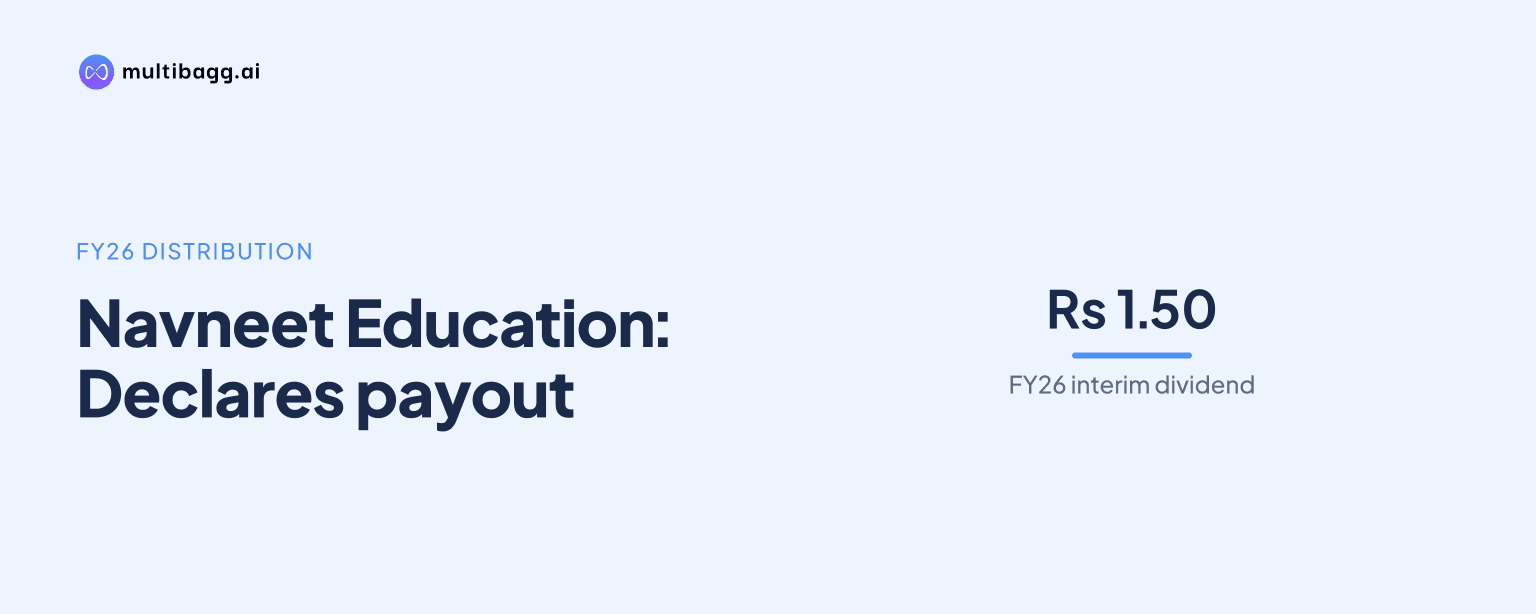
Navneet Education Ltd declared a second interim dividend of ₹1.50 per equity share for FY 2025-26, with 3 June 2026 fixed as both the record date and ex-dividend date. The 75% payout applies to shares with a face value of ₹2 each and is scheduled to be paid on or before 19 June 2026.
Know Navneet Education inside out
Results, valuation, peers and who's buying, in one view.
What dividend has Navneet Education Ltd declared?
Navneet Education Ltd declared a second interim dividend of ₹1.50 per equity share, equivalent to 75% of the ₹2 face value, for the financial year 2025-26. The company announced the dividend on 21 May 2026 following a board meeting.
The company stated that shareholders whose names appeared in the register of members, or who were recorded as beneficial owners through depositories, on Wednesday, 3 June 2026 would be eligible. This date was fixed as the record date in accordance with Regulation 42 of the SEBI Listing Obligations and Disclosure Requirements regulations.
The record date and ex-dividend date were both 3 June 2026. In practical terms, the ex-date is the date from which buyers of the share are not entitled to receive this declared dividend. Investors needed to hold the shares in the eligible form by the record-date requirement to qualify for the payment.
Navneet Education said the second interim dividend would be paid on or before 19 June 2026. The supplied company disclosure identifies the payment as an interim dividend, rather than a final dividend, and links it specifically to FY 2025-26.
What are the key dates and figures for the payout?
The key payout figure is ₹1.50 per share, while the company has described it as a 75% dividend on its ₹2 face-value equity shares. The announcement, record date, ex-date and payment deadline provide the main timeline for shareholders.
The supplied market data also lists a dividend yield of 2.39% alongside the 3 June 2026 ex-date and a share price of ₹146.88. Other data excerpts in the source material show different yield figures, reflecting differing methodologies and payout periods. The board-approved per-share dividend and the disclosed dates are the more direct reference points for this specific corporate action.
How does this compare with Navneet Education Ltd's recent dividends?
Navneet Education Ltd has made several recent distributions, including ₹1.50 per share interim and final payouts as well as a ₹2.60 final dividend in 2024. The latest declared ₹1.50 payment follows an interim dividend of the same amount with an 18 November 2025 ex-date.
The company had also recommended a final dividend of ₹1.50 per share for FY 2024-25 at its board meeting on 19 May 2025. Market-data records in the supplied material show 22 September 2025 as the ex-date for that final dividend. This is separate from the 3 June 2026 second interim dividend for FY 2025-26.
In 2024, the dividend history includes a ₹2.60 per share final dividend with an August 2024 ex-date, and a ₹1.50 per share interim dividend in November 2024. These entries indicate that payout amounts have varied by year and by dividend classification.
Got a follow-up? Ask IRIS
What does the dividend mean for Navneet Education Ltd investors?
For eligible shareholders, the declared amount translates into a cash distribution of ₹1.50 for every equity share held on the applicable record date. The corporate action is relevant to investors tracking income from holdings, while the ex-date establishes the cut-off for dividend eligibility in market transactions.
The supplied return data reports a 6.06% price return and a 2.12% dividend return over the last three months, producing a total return of 8.18% for that stated period. These figures show how a dividend can contribute to an investor's total return alongside changes in the market price of the stock.
A dividend declaration does not, by itself, establish a future payout pattern or share-price direction. The available records show that Navneet Education's dividends have been uneven across periods, with different payment amounts and interim or final classifications. Investors assessing the stock's income profile would need to distinguish between a declared dividend, historical payouts and any annualised figures published by market-data services.
How does the declaration fit into the company's dividend record?
The latest ₹1.50 declaration adds another interim distribution to Navneet Education's recorded payout history. The source material lists 34 dividends to date and notes that dividends have been paid in Indian rupees, with biannual frequency cited by one data provider.
However, the information also contains different annual dividend and yield calculations, including annualised payout figures of ₹3.00 and ₹4.50 in separate excerpts. Such variations can arise when providers use different trailing periods, include different declared payments or annualise the latest distribution. For this event, the company's disclosed ₹1.50 second interim dividend, the 3 June 2026 record date and the payment deadline are the confirmed details.
Conclusion
Navneet Education Ltd's second interim dividend of ₹1.50 per share gives eligible shareholders a 75% payout on the company's ₹2 face-value equity shares for FY 2025-26. The announcement is also part of a recent dividend record that includes ₹1.50 payouts in 2025 and a ₹2.60 final dividend in 2024, while the supplied three-month return data reports an 8.18% total return.
The next confirmed event in the disclosed timetable was payment on or before 19 June 2026. Investors should watch future board announcements for any subsequent dividend decisions and compare them with the company's actual payout history rather than relying solely on annualised dividend-yield estimates.