










Navneet says costs offset stationery revenue growth in Q2
Key highlights
- Navneet reported Q2 FY27 stationery revenue of Rs 184 crore, up 18.7% year on year.
- Domestic stationery revenue was Rs 52 crore in Q2 FY27 and rose almost 34%.
- Navneet said export discounts affected H1 FY27 profitability before reversals in June and July.
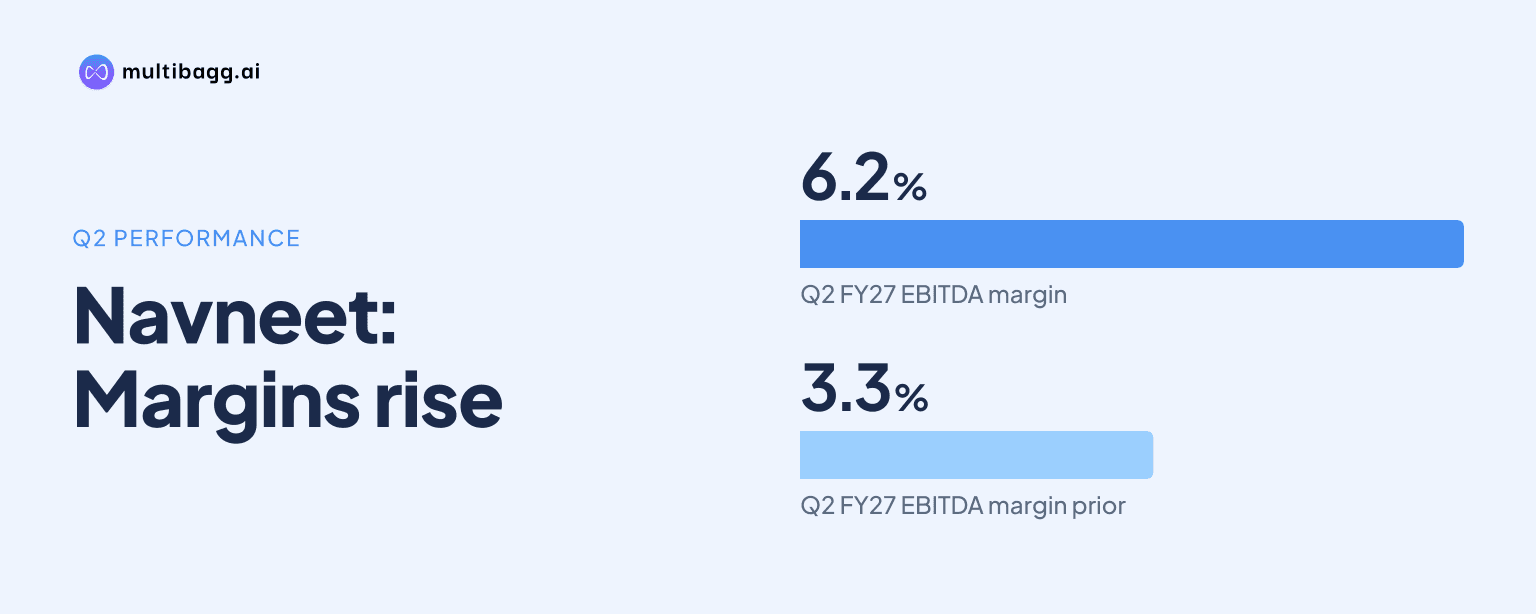
- Standalone Q2 FY27 EBITDA rose 150% to Rs 20 crore, and margin increased to 6.2% from 3.3%.
powered by IRIS
Navneet Education Limited said Q2 FY27 stationery revenue rose 18.7% year on year to Rs 184 crore, but profitability did not rise proportionately because export discounts, domestic brand and hiring expenditure, and fixed costs at a delayed plastic-products plant weighed on margins. Management said most export discounts had ended by H2 FY27.
Know Navneet Education inside out
Results, valuation, peers and who's buying, in one view.
What did Navneet report for stationery sales?
Navneet reported total stationery revenue of Rs 184 crore in Q2 FY27, representing year-on-year growth of 18.7%. Domestic stationery revenue was Rs 52 crore, up almost 34%, while export stationery revenue was Rs 132 crore. Management attributed domestic growth to deeper market penetration and additions across its paper and non-paper stationery range.
Stationery contributed more than half of Navneet's Q2 FY27 consolidated operational revenue of Rs 324 crore. Publication revenue was Rs 140 crore, up 53.8% year on year partly because revenue spilled over from Q1. The comparison shows that both principal segments increased sales, but the sources of profitability differed because stationery carried expansion-related costs.
Why are Navneet's domestic stationery margins under pressure?
Navneet said domestic stationery margins were under pressure because spending on branding and senior manpower came before a full revenue contribution from non-paper stationery products. Management said it plans to spend more on brand-building for at least the next two years as it seeks to expand beyond paper-based stationery and support pricing through a stronger brand.
The company said it had not introduced a new product category in India during the preceding six months, but launched at least 70 items within existing paper and non-paper categories. Management said most of these items were gaining market acceptance and supported growth in domestic stationery revenue, even as marketing, initial business costs and additional manpower reduced near-term profitability.
How did export discounts affect Navneet's profitability?
Navneet said export profitability was reduced in H1 FY27 because it granted additional discounts after United States tariffs were introduced. Although export stationery revenue reached Rs 132 crore in Q2 FY27, management said many shipments had already been made at discounted prices before those discounts were reversed in June and July.
Management described the discounting as the first such reduction in agreed export prices in Navneet's 30-year history. It said most additional discounts had been discontinued and expected products to be sold at agreed prices from H2 FY27, which management said should improve profitability. This is an expectation disclosed by management, rather than a quantified stationery-margin forecast.
What supports Navneet's export recovery outlook?
Navneet said its improved export outlook reflects a broader product offering rather than faster demand in existing categories alone. Management said it spent the prior three to four months developing additional categories and products, then began presenting them to customers. It said new orders were mainly being finalised in October and November.
The company also said the current 10% tariff applies across countries and products and, in management's view, does not specifically disadvantage Indian goods. Management had previously identified slower offtake from United States retail shelves as a challenge, but said new product presentations and lower tariff uncertainty had increased its confidence in a near-term U-shaped export recovery.
Got a follow-up? Ask IRIS
What was the impact of Navneet's plastic-products plant?
Navneet said depreciation and fixed costs from a new plastic-products plant reduced stationery profitability because the facility's sales ramp-up was delayed. The plant had been established in anticipation of larger orders from existing markets, but management said higher raw-material prices during tariff-related disruption and war conditions made customers reluctant to place orders.
The delayed ramp-up created a timing mismatch: plant costs were incurred before planned order volumes materialised. Management grouped the plant's depreciation and fixed costs with export discounts, domestic branding and senior hiring as the principal reasons why higher Q2 FY27 stationery revenue did not translate into proportional profitability. It did not disclose plant utilisation, a revenue target or a date for the plant to reach expected volumes.
Did Navneet give a FY27 stationery margin target?
No, Navneet did not provide a FY27 stationery-margin target, a segment margin figure or guidance for a decline of about two percentage points in the supplied Q2 FY27 call. Management explained the costs affecting stationery profitability and said export pricing should improve from H2 FY27, but it did not quantify the expected benefit.
Navneet did report company-level earnings before interest, tax, depreciation and amortisation, or EBITDA, for Q2 FY27. Standalone EBITDA rose 150% to Rs 20 crore and the margin increased to 6.2% from 3.3% a year earlier. Consolidated EBITDA was Rs 11 crore, with the margin rising to 3.4% from 0.4%, figures that include businesses beyond stationery.
Conclusion
Navneet's Q2 FY27 results show that sales growth alone did not determine stationery profitability. Stationery revenue increased 18.7% to Rs 184 crore, including almost 34% domestic growth, while export discounts through June and July, brand investment, senior hiring and under-absorbed plant costs offset part of the sales benefit. Meanwhile, standalone EBITDA rose to Rs 20 crore from the prior-year period.
The next disclosures to watch are whether export orders being finalised in October and November translate into higher sales at agreed prices in H2 FY27, and whether the 70-plus recently introduced stationery items absorb branding and manpower costs. Management's plan to continue domestic brand spending for at least two years and the unresolved sales ramp-up at the plastic-products plant remain relevant to future stationery profitability.