










Navneet says higher grades may expand publishing revenue
Key highlights
- Navneet expects the curriculum-change cycle begun in FY26 to continue for the next two financial years.
- H1 FY27 publication revenue rose 6.7% to Rs 544 crore from Rs 510 crore.
- Q2 FY27 publication revenue rose 53.8% to Rs 140 crore, with management citing Q1 revenue spillover.
- H1 FY27 EBITDA margin declined to 20.2% from 23.0% a year earlier.
powered by IRIS
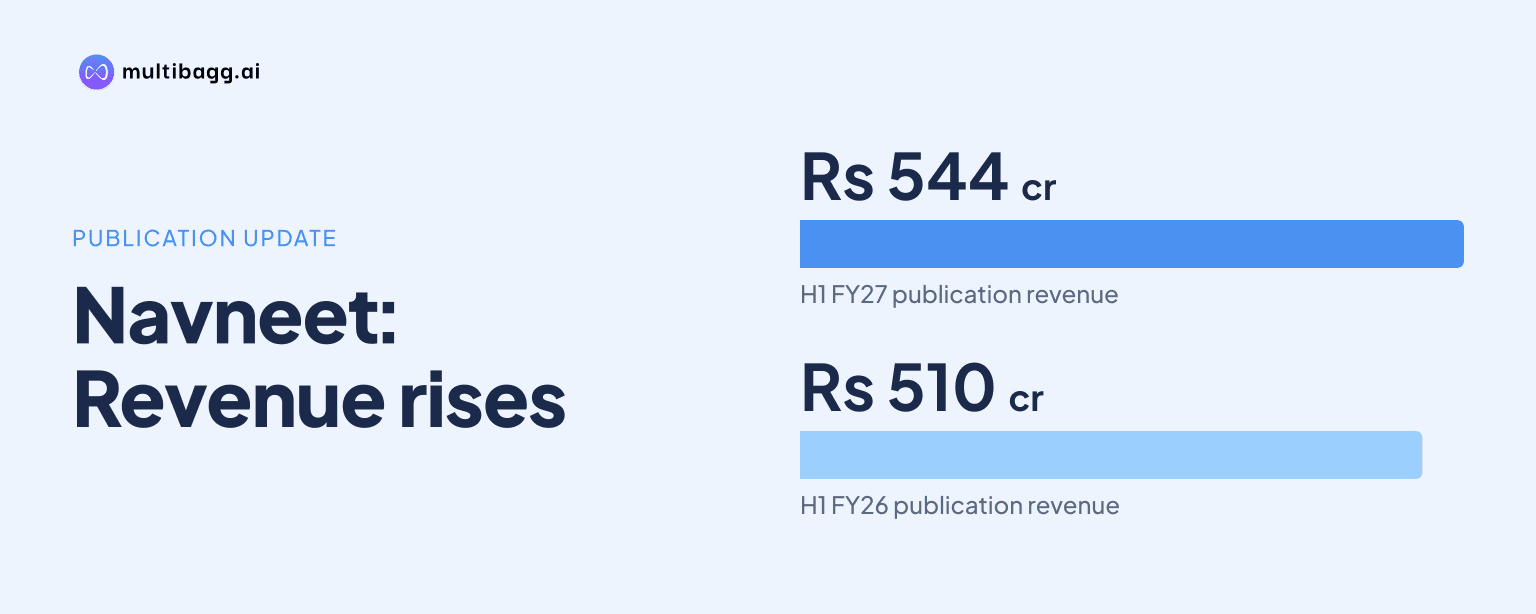
Navneet Education Limited said higher school grades are expected to enter the curriculum-change cycle over the next two financial years and carry a larger revenue share than lower grades already revised. The outlook follows 6.7% growth in H1 FY27 publication revenue, which reached Rs 544 crore from Rs 510 crore in H1 FY26.
Know Navneet Education inside out
Results, valuation, peers and who's buying, in one view.
Why does Navneet expect higher grades to expand publishing revenue?
Navneet expects higher grades to enter the curriculum-change cycle during the next two financial years, after lower grades changed in FY26 and FY27. Managing Director Gnanesh (Sunil) Gala said higher grades contribute a higher revenue share than lower grades, making their anticipated revision the publishing catalyst identified in the Q2 FY27 commentary.
The presentation does not identify the individual grades due for revision, give dates within the two-financial-year period, or quantify the associated revenue opportunity. Management’s statement is therefore an outlook rather than numerical guidance, based on a transition from lower grades revised in FY26 and FY27 to higher grades with a larger stated revenue contribution.
Publication revenue provides the reported base for that outlook. Navneet recorded Rs 544 crore of publication revenue in H1 FY27, up Rs 34 crore from Rs 510 crore in H1 FY26. In Q2 FY27, publication revenue rose 53.8% to Rs 140 crore from Rs 91 crore, although management said this increase was mainly due to revenue spilling over from Q1 into Q2.
How did Navneet's publication revenue compare with stationery revenue?
Navneet's publication revenue rose in both Q2 and H1 FY27, while domestic stationery increased across both periods and export stationery declined for the half year. Publications increased by Rs 49 crore in Q2 FY27 and Rs 34 crore in H1 FY27, whereas export stationery rose in the quarter but was lower year on year over six months.
Domestic stationery increased by Rs 44 crore to Rs 198 crore in H1 FY27 from Rs 154 crore in H1 FY26. Export stationery, in contrast, fell by Rs 7 crore to Rs 366 crore during H1 FY27 from Rs 373 crore, despite its Q2 FY27 revenue rising by Rs 15 crore to Rs 132 crore.
Navneet's revenue from operations was Rs 1,109 crore in H1 FY27, compared with Rs 1,038 crore in H1 FY26, an increase of Rs 71 crore. Q2 FY27 revenue rose 31.7% to Rs 324 crore from Rs 246 crore, but the presentation does not disclose how much of reported publication revenue came specifically from lower-grade curriculum changes.
Got a follow-up? Ask IRIS
What happened to Navneet's profitability in H1 FY27?
Navneet's H1 FY27 revenue increased, but its earnings before interest, tax, depreciation and amortisation, or EBITDA, and profit before tax, or PBT, were below the prior-year period. EBITDA was Rs 224 crore in H1 FY27 versus Rs 239 crore in H1 FY26, while EBITDA margin declined to 20.2% from 23.0%.
PBT was Rs 203 crore in H1 FY27, compared with Rs 208 crore a year earlier, and PBT margin decreased to 18.3% from 20.0%. H1 FY27 PBT included a Rs 10 crore reversal of provision for leave encashment following a change in wage definition, a Rs 2.3 crore net fair-value gain on K12 by NLLP, and Rs 5 crore of fair value related to CP Capital and Career Point Edutech investments.
Q2 profitability moved higher from the year-earlier quarter. Q2 FY27 EBITDA was Rs 20 crore against Rs 8 crore in Q2 FY26, lifting the EBITDA margin to 6.2% from 3.3%. Q2 FY27 PBT was Rs 3 crore, compared with a Rs 8 crore loss a year earlier, and included a Rs 2.3 crore net fair-value gain on K12 by NLLP and Rs 0.5 crore of fair value related to CP Capital and Career Point Edutech.
What other factors could affect Navneet during the curriculum cycle?
Navneet said domestic stationery should continue to grow through branding and non-paper stationery, while export recovery remains conditional on external conditions. Domestic stationery revenue increased 34.2% in Q2 FY27 to Rs 52 crore from Rs 38 crore and reached Rs 198 crore in H1 FY27, compared with Rs 154 crore in H1 FY26.
Management said it plans to penetrate markets more aggressively with customer-centric products in domestic stationery. This is a disclosed strategy rather than a revenue forecast. Domestic stationery was smaller than export stationery in H1 FY27, at Rs 198 crore versus Rs 366 crore, but domestic revenue rose Rs 44 crore while export revenue fell Rs 7 crore year on year.
Export stationery generated Rs 132 crore in Q2 FY27, up 13.6% from Rs 117 crore, but H1 FY27 revenue was Rs 366 crore versus Rs 373 crore in H1 FY26. Management said exports have shown signs of revival and could see a U-shaped recovery in the near term if supply-chain disruptions, geopolitical challenges and weakening global demand become more favourable for exporters.
Working-capital measures also changed between September 2025 and September 2026. Receivable days increased to 55 from 52, while finished-goods inventory days rose to 97 from 88. Raw-material inventory days declined to 71 from 84.
Conclusion
Navneet identifies the next two financial years as a continuation of the curriculum-change cycle that began in FY26, with higher grades expected to carry a larger revenue share than lower grades revised in FY26 and FY27. The reported publication base was Rs 544 crore in H1 FY27, up 6.7%, while Q2 publication growth to Rs 140 crore was affected by Q1 revenue spillover.
The next results may indicate whether higher-grade revisions occur within management's stated timeframe and how they affect publication revenue and margins. Other disclosed factors to watch are the domestic stationery branding and non-paper product plan, the conditions attached to an export recovery, and working-capital measures after finished-goods inventory days reached 97 in September 2026.