










Nazara to seek non-gaming exits while integrating Bluetile
Key highlights
- Gaming generated 82% of Nazara’s Q2 revenue and 100% of EBITDA before corporate costs.
- Nazara said Bluetile and BestPlay currently generate roughly 95% to 96% of revenue from in-app advertising.
- The Bluetile and BestPlay transaction is valued at about US$30.3 crore, with US$8.55 crore paid and approximately US$10 crore of debt under discussion.
- Fusebox had four intellectual properties and around seven seasons planned for 2026, with four seasons already delivered.
powered by IRIS
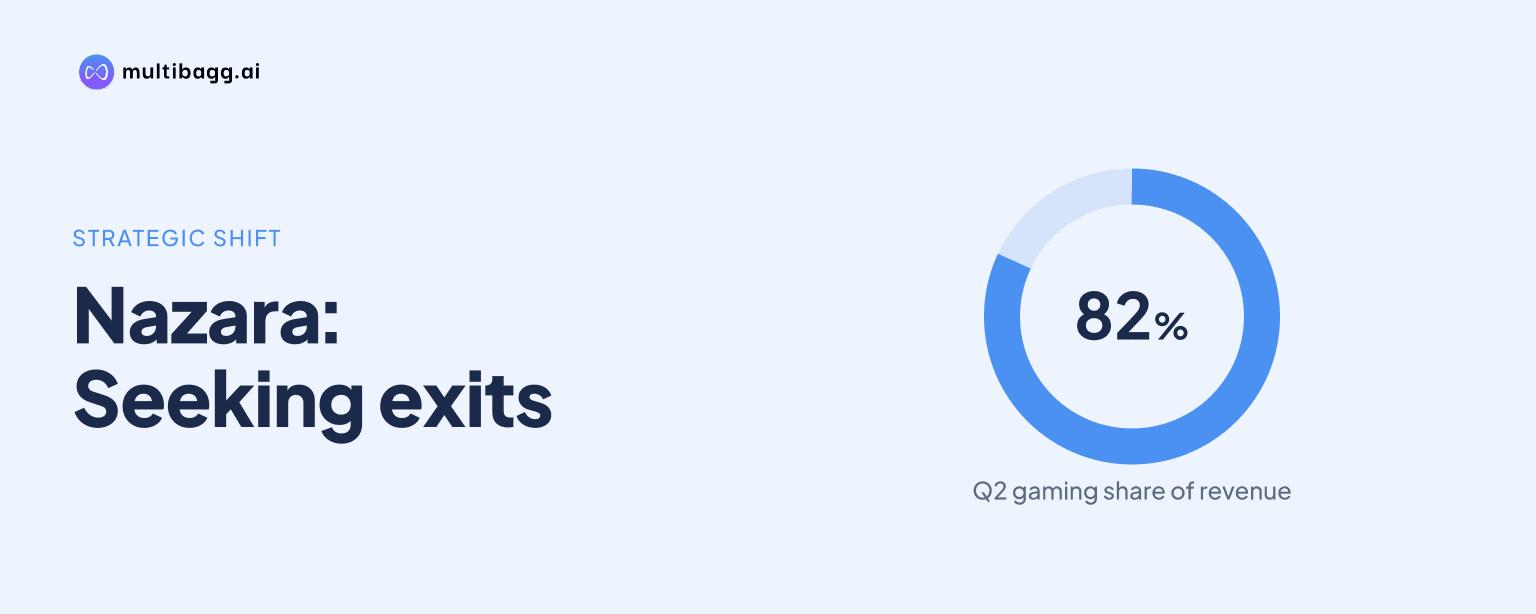
Nazara has made gaming its core business after the segment generated 82% of Q2 revenue and 100% of earnings before interest, tax, depreciation and amortisation, or EBITDA, before corporate costs. Management said it will integrate Bluetile, build central gaming capabilities and consider exits from profitable non-gaming businesses when suitable valuations and buyers emerge.
Know Nazara Technologies inside out
Results, valuation, peers and who's buying, in one view.
Why is Nazara considering exits from non-gaming businesses?
Nazara is considering strategic exits because gaming now accounts for the overwhelming share of the group’s operating contribution. Raymond Stauffer described gaming as having three pillars: mobile, PC and console, and offline gaming. He said the global gaming total addressable market exceeds US$20,000 crore, while non-gaming businesses represent only a minor share of group revenue and EBITDA.
The Q2 mix is the clearest measure of the stated priority: gaming supplied 82% of revenue and 100% of EBITDA before corporate costs. Mithun Sacheti also said gaming represented about 80% of the business, though that statement was not presented as the same revenue measure. Nazara’s management therefore framed the portfolio plan as a move to concentrate resources on the gaming platform rather than a decision to close every non-gaming operation.
Arun Agarwal said Nazara wants to “double down” on gaming and will deconsolidate non-gaming activities while monetising them over time. No sale agreement, buyer, valuation or asset-specific timetable was disclosed on the call. The company’s immediate task is instead to complete Bluetile integration and establish a new centre of excellence, or COE, for shared group capabilities.
Will Nazara sell its non-gaming assets under pressure?
No, management said Nazara does not face a need for a distressed sale. Anupriya Sinha Das said the non-gaming businesses are profitable in their own right and that the company would seek the right value and the right home before monetising them. She also said there was no hard internal deadline for a disposal.
That approach matters because the company is also completing the Bluetile and BestPlay acquisition. Management put the transaction value at about US$30.3 crore, of which US$8.55 crore had already been paid. It said the US$7.7 crore payment due in October had been funded through a share issuance, while it was in discussions with multiple bankers on approximately US$10 crore of debt.
Management said the remaining consideration would be funded through internal accruals, after the October payment and the planned debt. It did not say that proceeds from a non-gaming disposal were needed to fund the acquisition. Das instead described a potential sale as an opportunity to strengthen the balance sheet if Nazara receives an appropriate offer, separating the disposal process from the stated acquisition-financing plan.
How will Nazara integrate Bluetile into its gaming platform?
Nazara’s near-term inorganic priority is Bluetile integration and the transition of the new COE. Stauffer said the company continues to assess merger and acquisition, or M&A, opportunities, but is not aggressively pursuing new deals while this internal work is under way. Any future target would need to fit the gaming thesis and either benefit from Nazara’s central platform or add capabilities to it.
The intended model is a two-way exchange of operating tools and practices. Management said Bluetile and BestPlay will receive information and capabilities from other Nazara teams, while their own methods can be adopted elsewhere in the group. This is the mechanism behind management’s stated focus on qualitative year-on-year growth rather than a specific revenue-growth forecast for the two businesses.
Bluetile and BestPlay currently derive roughly 95% to 96% of revenue from in-app advertising, with the balance from in-app purchases. Management expects the mix to change as it releases more games that rely more heavily on in-app purchases. Wildoku, launched around two to three weeks before the call, was in technical testing, and management said it expected to assess its results shortly.
Got a follow-up? Ask IRIS
What does Nazara’s gaming portfolio strategy involve?
Nazara’s strategy is to diversify across game genres, user groups and the expected lifespan of intellectual property, or IP. Management cited Human: Fall Flat, a Curve IP that marked its 10th anniversary, and Animal Jam as examples of longer-lived games. It contrasted such titles with shorter-cycle games where users may churn faster, without giving a portfolio-wide retention target.
Management said it considers the expected life of an IP, a game and, where applicable, a game engine when assessing an acquisition. Fusebox was presented as an example of this approach: Nazara acquired a game engine that had begun with one IP, then added further IP and plans to diversify it further. The strategy therefore places value on the underlying content-production system as well as any individual game licence.
Fusebox had four IPs and around seven seasons planned for 2026, according to management. Four seasons had already been delivered, while Big Brother and a new season of Traitors were live or being launched, alongside Love Island. Management said early Traitors cohorts showed payer retention about three times Love Island’s cohorts, but stressed that the data was early and that marketing would need to expand to reach suitable audiences.
How is Nazara deciding where to invest in new games?
Nazara says it will scale user-acquisition spending and capital only when game data meets its internal thresholds. At WildWorks, management said the Animal Jam release on Roblox did not generate traction that met its bar, so the game was shelved for now. The decision illustrates the company’s stated use of performance data rather than a commitment to scale every product launch.
Go Slinky Go! remained in soft launch because early retention metrics were not sufficient to support wider investment. Management said iterations and new features were planned through October and November, after which it would scale the title only if key performance indicators, or KPIs, passed its green-light gates. It did not disclose the retention level or the numerical thresholds required.
The same discipline applies to marketing timing. Stauffer called August the worst month of the year for mobile-gaming seasonality and said teams adjust marketing allocation accordingly. Fusebox may experience temporary revenue dips depending on content-season timing, management said, but it plans to increase user-acquisition and content investment when data supports profitable growth.
Conclusion
Nazara’s portfolio direction is clear: gaming is the core activity because it accounted for 82% of Q2 revenue and all EBITDA before corporate costs. The company plans to retain profitable non-gaming assets until it can monetise them at an acceptable value, while directing management attention toward Bluetile, shared gaming capabilities and a diversified portfolio of games and IP.
The next developments to watch are the completion of Bluetile integration, the proposed approximately US$10 crore debt raise and any disclosure when discussions on non-gaming assets become material enough to communicate. Management also identified product milestones: Go Slinky Go! is being iterated through October and November, while Fusebox has around seven seasons planned for 2026.