










Natural Capsules Limited begins steroidal API production
Key highlights
- NCL started commercial production of large-volume steroidal API batches in March 2026.
- NCL expects about Rs 67 crore of PLI incentives over six years for three products.
- The Tumkur steroidal API facility spans 5 acres and is designed for zero liquid discharge.
- NCL spent Rs 1.60 crore on R&D in FY26 and reports a 27-member R&D team.
powered by IRIS
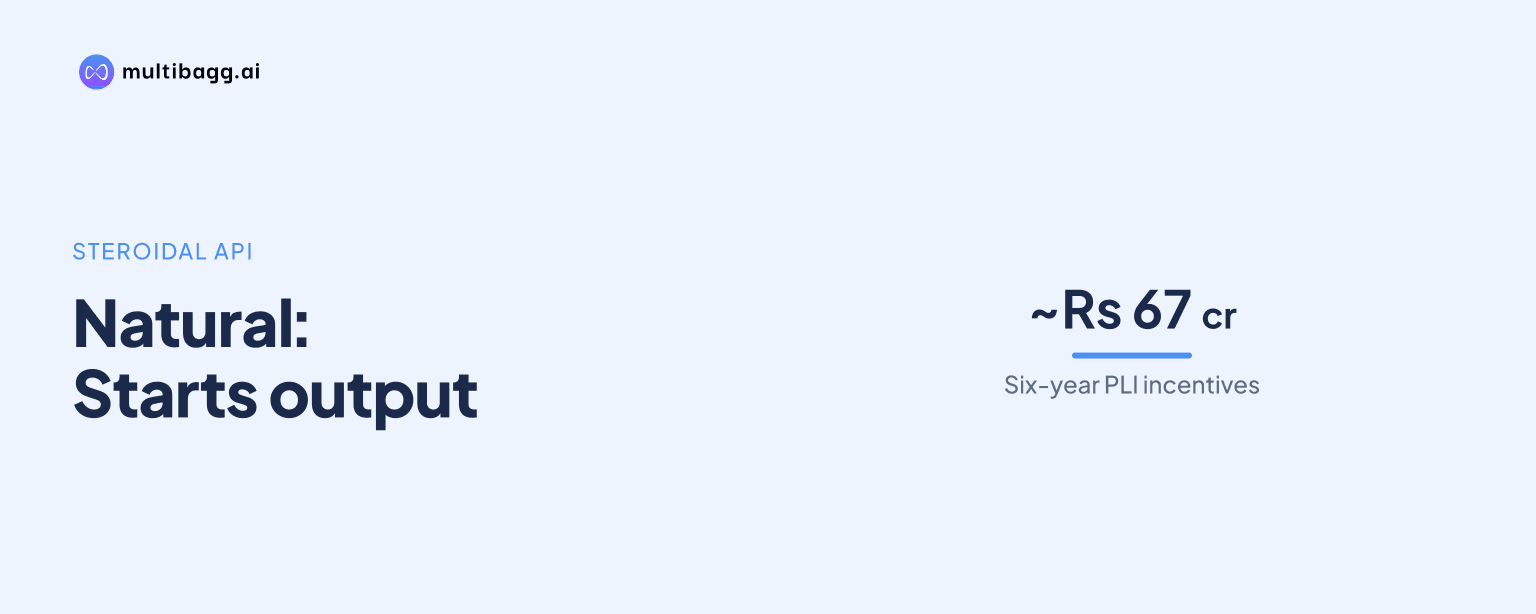
Natural Capsules Limited began commercial production of large-volume steroidal active pharmaceutical ingredient (API) batches in March 2026, after a development programme that started in 2018. NCL expects about Rs 67 crore in Production Linked Incentive (PLI) payments over six years for three fermentation-based products, although it has not disclosed API sales, volumes or revenue from the new operation.
Know Natural Capsules inside out
Results, valuation, peers and who's buying, in one view.
Has NCL started commercial steroidal API production?
Yes, NCL says commercial production of large-volume steroidal API batches began in March 2026. The activity is conducted through Natural Biogenex Private Limited, NCL’s subsidiary incorporated in 2020, rather than through its established hard-capsule segment. The presentation does not state the volume produced, capacity available, customer base, sales value or revenue contribution from the March 2026 start.
The commercial milestone followed an eight-year development path. NCL started an R&D centre in August 2018 to validate fermentation and synthesis technology using a unique microbe, achieved laboratory-scale hydrocortisone production from 9OHAD in July 2019, and began a second fermentation process for Prednisolone in the same month. It filed a patent for an innovative 9OHAD manufacturing process in October 2019 and obtained test drug licences for steroidal APIs in August 2020.
In February 2021, NCL was awarded three PLI applications covering Dexamethasone, Betamethasone and Prednisolone. The sequence moved from laboratory work and process development to large-volume commercial batches, but the presentation gives no period-by-period API production data. It also does not distinguish whether the March 2026 batches were sold, used for customer qualification, or retained as inventory.
Which steroidal APIs will NCL manufacture?
NCL identifies Hydrocortisone, Prednisolone, Betamethasone, Dexamethasone and their derivatives as the steroidal APIs planned for manufacture. The greenfield facility is at Tumkur and extends across 5 acres. NCL describes it as India’s first integrated steroidal API facility to use a chain of fermentation and synthesis reactions.
The Tumkur facility is described as a zero-liquid-discharge manufacturing site and is being set up in compliance with World Health Organization Good Manufacturing Practice (WHO GMP), US Food and Drug Administration (USFDA) and European Union Good Manufacturing Practice (EU GMP) certification guidelines. This wording describes the standards guiding the project and does not say the facility has received WHO GMP, USFDA or EU GMP certification.
NCL’s disclosed process work included improvements in August 2020 related to effluent and de-foaming agents. Its R&D programme also covers new products in steroidal and hormonal APIs, process changes to improve yields, and new manufacturing processes for existing products. The company reports two Department of Scientific and Industrial Research-recognised R&D facilities, 27 team members focused on product innovation and yield efficiency, two granted patents and three patents under filing.
What does NCL’s Rs 67 crore PLI expectation cover?
NCL expects about Rs 67 crore in PLI incentives over six years for Dexamethasone, Betamethasone and Prednisolone. These three products fall within the fermentation-based niche key starting materials, drug intermediates and APIs category under the Government of India scheme. NCL received its three PLI application awards in February 2021.
The Government of India approved the PLI scheme on March 20, 2020 to promote domestic production of critical key starting materials, drug intermediates and APIs. According to the presentation, a Department of Pharmaceuticals drug-security committee identified 53 APIs for which India was heavily dependent on imports. The scheme covers 41 products in four target segments, while NCL’s three selected products are in the second category.
For fermentation-based products, the presentation specifies an incentive of 20% on eligible sales from FY25 to FY28, 15% in the year shown as FY29, and 10% in FY30. NCL says it expects the incentive over six years, but it does not disclose the eligible-sales forecast, project cost, incentive amount received to date, or timing of individual payments. The Rs 67 crore figure is therefore management’s expectation rather than a reported receipt.
Got a follow-up? Ask IRIS
How does API development compare with NCL’s R&D spending and financial results?
NCL spent Rs 1.60 crore on R&D in FY26, unchanged from FY25 and lower than Rs 2.88 crore in FY23. R&D spending was Rs 2.12 crore in FY22, Rs 2.08 crore in FY24 and Rs 1.60 crore in FY25. R&D spending as a share of revenue declined from 1.67% in FY23 to 0.95% in FY25; the presentation does not provide the FY26 percentage.
The start of commercial API batches coincided with a change in consolidated earnings. Revenue from operations rose by Rs 17.99 crore to Rs 187.20 crore in FY26 from Rs 169.21 crore in FY25. However, earnings before interest, tax, depreciation and amortisation (EBITDA), excluding other income, changed from a profit of Rs 17.52 crore in FY25 to a loss of Rs 1.56 crore in FY26, while interest cost rose by Rs 8.02 crore to Rs 17.14 crore.
Net profit after tax moved from Rs 0.62 crore in FY25 to a loss of Rs 24.66 crore in FY26, and total equity declined from Rs 257.16 crore to Rs 234.72 crore. Total assets nevertheless increased from Rs 419.35 crore in FY25 to Rs 424.16 crore in FY26. The presentation does not attribute these financial movements to the API project, nor does it report separate API-segment revenue, operating costs, capital expenditure or profitability.
What regulated-market approvals has NCL disclosed for its API facility?
NCL has disclosed test drug licences for steroidal APIs obtained in August 2020, while stating that the Tumkur facility is being set up to WHO GMP, USFDA and EU GMP certification guidelines. The presentation does not state that NCL has secured manufacturing approval, inspection clearance, certification or product registration from the WHO, USFDA or European Union authorities.
The distinction matters because the presentation separately identifies commercial production in March 2026 and the facility’s certification-guideline alignment. NCL has reported the production start, three PLI application awards and test drug licences, but has not disclosed a date for regulated-market certification or approval. It also does not identify any regulated-market customers, product filings, export sales or customer audit outcomes for the API venture.
Conclusion
NCL has moved its steroidal API programme from laboratory validation and process development into commercial large-volume production. The project combines a Tumkur greenfield site, fermentation and synthesis processes, four named steroidal API molecules and three PLI-selected products. Its commercial outcome cannot yet be measured from the presentation because NCL has not reported standalone API sales, volumes, margins or customer approvals.
The next disclosed milestones to watch are the ramp-up of large-volume batches, progress toward WHO GMP, USFDA and EU GMP certification guidelines, and eligible sales that could support PLI payments through FY30. NCL’s expected Rs 67 crore incentive depends on the scheme’s six-year sales-linked structure, while the timing of approvals, payments and regulated-market revenue remains unresolved in the presentation.