










NGL Fine-Chem Limited says Phase II ramp-up will pressure margins
Key highlights
- NGL Fine-Chem expects Phase II utilisation to reach 30% to 40% over the next two to three quarters.
- NGL Fine-Chem reported Q2FY27 revenue from operations of Rs 158.71 crore, up 31.97% year on year.
- NGL Fine-Chem reported Q2FY27 EBITDA of Rs 28.06 crore and an EBITDA margin of 17.68%.
- NGL Fine-Chem disclosed Rs 220.72 crore of capex for its Tarapur greenfield expansion.
powered by IRIS
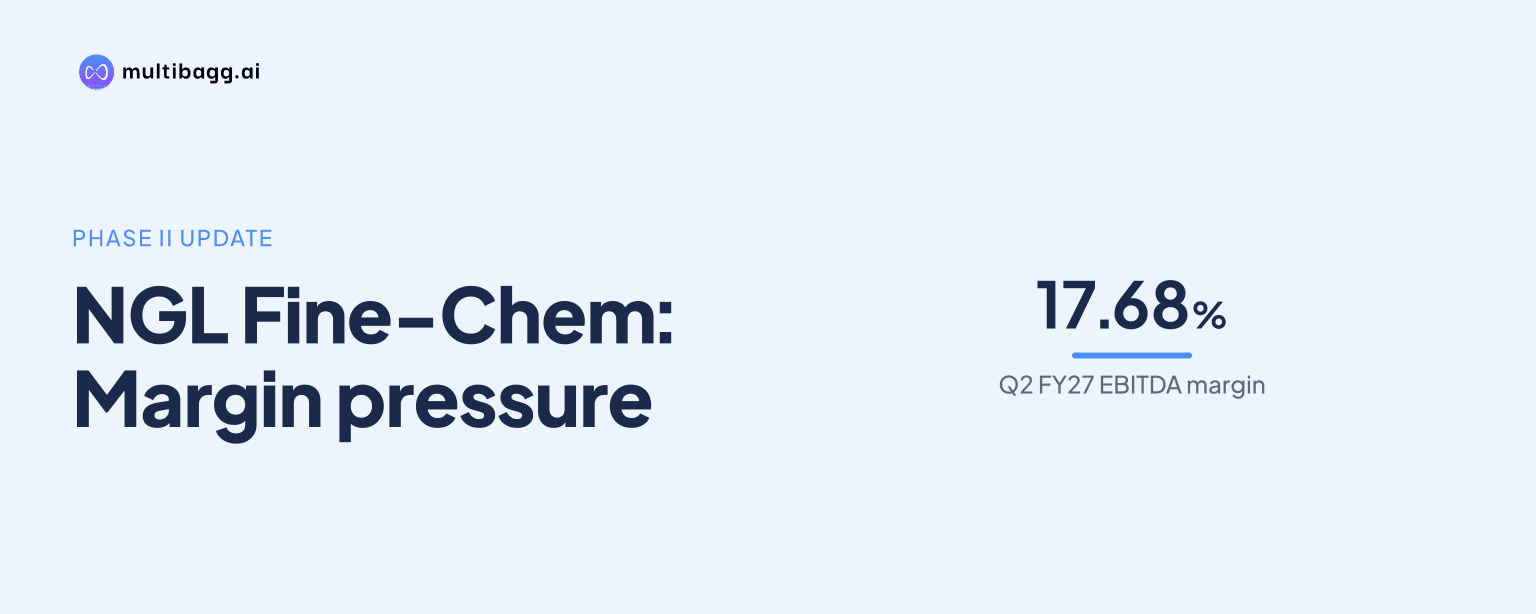
NGL Fine-Chem Limited says its commissioned and fully staffed Phase II facility will pressure margins over the next few quarters as employee, interest and depreciation costs enter the profit and loss statement before utilisation reaches management’s expected 30% to 40% level in two to three quarters.
Know NGL Fine Chem inside out
Results, valuation, peers and who's buying, in one view.
Why will NGL Fine-Chem's Phase II plant pressure margins?
NGL Fine-Chem says Phase II will pressure margins because the facility has been commissioned and fully staffed, causing employee expenses, interest and depreciation to start flowing through the profit and loss statement before output reaches 30% to 40% utilisation. Management expects that level of utilisation over the next two to three quarters.
Management said absolute profit should nevertheless rise as volumes from the new plant increase. It expects consolidated profitability to improve once the facility reaches optimum utilisation, but the presentation does not quantify optimum utilisation or provide a margin target. The near-term use of the capacity is in unregulated markets, while the company builds the facility’s regulatory credentials.
The company has started transferring European registrations to the new plant and expects to complete the process by the end of 2027. In the United States, NGL Fine-Chem has filed Veterinary Master Files for nine products; management expects its customer to complete related filings by December 2026, paving the way for a United States Food and Drug Administration inspection.
How did NGL Fine-Chem perform in Q2FY27?
NGL Fine-Chem reported revenue from operations of Rs 158.71 crore in Q2FY27, up 14.05% from Rs 139.16 crore in Q1FY27 and 31.97% from Rs 120.26 crore in Q2FY26. Management attributed the growth to volumes and said demand was robust across product segments and geographies.
Earnings before interest, tax, depreciation and amortisation, or EBITDA, rose 20.48% sequentially to Rs 28.06 crore, and the EBITDA margin increased to 17.68% from 16.73%. Profit after tax, or PAT, fell 11.68% sequentially to Rs 16.25 crore from Rs 18.40 crore despite the revenue increase.
Depreciation and amortisation expense increased 24.76% quarter on quarter to Rs 6.55 crore, while finance cost rose 13.13% to Rs 1.12 crore. The year-on-year comparison was different: EBITDA increased 63.52% from Rs 17.16 crore and PAT rose 68.74% from Rs 9.63 crore in Q2FY26.
Got a follow-up? Ask IRIS
What does NGL Fine-Chem's financial position show about expansion?
NGL Fine-Chem’s net block, the carrying value of fixed assets after depreciation, rose to Rs 285.70 crore in H1FY27 from Rs 164.09 crore in FY26. The increase coincided with capital additions as the company commissioned Phase II, though the presentation does not assign the full Rs 121.61 crore movement in net block to that facility.
The company separately disclosed Rs 220.72 crore of capital expenditure for a greenfield expansion at Tarapur, funded through debt and internal accruals. It said the expansion provides capacity to meet demand for pipeline products, but it did not state that the Tarapur greenfield project is the same project as Phase II.
Long-term borrowings declined by Rs 5.72 crore to Rs 50.68 crore, while short-term borrowings increased by Rs 19.41 crore to Rs 71.43 crore. Inventories rose by Rs 48.10 crore to Rs 118.38 crore and trade receivables increased by Rs 5.88 crore to Rs 136.76 crore over the same FY26 to H1FY27 comparison.
Cash flow from operating activities was Rs 35.80 crore in H1FY27, while investing cash outflow was Rs 44.05 crore and financing cash inflow was Rs 10.50 crore. Cash at the end of H1FY27 was Rs 5.05 crore, compared with Rs 2.81 crore at the end of FY26.
Which markets and products can support NGL Fine-Chem's capacity ramp-up?
NGL Fine-Chem generated 95% of Q2FY27 segment revenue from animal active pharmaceutical ingredients, or animal APIs, unchanged from Q1FY27 and up from 90% in Q2FY26. Human APIs accounted for 3%, intermediates for 1% and formulations for 0%, showing that the revenue base remains dominated by veterinary products.
Asia contributed 41% of Q2FY27 revenue, followed by rest of world at 28%, India at 22% and Europe at 9%; the United States contributed 0%. Compared with Q1FY27, India’s share increased from 20% to 22%, while rest of world declined from 30% to 28% and Europe declined from 10% to 9%.
Product concentration reduced across the three reported quarters. The top three products accounted for 29% of Q2FY27 revenue, versus 31% in Q1FY27 and 32% in Q2FY26, while the top 10 products represented 65%, compared with 68% and 69%, respectively.
NGL Fine-Chem lists 45 APIs, comprising 43 veterinary APIs and two human APIs, as well as one intermediate and 11 finished dosage forms. It reported veterinary API revenue of Rs 466 crore in FY26, compared with Rs 327 crore in FY25, and says it has five manufacturing facilities in Tarapur and Navi Mumbai.
Conclusion
NGL Fine-Chem’s Phase II ramp-up introduces a cost-versus-utilisation timing issue: employee, interest and depreciation charges start now, while management expects 30% to 40% utilisation only over the next two to three quarters. Q2FY27 reported revenue of Rs 158.71 crore, EBITDA of Rs 28.06 crore and PAT of Rs 16.25 crore provide the financial base before the fuller ramp-up effect emerges.
The next disclosed items to watch are progress toward 30% to 40% utilisation, customer filings related to nine United States Veterinary Master Files by December 2026, and completion of European registration transfers by the end of 2027. Management’s expectation of improved consolidated profitability depends on the plant reaching optimum utilisation, which it has not quantified.