










Kalyan India Q2 profit rises 62% amid demand and duty gain
Key highlights
- Kalyan India Q2FY27 profit after tax rose 62% to Rs 424 crore from Rs 262.2 crore.
- Kalyan India Q2FY27 revenue rose 27% to Rs 8,700.7 crore, supported by about 20% same-store sales growth.
- Kalyan reported a roughly Rs 52 crore one-off import-duty gain and Rs 8.3 crore of silver and platinum position losses in Q2FY27.
- Non-South India revenue grew 31% to Rs 4,818.2 crore, versus 23% growth in the South to Rs 3,882.5 crore.
powered by IRIS
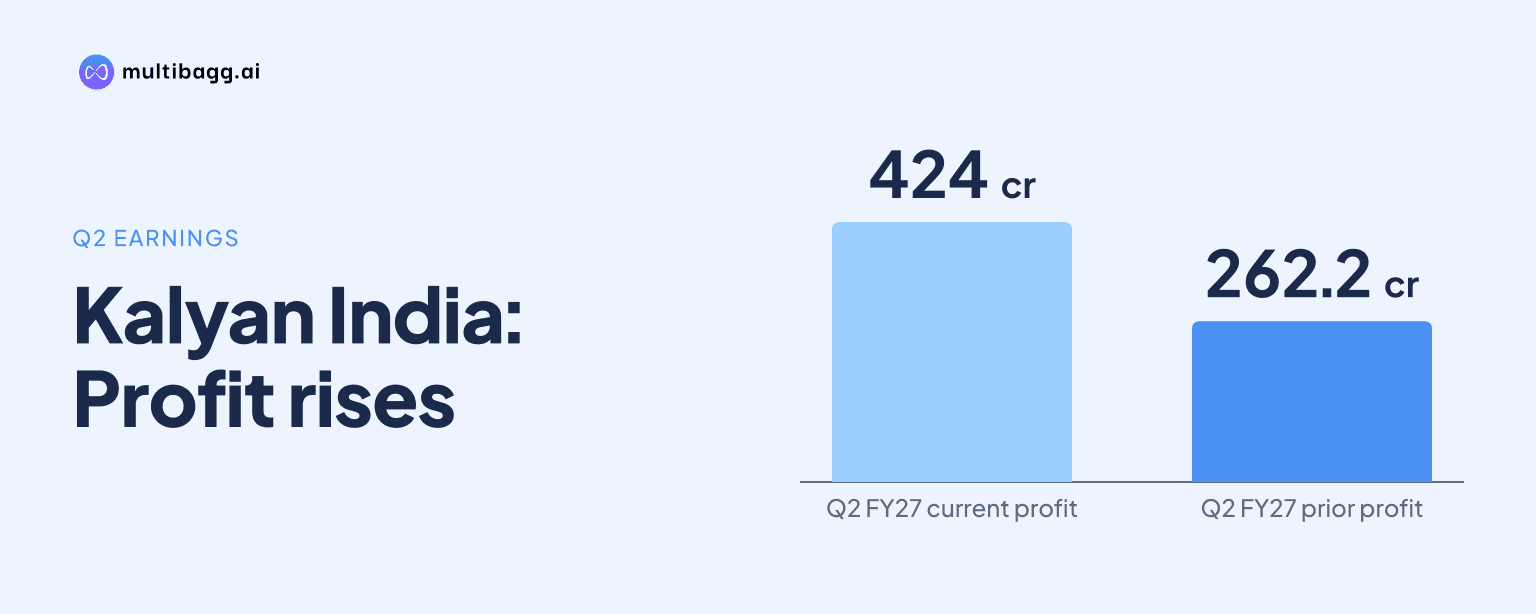
Kalyan Jewellers reported India profit after tax of Rs 424 crore in Q2FY27, up 62% from Rs 262.2 crore a year earlier, as revenue rose 27% to Rs 8,700.7 crore and same-store sales growth was about 20%. The presentation also records a roughly Rs 52 crore one-off gain from the import-duty hike.
Know Kalyan Jewellers India inside out
Results, valuation, peers and who's buying, in one view.
How did Kalyan perform in India during Q2FY27?
Kalyan’s India revenue rose 27% year on year to Rs 8,700.7 crore in Q2FY27, while profit after tax increased 62% to Rs 424 crore. Gross profit grew 24% to Rs 1,063.1 crore and earnings before interest, tax, depreciation and amortisation, or EBITDA, rose 27% to Rs 548.5 crore. The profit increase therefore outpaced revenue, gross profit and EBITDA growth in the quarter.
Kalyan added 12 new India showrooms during Q2FY27, resulting in a net addition of 11, while the year-earlier quarter had 15 showroom launches. Its reported showroom count nevertheless rose by 65 year on year to 365. Revenue excludes bullion sales in both periods, according to the presentation, making the comparison specific to Kalyan’s jewellery-business revenue measure.
What drove Kalyan’s 27% India revenue growth?
Kalyan said healthy same-store sales growth, or SSSG, of about 20% was the main driver of its 27% India revenue increase in Q2FY27. Business-to-consumer revenue grew about 23%, and more than 33% of customers during the quarter were new customers. The figures show that existing stores contributed substantially alongside the expanded showroom base.
The Non-South market grew faster than the South. Non-South revenue increased 31% to Rs 4,818.2 crore from Rs 3,679.4 crore, whereas South revenue rose 23% to Rs 3,882.5 crore from Rs 3,163.5 crore. Non-South consequently contributed about 55% of total India revenue, while SSSG was about 21% there, compared with about 19% in the South.
Category growth was also broad-based. Gold revenue rose 28% to Rs 5,854.7 crore and studded revenue grew 27% to Rs 2,692 crore. Studded jewellery accounted for 30.94% of revenue, compared with 30.91% a year earlier, showing little year-on-year change in category mix despite the higher revenue base.
What affected Kalyan’s margins and Q2FY27 profit?
Kalyan’s reported Q2FY27 profit included a roughly Rs 52 crore one-off gain related to the import-duty hike, according to the presentation. That item is relevant when comparing the 62% increase in profit after tax with the 27% increases in revenue and EBITDA. The presentation does not allocate the full change in profit after tax among individual drivers.
Gross margin was affected by open positions in silver and platinum. Kalyan recorded losses of about Rs 8.3 crore on those positions in Q2FY27, compared with gains of about Rs 21.2 crore in Q2FY26. This created a year-on-year adverse swing of about Rs 29.5 crore in the gross-margin comparison, even as gross profit increased by Rs 208.4 crore.
The presentation also shows that recycled gold represented 42% of India revenue in Q2FY27, against 29% in Q2FY26 and 46% in Q1FY27. Recycled-gold share was therefore 13 percentage points higher than a year earlier but 4 percentage points below the immediately preceding quarter. The source provides the mix figures but does not quantify their separate effect on quarterly profitability.
Got a follow-up? Ask IRIS
How did Kalyan’s regions and store model compare?
Kalyan’s India business generated faster revenue and profit growth than its Middle East business in Q2FY27. Middle East revenue increased 11% to Rs 961.3 crore and EBITDA rose 15% to Rs 70.6 crore, but profit after tax declined 19% to Rs 12.2 crore from Rs 15.1 crore. Its Middle East showroom count remained at 38, while India’s count rose 22% to 365.
At the consolidated level, revenue rose 31% to Rs 10,322.6 crore and profit after tax rose 64% to Rs 427.1 crore in Q2FY27. India profit of Rs 424 crore accounted for most of the reported consolidated profit, though the presentation does not provide a reconciliation of every segment-level and corporate item between the India, Middle East and consolidated measures.
Franchised showrooms accounted for about 59% of Kalyan’s India revenue in Q2FY27. The company operates a franchisee-owned, company-operated, or FOCO, model under which the franchisee bears capital expenditure outside South India, inventory investment and most showroom expenses other than salaries. As at September 30, 2026, Kalyan had 246 FOCO showrooms within its 365-showroom India network.
What does Kalyan disclose about non-core asset sales and debt?
Kalyan disclosed on its FY27 performance page that it had divested a first set of non-core real-estate assets worth Rs 86 crore. That disclosure is for FY27 and is not assigned to Q2FY27 profit after tax in the supplied India performance summary. The presentation supports the FY27 divestment but does not state its gain or loss or its quarterly accounting treatment.
Management also said real-estate assets worth Rs 16 crore were expected to be divested during Q3FY27. It further expected collateral releases worth Rs 200 crore during FY27 that could subsequently be divested. These are disclosed expectations rather than completed transactions, and the presentation does not specify the eventual gains, losses or accounting treatment from those potential sales.
Kalyan’s standalone gross debt stood at Rs 1,198.9 crore as of September 30, 2026, consisting entirely of gold metal loans, with non-gold-metal debt reported as nil. The presentation says non-gold-metal debt in India had been completely repaid by September 2026, following repayment of Rs 1,324.1 crore of such loans between April 1, 2023 and September 30, 2026.
Conclusion
Kalyan’s Q2FY27 India result combined broad-based demand growth with higher reported profit: revenue rose 27%, SSSG was about 20%, and profit after tax increased 62% to Rs 424 crore. Non-South markets grew faster than the South, while gold and studded categories both expanded by at least 27%. The reported profit comparison also included a roughly Rs 52 crore import-duty gain, while commodity-position losses contrasted with gains in the prior-year quarter.
The next items to watch are Kalyan’s planned Q3FY27 divestment of Rs 16 crore of real-estate assets, the possible FY27 release of Rs 200 crore of additional collateral, and its stated plan for 84 additional Kalyan India FOCO showrooms during FY27. The presentation also says Kalyan is discussing a larger FOCO partnership with potential Middle East investors, but gives no timing or transaction terms.