










Kalyan Jewellers’ My Kalyan Contributes 18% of India Revenue
Key highlights
- Kalyan reports 1,203 My Kalyan centres in India supported by 5,053 employees.
- My Kalyan contributes about 18% of Kalyan’s revenue from operations in India.
- The network endeavours to connect with 10 million customers each year.
- My Kalyan accounts for about 31% of purchase advance-scheme enrolments in India.
powered by IRIS
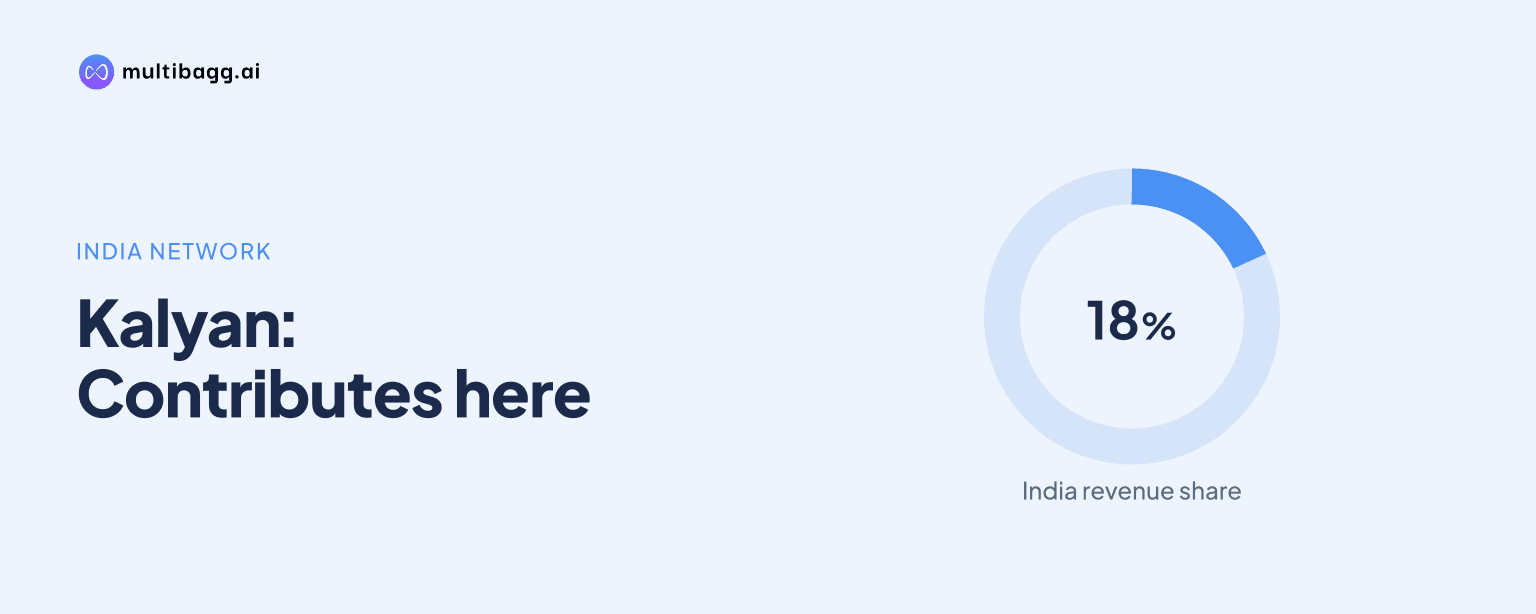
Kalyan Jewellers says its 1,203-centre My Kalyan network contributes about 18% of revenue from operations in India, making grassroots outreach a material channel alongside showrooms. The network has 5,053 personnel, endeavours to connect with 10 million customers each year and accounts for about 31% of Indian purchase advance scheme enrolments.
Know Kalyan Jewellers India inside out
Results, valuation, peers and who's buying, in one view.
How large is Kalyan’s My Kalyan network?
Kalyan operates 1,203 My Kalyan centres in India through a workforce of 5,053 dedicated personnel. The presentation describes these employees as conducting door-to-door and direct marketing among local communities across urban, semi-urban and rural areas, rather than operating only from conventional jewellery showrooms.
The network endeavours to connect with 10 million customers each year, according to Kalyan. That reach is supported by centres that showcase product catalogues, direct prospective customers to showrooms, enrol customers in purchase advance schemes and add information to the company’s customer database.
The presentation positions the centres as a response to jewellery demand in rural and semi-urban markets, where it says penetration of organised jewellery retail is low. In this model, My Kalyan is intended to identify latent demand and take customers towards Kalyan’s showroom network rather than replace the showroom transaction.
How does My Kalyan turn outreach into revenue?
Kalyan reports that My Kalyan contributes about 18% of revenue from operations in India, while contributing about 31% of enrolments in purchase advance schemes in India. The network’s disclosed share of advance-scheme acquisition is therefore 13 percentage points higher than its stated share of India operating revenue.
The source identifies several mechanisms behind those measures: personnel use catalogues to present products, generate showroom traffic and build relationships with participants in the wedding ecosystem. These activities link local outreach with showroom visits and advance-scheme enrolment, two routes through which Kalyan can engage customers before a jewellery purchase.
The 10 million annual customer connections are described as an endeavour rather than a reported customer count or transaction count. Similarly, the contribution figures are approximate, and the presentation does not specify the revenue value, the number of customers who buy after contact, or the conversion rate from advance-scheme enrolment to a showroom sale.
Kalyan also says My Kalyan helps enrich its customer database. The company’s digital initiatives describe staff using a mobile application to store customer data and manage lead generation, while the centres support the Near Me Search function that directs search traffic to local-store micro-sites.
Got a follow-up? Ask IRIS
How does Kalyan localise the My Kalyan channel?
Kalyan uses My Kalyan as part of a broader localisation approach covering state- and city-specific campaigns, communication in local languages and product portfolios tailored to local preferences. The company also says it has 15 procurement centres across key jewellery-manufacturing regions and works with local artisans as contract manufacturers.
At showroom level, Kalyan says it recruits staff who speak local languages and understand local culture, while designing showrooms around local tastes and sensibilities. My Kalyan extends that approach outside the showroom through personnel working in neighbourhoods and communities across urban, semi-urban and rural markets.
The presentation illustrates micro-market targeting through Mumbai-region priorities: Borivali for Gujarati and North Indian customers, Thane for Maharashtrian customers, Ghatkopar for Gujarati and South Indian customers, and Vashi for South Indian customers. This example supports Kalyan’s stated approach of matching product designs, sales staff and brand communication to specific local populations.
Kalyan identifies local celebrities and influencers as another part of its hyperlocal model. Its stated rationale is that a wide assortment of designs, locally recruited sales staff and regional communication can address target micro-markets, while My Kalyan provides direct community contact to support those efforts.
How does My Kalyan compare with Kalyan’s showroom footprint?
Kalyan’s 1,203 My Kalyan centres are more than three times its 365 Kalyan showrooms in India. This separates the physical roles of the network: showrooms provide retail selling space, while the larger centre network is presented as a local marketing and customer-engagement layer that drives traffic to those stores.
The 365 Kalyan showrooms in India have more than 10,78,900 square feet of aggregate retail space, compared with 138 Candere showrooms with more than 1,49,900 square feet. My Kalyan centres are not presented as retail-space locations; the source assigns them outreach functions including catalogue display, data collection and purchase advance-scheme enrolment.
Kalyan’s showroom footprint is weighted towards non-South India, which accounts for 258 of its 365 Indian Kalyan showrooms, compared with 107 in South India. The presentation separately gives a 71% non-South India presence and a 29% South India presence, while My Kalyan is described as operating across India without a regional centre split.
The comparison also separates customer acquisition from sales infrastructure. A My Kalyan centre can contact households and develop leads through 5,053 personnel, whereas a showroom offers the physical retail setting; the presentation does not disclose how many centres are linked to each showroom or whether centre productivity varies by region.
Conclusion
Kalyan’s disclosed figures show that My Kalyan is a sizable customer-acquisition and engagement network, with 1,203 centres, 5,053 employees and an effort to connect with 10 million customers each year. Its approximate 18% contribution to India revenue from operations and 31% share of purchase advance-scheme enrolments indicate roles in both sales generation and pre-purchase customer enrolment.
What to watch next is whether Kalyan provides a reporting period for the approximate 18% revenue contribution and 31% enrolment share, along with regional centre data or conversion information linking outreach to showroom sales. The presentation does not disclose a future target for My Kalyan centre additions, revenue contribution, customer connections or advance-scheme enrolments.