










Nifty Rises 0.8% as Sensex Rebounds 1,500 Points
Key highlights
- Nifty rose as much as 0.8% after opening 0.53% lower at 25,378.05.
- Sensex rebounded more than 1,500 points from its intraday low after opening down 453.19 points.
- Foreign institutional investors bought more than ₹7,411 crore of Indian equities on a provisional basis on Thursday.
- Waaree Energies signed a PPA for 700 MW of solar capacity and 2,800 MWh of storage.
powered by IRIS
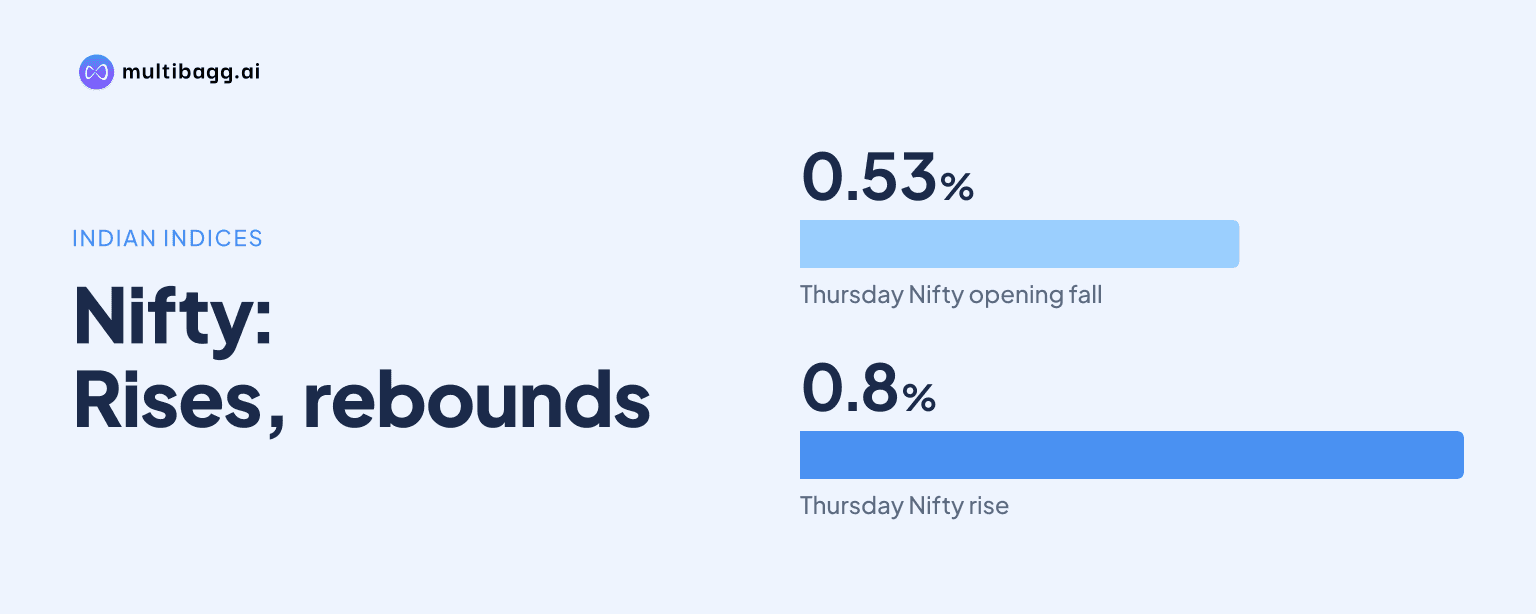
NSE Nifty 50 rose as much as 0.8% on 20 November 2026 while BSE Sensex rebounded more than 1,500 points from its intraday low, as a stronger rupee, sustained foreign buying and lower oil prices outweighed a sharp global technology-led sell-off. The recovery followed a gap-down opening after US and Asian equities weakened.
Why did Nifty and Sensex recover today?
NSE Nifty 50, or Nifty, and BSE Sensex, or Sensex, recovered because domestic liquidity and currency support proved stronger than the initial global risk-off impulse. The benchmarks opened under pressure after Wall Street fell more than 2% overnight and Asian markets tumbled on renewed concern over lofty artificial-intelligence valuations. At the opening, Sensex dropped 453.19 points, or 0.55%, to 82,568.56, while Nifty slipped 136.25 points, or 0.53%, to 25,378.05.
Selling then eased and buyers returned to heavyweight banks and information technology stocks. The rupee strengthened past 93 against the US dollar, its best level since April, helping improve the relative appeal of Indian assets. Softer commodity prices also reduced concern about India’s import bill and future inflation pressures.
Foreign institutional investors remained a crucial support. They bought more than ₹7,411 crore of Indian equities on a provisional basis on Thursday, extending a run of 14 straight buying sessions. The scale of November purchases, reported above ₹1 lakh crore so far, has given domestic equities a cushion during bouts of global volatility.
What did global markets signal for stock market today?
Global signals were plainly negative at the start of stock market today, with the sell-off centred on technology and AI-linked shares. The Dow Jones Industrial Average fell 2.19%, the S&P 500 declined 2.02%, and the Nasdaq Composite lost 2.25% in the preceding US session. Investors are reassessing whether returns from heavy AI infrastructure spending can justify the capital being deployed.
Asia followed Wall Street lower. Japan’s Nikkei 225 was reported down more than 4%, while South Korea’s Kospi suffered losses of roughly 4% to 5% in various updates. The broader retreat pushed the MSCI All Country World Index towards a seventh straight daily decline, its longest losing run since September 2023.
India initially tracked this caution but later decoupled. The market’s lower direct exposure to the global AI trade was cited as one reason local sentiment stabilised. That does not make Indian equities immune: a prolonged US technology correction could still affect risk appetite, foreign flows and Indian IT-sector expectations.
Which sectors led the intraday turnaround?
Private banks and information technology shares led the rebound after the early decline, while the stronger rupee and foreign inflows improved sentiment toward large-cap financials. Banking strength mattered because lenders carry substantial weights in both headline indices. Nifty Bank had recently touched a record above 64,400, showing that the sector entered the session with firm momentum.
The market also retained support from the previous session’s leadership. On Thursday, Nifty gained 286.35 points, or 1.14%, to 25,514.30, while Sensex added 989.94 points, or 1.21%, to 83,021.75. Autos were the standout then, with the Nifty Auto index climbing 4.4% as easing input costs and strong festival demand improved the margin outlook.
Friday’s early losers included Axis Bank, Titan, Tata Steel, Larsen & Toubro and Eternal. The reversal therefore reflected selective heavyweight buying rather than a uniformly risk-on market. Investors should distinguish between an index rebound and broad-based strength across mid- and small-cap shares.
Got a follow-up? Ask IRIS
What do Waaree Energies and SEPC announcements mean?
Waaree Energies Ltd disclosed a sizeable renewable-energy contract, while SEPC Ltd approved a share-swap transaction to acquire an overseas engineering business. Waaree Energies said its wholly owned subsidiary executed a power purchase agreement with Solar Energy Corporation of India for a Solapur project comprising 700 MW of solar capacity and 700 MW/2,800 MWh of energy storage.
The agreement is material because it combines solar generation with storage, a segment increasingly important for delivering power beyond daylight hours. Execution milestones, project financing, equipment supply and commissioning timelines will determine how the contract translates into revenue and profitability.
SEPC approved the preferential allotment of 153 crore equity shares at ₹10 each to acquire a 90% stake in Avenir International Engineers and Consultants LLC, Abu Dhabi. The transaction expands SEPC’s overseas engineering footprint, but investors should assess the resulting equity dilution, acquisition terms and the target company’s financial contribution once fuller details emerge.
What should investors watch after Sensex today?
Investors should watch whether foreign inflows hold up alongside the rupee’s gains and whether Brent crude remains near the reported $90-a-barrel level. Lower crude helps India’s inflation, current-account and corporate-margin outlook, but any sustained rise would weaken that support. The day’s sharp recovery also leaves Nifty sensitive to profit-taking after its strong November advance.
Overseas macro signals remain important. The final University of Michigan consumer-sentiment reading is due, with particular attention on inflation expectations that were previously 4.3% for one year and 3.4% for five years. Comments from Federal Reserve officials Christopher Waller and Michael Barr could move the dollar, Treasury yields and global equities.
A hawkish policy message would challenge emerging-market valuations and potentially slow foreign purchases. Conversely, stable yields, a contained oil market and continued allocation away from expensive global technology stocks would remain constructive for Nifty today and Sensex today.
Conclusion
The intraday rebound showed that domestic factors - a firmer rupee, strong foreign flows, lower oil and buying in heavyweight banks - can offset a difficult global opening. Still, the gap between weak global technology sentiment and resilient Indian benchmarks means volatility could remain elevated rather than disappear.
Next, investors should track US consumer sentiment, inflation expectations, Federal Reserve remarks and the OPEC monthly report for cues on rates and crude. At the company level, Waaree Energies’ Solapur project execution and SEPC’s proposed Abu Dhabi acquisition will be the key disclosed milestones to monitor.