










Cummins India Q2 PAT Falls 27% as Costs Pressure Margins
Key highlights
- Cummins India’s standalone Q2 FY27 PAT fell 27% year-on-year to ₹466.89 crore.
- Q2 FY27 revenue from operations rose 4% to ₹3,247.47 crore.
- Domestic sales increased 5% to ₹2,692 crore, while export sales rose 2% to ₹555 crore.
- Profit before tax fell 28.4% year-on-year to ₹601 crore amid commodity-cost pressure.
powered by IRIS
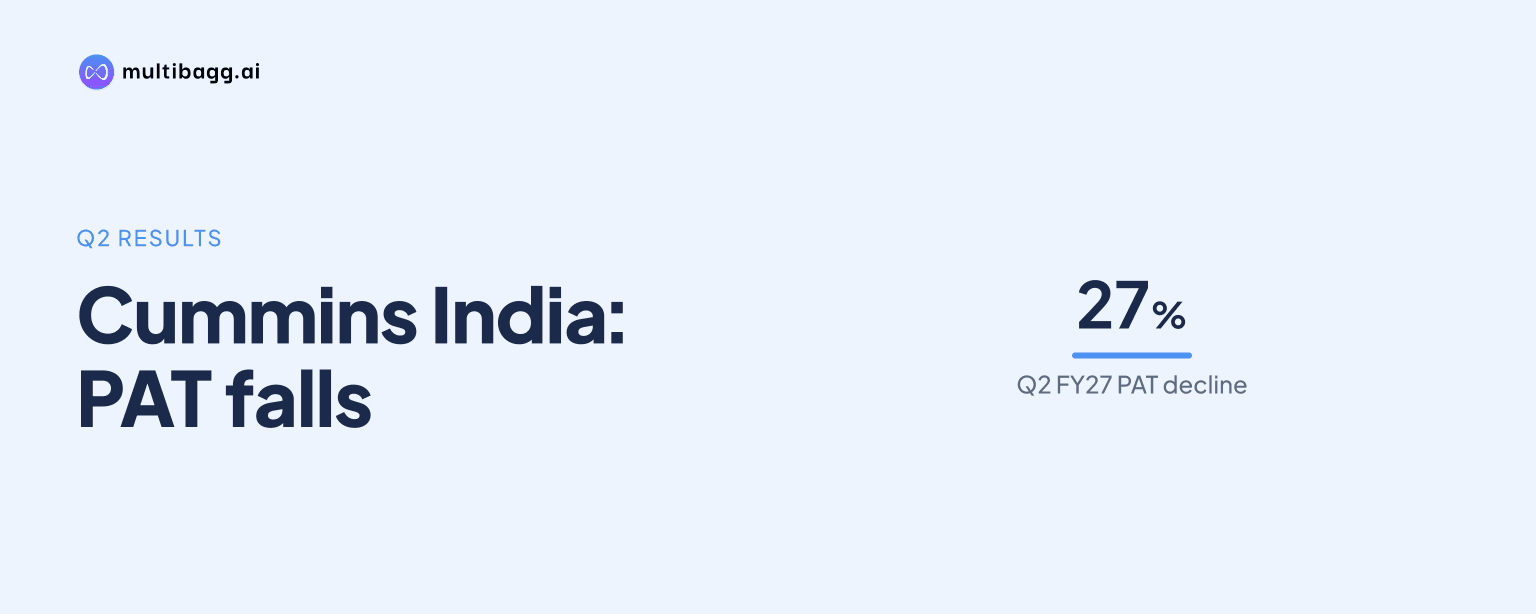
Cummins India Limited reported standalone profit after tax of ₹466.89 crore for Q2 FY27, down 27% year-on-year, as commodity-cost inflation, freight costs and an adverse product mix outweighed 4% growth in revenue to ₹3,247.47 crore. The result highlights the pressure on profitability despite continued demand across its key end markets.
Know Cummins India inside out
Results, valuation, peers and who's buying, in one view.
What caused Cummins India’s Q2 FY27 profit decline?
Cummins India said its profit before tax fell 28.4% year-on-year to ₹601 crore in the quarter ended September 30, 2026. The company attributed the decline in profitability to commodity-cost inflation, while the reported result also reflected freight inflation and an adverse product mix.
Standalone profit after tax stood at ₹466.89 crore, compared with ₹637.69 crore in the corresponding quarter of the previous year. On a consolidated basis, PAT was ₹490.07 crore versus ₹635.86 crore a year earlier. Consolidated profit before tax before exceptional items was ₹586.57 crore, down from ₹765.83 crore.
The company’s Board approved the unaudited second-quarter and first-half results on November 4, 2026. The auditors’ limited review did not report matters indicating a material misstatement, according to the earnings summary.
How did Cummins India’s sales perform in the September quarter?
Cummins India’s revenue from operations increased 4% year-on-year to ₹3,247.47 crore in Q2 FY27 from ₹3,121.58 crore. Management said demand remained robust across key end markets and that order execution supported the increase in year-on-year revenue.
Domestic sales rose 5% to ₹2,692 crore from ₹2,577 crore in the year-earlier quarter. Export sales increased 2% to ₹555 crore. The domestic business therefore remained the larger contributor to quarterly sales, accounting for most of the reported revenue growth.
Sequentially, however, revenue declined 4% from ₹3,375 crore in the preceding quarter. Domestic sales were 6% lower quarter-on-quarter, while export sales rose 6%. Profit before tax declined 16.6% sequentially to ₹601 crore, showing that the pressure on profit was present even as exports improved from the June quarter.
Which business segments supported domestic sales growth?
Cummins India’s distribution business was the largest reported source of domestic growth, with quarterly sales increasing 13% year-on-year to ₹900 crore. Industrial domestic business sales rose 5% to ₹406 crore, while power-generation domestic sales declined 2% to ₹1,308 crore.
The segment data show differing demand and execution trends within the domestic portfolio. Power-generation sales also fell 8% sequentially, while industrial domestic sales were down 11% quarter-on-quarter. Distribution sales rose 2% from the previous quarter, providing relative support to domestic revenue during the period.
In exports, high-horsepower sales were ₹268 crore, down 4% year-on-year and 10% sequentially. Overall export sales still rose 2% from the year-earlier quarter to ₹555 crore, indicating that other export activity offset the decline reported in high-horsepower exports.
The company also launched QSK60-powered G34 and G37 genset solutions at bauma CONEXPO INDIA 2026. It showcased a CPCB IV+ compliant 125 kVA generator set and aftermarket offerings, linking its product activity to cleaner-power requirements in India.
Got a follow-up? Ask IRIS
What do the first-half figures show about Cummins India’s earnings trend?
Cummins India’s consolidated revenue for the first half of FY27 rose to ₹6,622.40 crore from ₹5,980.29 crore in the prior-year period. But consolidated PAT declined to ₹1,099.35 crore from ₹1,240.66 crore, showing that higher sales in the first half did not translate into higher net profit.
The first-half pattern is consistent with the September-quarter result: revenue expanded, but costs affected profitability. The reported quarterly numbers do not establish the duration of inflationary pressures, but they show that pricing, input costs, freight and product mix were significant to the company’s financial performance in Q2.
Management, led by Managing Director Gbile Adewunmi and Chief Financial Officer Soma Ghosh on the earnings call, said demand continued to be robust across key end markets. This makes the quarter notable for investors because the central issue was not a reported broad-based sales contraction, but the gap between revenue growth and profit performance.
Why do costs and product mix matter for investors?
Commodity and freight costs matter because they can reduce margins even when a company records higher sales. Cummins India’s Q2 result illustrates this relationship: revenue rose 4%, whereas profit before tax fell 28.4% and standalone PAT fell 27% year-on-year.
Product mix also affects profitability because different products and business segments can carry different cost and margin structures. Cummins India specifically identified an adverse product mix alongside inflationary pressures, while the segment figures showed growth in distribution and industrial domestic sales but lower power-generation sales.
For investors, the result places attention on the company’s ability to convert demand and order execution into profit while input and freight costs remain elevated. For customers and industry users, the company’s continued product launches and CPCB IV+ compliant generator offering indicate ongoing activity in power solutions, although the reported results did not provide a financial outlook or a quantified margin-recovery target.
Conclusion
Cummins India delivered higher Q2 FY27 revenue and domestic sales, supported by demand across its key markets, but profit declined sharply as commodity costs, freight inflation and product mix weighed on margins. The contrast between 4% revenue growth and the 27% fall in standalone PAT is the key financial outcome of the quarter.
The next reported developments to watch are sales execution across domestic power generation, distribution, industrial operations and exports, along with the direction of commodity and freight costs. Management has stated that demand remains robust, but the available disclosures do not specify a timetable or target for easing the cost pressures reflected in Q2 FY27.