










Cummins India says non-data-centre powergen grew despite decline
Key highlights
- Cummins India said non-data-centre powergen grew despite a 2% quarterly decline in overall powergen.
- Data centres accounted for about 30%-40% of Cummins India powergen sales.
- Cummins India reported Rs 236 crore in mid-range powergen sales, versus Rs 142 crore in heavy-duty sales.
- Management said inflationary commodity costs caused most of a 400-basis-point gross-margin decline.
powered by IRIS
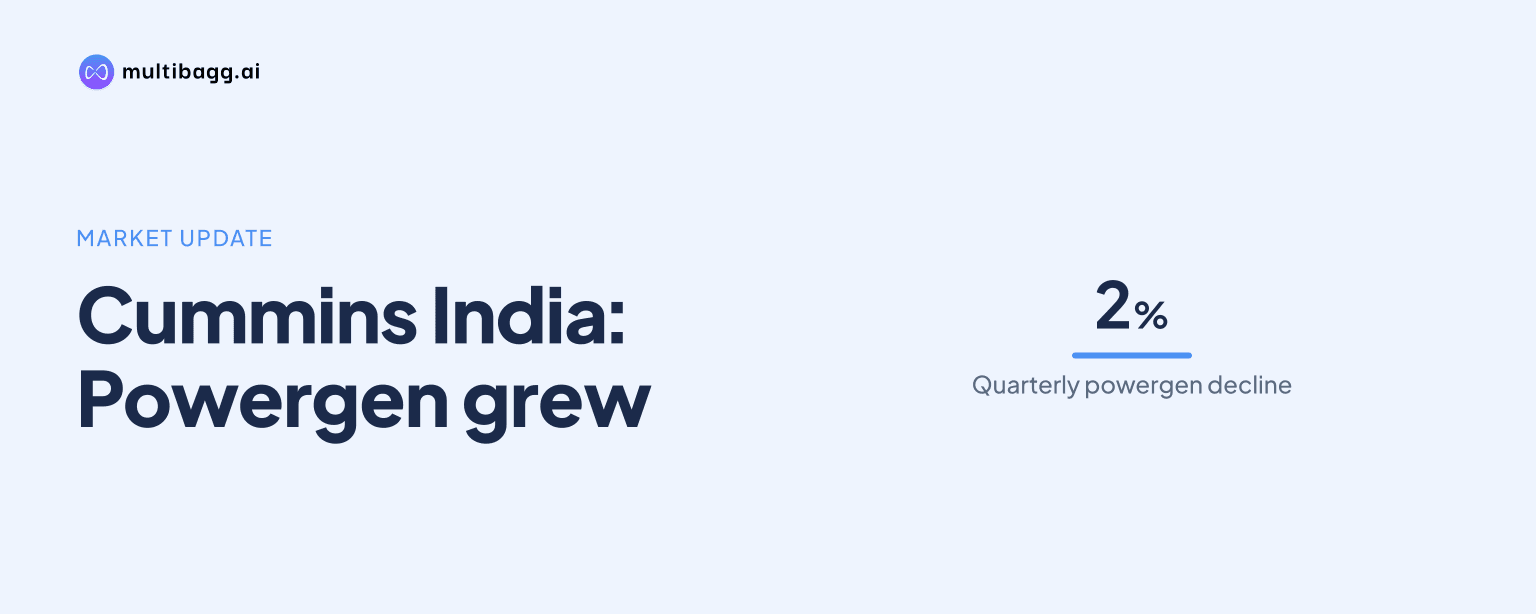
Cummins India Limited said non-data-centre powergen grew in the reported quarter despite a 2% quarter-on-quarter decline in the overall division, as project-delivery mix changed. Data centres accounted for about 30%-40% of powergen sales, while management cited better performance in realty, manufacturing, residential and normal realty projects.
Know Cummins India inside out
Results, valuation, peers and who's buying, in one view.
Why did Cummins India powergen decline 2% in the quarter?
Cummins India said the 2% quarterly decline in overall powergen reflected delivery mix and project execution rather than a broad fall in demand outside data centres. Management said customer project schedules and site readiness determine when equipment is delivered, which can shift revenue between reporting periods even when the order book remains robust.
Data centres represented about 30%-40% of powergen sales, making delivery timing in that business material to the division's quarterly result. Management said the quarter had a different mix of data-centre deliveries, while describing powergen excluding data centres as growing “pretty well.” It did not disclose the data-centre revenue amount or total powergen revenue for the period.
The company also cautioned that quarter-on-quarter comparisons do not capture the varied delivery patterns across products and end markets. Management made the same point for industrial projects, where rail inventory, marine execution and compressor supply constraints affected the quarter, contributing to 4% overall growth rather than a single demand issue.
How did Cummins India non-data-centre powergen perform?
Cummins India said non-data-centre powergen performed better in realty, manufacturing, residential and normal realty projects during the quarter. Management did not provide a percentage growth rate for those end markets, but said their performance compared favourably with the project-led variation in data-centre deliveries.
The disclosed domestic product values show sales across lower-horsepower, mid-range and heavy-duty equipment. Lower-horsepower, or LHP, powergen sales were Rs 98 crore, while mid-range sales were Rs 236 crore and heavy-duty sales were Rs 142 crore. The undisclosed remaining amount included data-centre business and high-horsepower products.
The figures do not allow a calculation of non-data-centre growth because Cummins India did not disclose total powergen sales, data-centre revenue or comparable product-category figures. They show, however, that mid-range sales of Rs 236 crore exceeded heavy-duty sales of Rs 142 crore and LHP sales of Rs 98 crore in the reported quarter.
How dependent is Cummins India powergen on data centres?
Cummins India said data centres account for about 30%-40% of powergen sales, with the percentage moving as projects are executed and delivered. Management said the range was also around 30%-40% in the same quarter a year earlier, but it did not disclose an exact comparable share or revenue amount.
Management described the data-centre inquiry pipeline as robust and said the data-centre boom had not slowed meaningfully. It said the company works with customers on project execution timing so products are available when required, but it did not quantify the pipeline in megawatts or identify individual customer orders.
Cummins India said it was regularly assessing its global manufacturing network against demand and supply conditions. However, it announced no major production change, including no disclosed expansion for QSK60 engines or localisation plan for QSK95 engines, and said it would communicate any future change.
Got a follow-up? Ask IRIS
What did Cummins India report in industrial and export markets?
Cummins India reported industrial sales of Rs 131 crore in construction, Rs 117 crore in rail, Rs 54 crore in compressors, Rs 49 crore in mining and Rs 27 crore in marine. The balance of industrial sales came from defence, oil and gas, and parts, for which management did not provide separate values.
Management said rail was softer because coach factories held more inventory, while marine was affected by slower execution of certain projects. Compressor demand remained present, according to management, but supply-chain constraints limited deliveries. These segment-specific mechanisms were among the reasons cited for the quarter's 4% overall growth.
For exports, Cummins India said Europe accounted for 29%, the region labelled LAU by management for 28%, Asia-Pacific for 22%, and the Middle East for 15%. Management said geopolitical disruption made quarter-to-quarter export performance harder to assess and did not offer FY27 export growth guidance, although it said it expected solid export performance going forward.
What could affect Cummins India revenue and margins next?
Cummins India said project execution, commodity costs and the lag in pricing realisation are the main variables affecting near-term revenue and margins. Management said most of the 400-basis-point gross-margin decline discussed on the call resulted from inflationary commodity costs, with product mix accounting for a relatively small portion. One basis point equals one-hundredth of a percentage point.
Management said price changes apply to new orders, while the company continues to deliver existing orders at contracted prices. As a result, price revisions take time to appear in revenue whereas cost increases can affect results sooner. Cummins India did not provide a date for when pricing would catch up with input-cost inflation.
Tender-based industrial work has a similar constraint, management said. Once an order is won, it is generally executed at the agreed price unless the contract includes a price-change mechanism, which management said is uncommon. The company said it was reviewing prices, managing costs and working with suppliers that are also investing to meet demand.
Conclusion
Cummins India's 2% quarterly powergen decline was therefore presented as a delivery-mix outcome in a division where data centres represent about 30%-40% of sales. Management's comments indicate that realty, manufacturing and residential demand supported non-data-centre powergen, while industrial performance varied by rail inventory, marine project timing and compressor supply availability.
The next indicators are whether data-centre projects continue to execute to customer schedules, whether revised pricing reaches revenue as newer orders are delivered, and whether commodity costs remain elevated. Management said it is continuing to assess its manufacturing network but disclosed no major production change, while the export outlook remains subject to geopolitical uncertainty.