










Cummins India says commodity inflation drove 400-bp gross-margin fall
Key highlights
- Cummins India said commodity inflation caused most of its 400-basis-point Q2 FY27 gross-margin decline.
- Q2 FY27 sales rose 4% year on year to Rs 3,247 crore, while profit before tax fell 28.4% to Rs 601 crore.
- Domestic sales increased 5% year on year to Rs 2,692 crore, while exports rose 2% to Rs 555 crore.
- Data centres represented about 30% to 40% of Cummins India’s power-generation sales in Q2 FY27.
powered by IRIS
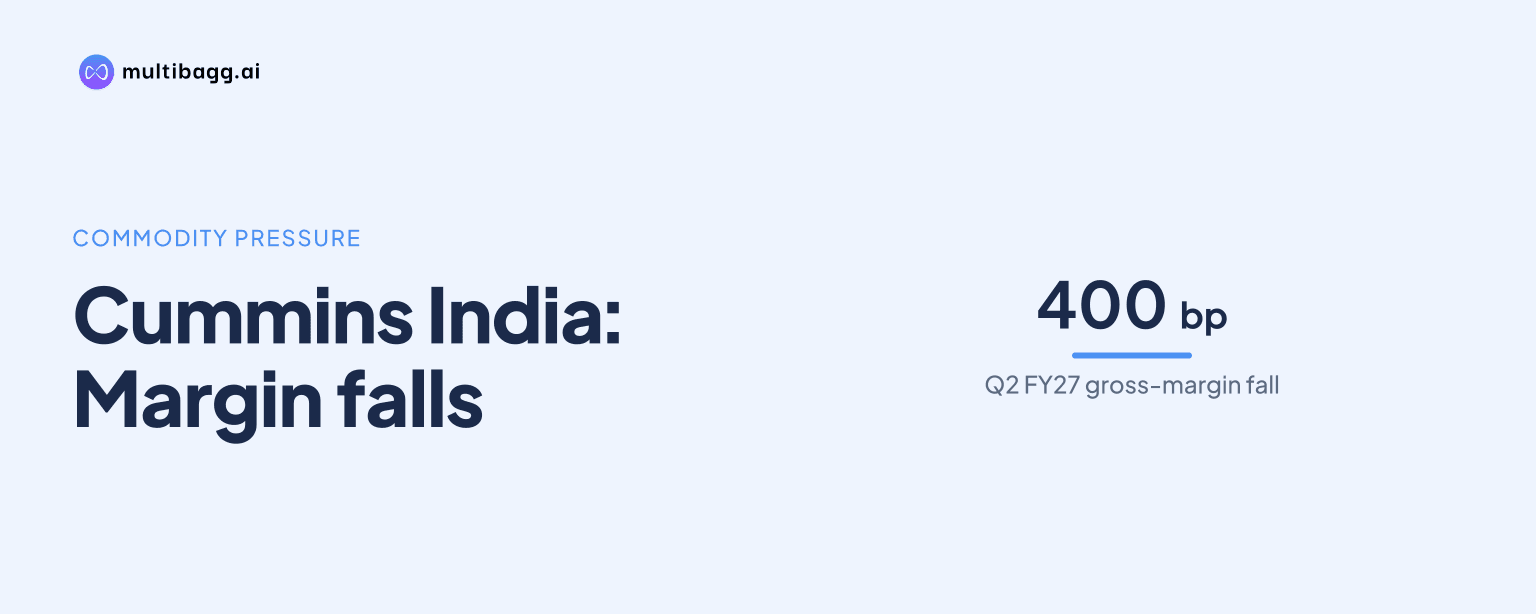
Cummins India Limited said most of its 400-basis-point gross-margin decline in Q2 FY27 came from inflation in commodity and input costs, rather than product mix, even as quarterly sales rose 4% year on year to Rs 3,247 crore. Management said price changes apply to new orders and therefore take time to affect execution from its existing order book.
Know Cummins India inside out
Results, valuation, peers and who's buying, in one view.
Why did Cummins India’s gross margin fall in Q2 FY27?
Cummins India said inflationary commodity costs caused most of the 400-basis-point fall in gross margin in the quarter ended September 30, 2026. A basis point is one-hundredth of a percentage point. Managing Director Gbile Adewunmi told an analyst that product mix accounted for only a relatively small portion of the decline, despite varying delivery patterns across the company’s products and end markets.
Management linked the cost pressure to prolonged geopolitical uncertainty and supply-chain challenges, which it said had raised commodity and input costs. The company had already identified these pressures in its prepared remarks, alongside a 28.4% year-on-year decline in profit before tax to Rs 601 crore in Q2 FY27. That profit change was materially larger than the 4% sales increase, showing the effect of costs on quarterly profitability.
Product mix nevertheless remained a secondary factor because some sales categories are project-led and lumpy, according to management. Data-centre deliveries were one example cited on the call. Cummins India did not quantify the portions of the 400-basis-point decline attributable to commodities and mix, nor did it disclose its gross-margin percentage for Q2 FY27.
How did Cummins India’s sales mix change in Q2 FY27?
Cummins India reported Rs 3,247 crore of Q2 FY27 sales, up 4% from Rs 3,122 crore a year earlier but down 4% from Rs 3,375 crore in the preceding quarter. Domestic sales increased 5% year on year to Rs 2,692 crore and declined 6% sequentially, while exports rose 2% year on year to Rs 555 crore and increased 6% from Q1 FY27.
The domestic power-generation business recorded Rs 1,308 crore of sales, down 2% from a year earlier and 8% from Q1 FY27. In contrast, distribution sales of Rs 900 crore rose 13% year on year and 2% sequentially. Industrial domestic sales reached Rs 406 crore, up 5% year on year but down 11% quarter on quarter, illustrating that performance differed by business even as total domestic sales grew from the prior year.
Export categories also moved in opposite directions. High-horsepower exports were Rs 268 crore, down 4% year on year and 10% sequentially, whereas low-horsepower exports were Rs 226 crore, up 3% from a year earlier and 25% from the preceding quarter. Management also said data centres represented about 30% to 40% of power-generation sales, while non-data-centre activity in realty, manufacturing, residential and normal realty projects performed better in the quarter.
Got a follow-up? Ask IRIS
When will Cummins India’s price increases reach reported revenue?
Cummins India said price actions have begun to affect new orders, but their benefit will arrive later in reported revenue because those orders are not executed immediately. Management did not provide a quarter-by-quarter timetable for recovery in Q2 FY27. It said its strong order book supports business visibility but also extends the lag between a new price and the delivery of the related order.
The mismatch in Q2 FY27 is that cost increases can emerge immediately or relatively quickly, whereas revised prices take time to flow through. Adewunmi said the company was seeing higher-than-expected cost increases even when it changed prices, making the ability to catch up dependent on further commodity-cost movement. He did not provide the proportion of outstanding orders placed before earlier price increases.
Management outlined three levers for mitigating the pressure at its November 16, 2026 call: pricing and better price realisation, supplier engagement and operational efficiency. On suppliers, it said partners are simultaneously ramping capacity and investing to meet demand, creating a balance between securing adequate capacity and managing costs. On efficiency, management gave no savings target or quantified opportunity, but said it remains an area of focus.
What other Q2 FY27 factors affected Cummins India’s profit?
Cummins India said there was one major one-off item in other expenses: a true-up of corporate-cost allocations, described as management cross-charges. Chief Financial Officer Soma Ghosh said the charges primarily reflected growing support needs from business growth in India, including data centres. The company did not quantify the true-up, but said it was recorded only in other expenses rather than raw-material costs.
On the operating side, management cited a different mix of data-centre deliveries, rail inventory, slower marine execution and compressor supply shortages as factors behind 4% sales growth in Q2 FY27. These factors explain parts of the quarterly sales pattern, but management separately identified commodity inflation, not these execution issues, as the dominant cause of the gross-margin deterioration.
Data-centre demand remained robust globally, management said, and Cummins India was working with suppliers to increase capacity for the QSK60 engine. It said the ramp-up must be sustainable across manufacturing facilities and suppliers. Management reported no major change to its production network at the November 16, 2026 call, while saying it continually assesses supply and demand across regions.
Conclusion
Cummins India’s Q2 FY27 results show a clear divergence between sales and profitability: revenue increased 4% year on year to Rs 3,247 crore, while profit before tax fell 28.4% to Rs 601 crore. Management’s direct explanation for the 400-basis-point gross-margin decline was commodity and input-cost inflation, with product mix playing a comparatively limited role.
The next issue to watch is the timing of price realisation on new orders against further cost increases, because management said existing order execution creates a lag. Cummins India is also working with suppliers to expand capacity for QSK60 demand, while management disclosed on November 16, 2026 that there was no major production-network change and gave no quantified margin-recovery target.