










Cummins India says data centres make up 30%-40% power sales
Key highlights
- Cummins India said data centres account for about 30%-40% of power-generation sales.
- Domestic power-generation sales were Rs 1,308 crore in Q2 FY27, down 2% year on year and 8% sequentially.
- Cummins India reported Q2 FY27 sales of Rs 3,247 crore, up 4% year on year.
- Profit before tax was Rs 601 crore in Q2 FY27, down 28.4% year on year.
powered by IRIS
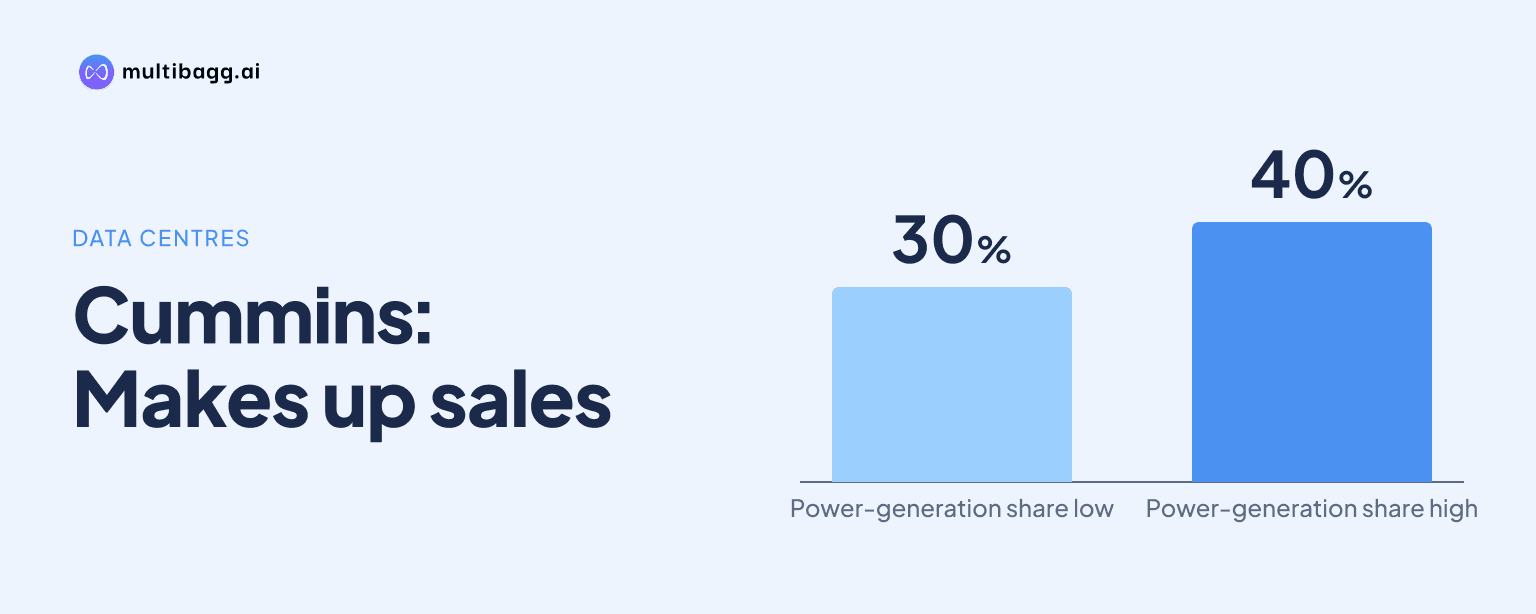
Cummins India Limited said on November 16, 2026 that data centres account for about 30%-40% of its power-generation sales, as global demand for QSK60 engines has been stronger than expected amid the artificial-intelligence boom. In the second quarter (Q2) of financial year 2027 (FY27), domestic power-generation sales were Rs 1,308 crore, down 2% year on year.
Know Cummins India inside out
Results, valuation, peers and who's buying, in one view.
How much of Cummins India power-generation sales comes from data centres?
Data centres contribute about 30%-40% of Cummins India power-generation sales, Managing Director Gbile Adewunmi said during the Q2 FY27 earnings call on November 16, 2026. Management did not disclose the data-centre contribution in rupees or clarify a separate percentage for domestic power-generation sales, but described the range as the continuing contribution of data centres to the power-generation business.
Domestic power-generation sales were Rs 1,308 crore in Q2 FY27, 2% below the year-earlier quarter and 8% below the preceding quarter. Chief Financial Officer Soma Ghosh said low-horsepower sales were Rs 98 crore, mid-range sales were Rs 236 crore and heavy-duty sales were Rs 142 crore. The remaining domestic power-generation business included data-centre business and high-horsepower products.
Ghosh said non-data-centre activity performed better during the quarter in realty, manufacturing, residential and normal realty projects. That commentary indicates the 2% year-on-year decline in domestic power-generation revenue was not attributed solely to non-data-centre markets. Management did not provide comparable segment growth rates for those individual end markets or a separate figure for data-centre sales.
Why is Cummins India raising supply for data-centre demand?
Cummins India is working to increase capacity across its plants and supplier base because QSK60 data-centre engine demand is robust globally and has exceeded expectations during the artificial-intelligence boom. Adewunmi said capacity depends not only on Cummins manufacturing facilities but also on suppliers that provide components needed for higher production.
Management said it wants to expand in a sustainable way that maintains appropriate long-term utilisation across facilities. An analyst asked whether delivery lead times had lengthened by several months and whether this could lead to market-share losses, but management did not confirm a specific lead-time increase, any loss of orders or a capacity figure for QSK60 engines.
The supply challenge was described as global rather than specific to India. Cummins India said it works with data-centre customers on project execution schedules so it can have the required products available for their projects. The company did not announce a new Indian production line, a supplier investment amount or a dedicated data-centre capacity target during the November 16 call.
Has Cummins India’s data-centre order pipeline slowed?
Cummins India said its data-centre inquiry pipeline remains robust and that the data-centre boom has not slowed meaningfully. Management did not disclose the pipeline in megawatts, project count, customer count or order value, even after an analyst used a hypothetical 100-megawatt pipeline to ask how inquiries had changed over the preceding six months.
Management separated the near-term project position from the medium-to-long-term outlook. Adewunmi said order books were in place and projects were being executed in the short to medium term, but said it was too early to judge how recent global developments might affect artificial-intelligence and data-centre demand over a longer period.
Cummins India also declined to discuss particular customers or potential large hyperscaler orders in the second half of FY27. Management instead said it was pleased with orders in hand and continuing inquiries. This leaves the timing, size and conversion of the data-centre pipeline undisclosed, despite the stated 30%-40% role of data centres in power-generation sales.
Got a follow-up? Ask IRIS
What did Q2 FY27 show about Cummins India’s sales mix?
Cummins India’s domestic power-generation sales fell in Q2 FY27 even though data centres remained a material part of that business, showing that quarterly revenue also reflected delivery mix and project execution. Distribution sales rose 13% year on year to Rs 900 crore, while industrial domestic sales increased 5% to Rs 406 crore, compared with the 2% decline in power generation.
At the company level, Q2 FY27 sales were Rs 3,247 crore, up 4% from Rs 3,122 crore a year earlier but down 4% from Rs 3,375 crore in the preceding quarter. Domestic sales of Rs 2,692 crore rose 5% year on year and fell 6% sequentially. Exports were Rs 555 crore, up 2% year on year and 6% from the prior quarter.
Management cited changes in the mix of data-centre deliveries, rail inventory, slower marine execution and compressor supply shortages as factors affecting quarterly growth. High-horsepower exports were Rs 268 crore, down 4% year on year and 10% sequentially, while low-horsepower exports were Rs 226 crore, up 3% year on year and 25% from the prior quarter.
How are inflation and pricing affecting Cummins India?
Cummins India said most of the Q2 FY27 margin deterioration resulted from commodity and material-cost inflation rather than product mix. In response to an analyst who cited a 400-basis-point drop in gross margin, management said mix represented only a relatively small portion of the decline. One basis point equals one-hundredth of a percentage point.
Profit before tax was Rs 601 crore in Q2 FY27, down 28.4% from the year-earlier quarter and 16.6% from the preceding quarter. Management said it is pursuing pricing actions, supplier cost mitigation and operational efficiencies. It also said higher costs can affect results sooner than revised prices because price changes apply to new orders that may take time to be executed.
Ghosh identified a one-off corporate-cost allocation true-up within other expenses, linked primarily to increased support for Indian business growth and data centres. Management did not quantify that item. Adewunmi said Cummins India continues to assess its global network and the balance of demand and supply, but reported no major change to production plans or QSK95 engine localisation.
Conclusion
Cummins India’s disclosure that data centres account for 30%-40% of power-generation sales establishes the segment as a significant part of its sales mix, even as domestic power-generation revenue fell to Rs 1,308 crore in Q2 FY27. The contrast between a robust inquiry pipeline and lower quarterly power-generation sales reflects project execution timing, delivery mix and the wider mix of power-generation end markets.
The next issue to watch is whether Cummins India announces changes to its production network as it assesses QSK60 capacity, supplier output and global demand. Management has disclosed no major network action or QSK95 localisation plan, while saying price realisation on newer orders will take time and that the medium-to-long-term data-centre outlook remains uncertain.