










Cummins India says industrial slowdown was execution-led
Key highlights
- Cummins India reported Rs 378 crore across five disclosed industrial categories in the current quarter.
- Construction generated Rs 131 crore and rail generated Rs 117 crore in the current quarter.
- Compressor revenue was Rs 54 crore, while management said supply constraints limited deliveries despite demand.
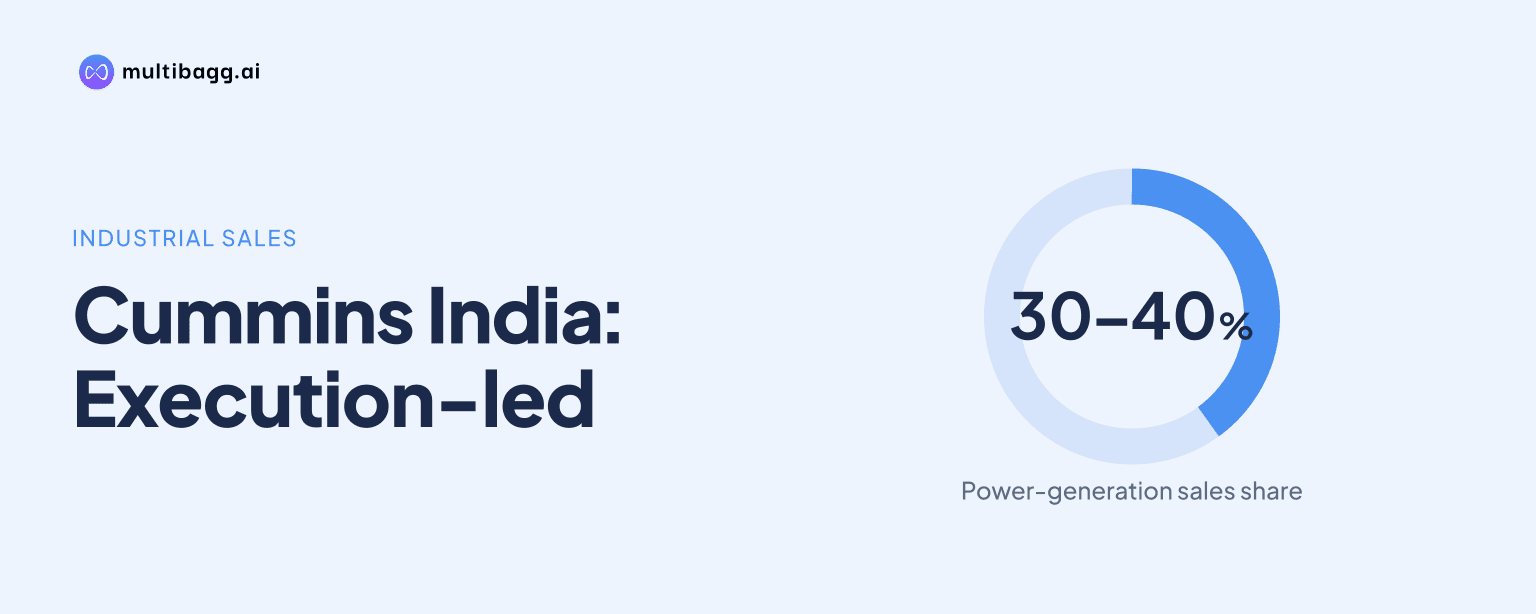
- Data centers accounted for about 30% to 40% of Cummins India power-generation sales.
powered by IRIS
Cummins India Limited said on November 16, 2026 that rail coach-factory inventory, slower marine-project execution and compressor supply constraints restrained current-quarter industrial performance rather than signalling a fundamental demand change; its five disclosed industrial categories generated Rs 378 crore, including Rs 248 crore from construction and rail.
Know Cummins India inside out
Results, valuation, peers and who's buying, in one view.
Why did Cummins India’s industrial business grow slowly?
Cummins India said the slower industrial outcome reflected rail inventory, delayed marine-project execution and compressor supply constraints, rather than one broad demand problem. Management gave that explanation after an analyst referred to 4% growth in the current quarter. It also cited a delivery-mix effect in data-center projects when discussing the wider quarterly growth result, showing that reported sales were affected by execution timing across more than one business.
The rail issue was higher inventory held by coach factories, which made that business softer in the quarter. Marine was slower because certain projects were not executed as quickly as expected, while compressor sales were limited by supply-chain constraints despite demand. These are distinct mechanisms: customer inventory affects replenishment, project progress determines marine delivery, and component availability limits the company’s ability to fulfil compressor demand.
Management said the combination of issues should be viewed as a timing matter over time, not a fundamental change in demand. That comment followed a question on whether rail inventory represented deferred execution that could improve in the second half. Cummins India did not quantify the value of delayed rail orders, unfinished marine projects or compressor deliveries that could not be completed during the current quarter.
Which industrial segments generated the disclosed revenue?
Cummins India reported construction as the largest disclosed industrial category at Rs 131 crore, followed by rail at Rs 117 crore. Compressor revenue was Rs 54 crore, mining contributed Rs 49 crore and marine generated Rs 27 crore. Construction exceeded rail by Rs 14 crore, while rail was more than four times the size of marine despite the coach-factory inventory issue.
The Rs 378 crore total applies only to the five named categories. Management said the remaining industrial business included defence, oil and gas, and parts, but gave no revenue figure for those operations. Construction and rail together made up Rs 248 crore of the disclosed total, so the rail inventory issue affected one of the two largest reported industrial lines.
The segment mix also illustrates why Cummins India did not attribute industrial performance to a single end-market trend. Construction, rail, compressors, mining and marine have different customer cycles and delivery patterns. Management said it continues to pursue opportunities in these markets, including tender-led government infrastructure activity, where it said product availability, distribution and service support are relevant to customer requirements.
Is Cummins India seeing weaker industrial demand?
Cummins India said the issues disclosed for rail, marine and compressors were not evidence of a fundamental demand contraction. In rail, management identified coach-factory inventory as the immediate constraint. In marine, it described the business as project-based and lumpy, meaning revenue depends on the progress of specific projects rather than a uniform quarterly run rate.
Compressor demand was not described as weak. Management said there was demand in that segment but supply-chain constraints made it difficult to deliver products to customers. It did not identify the affected component, disclose the number of delayed units or provide a timetable for restoring full supply, so the transcript does not support an estimate of revenue deferred by the shortage.
Management cautioned against assessing the industrial markets solely on a quarter-to-quarter basis because the drivers can change by period. It said the rail issue should resolve over time, but did not set a recovery date or provide an industrial revenue target. The November 16 call therefore distinguishes management’s longer-term opportunity assessment from the current-quarter evidence of Rs 117 crore in rail, Rs 54 crore in compressors and Rs 27 crore in marine.
Got a follow-up? Ask IRIS
How do execution, supply and pricing affect Cummins India sales?
Cummins India said project execution can influence reported sales in both industrial operations and power generation. Marine revenue depends on specific project progress, while data-center deliveries can alter power-generation mix between quarters. Management said data centers accounted for about 30% to 40% of power-generation sales, with the range fluctuating according to projects, deliveries and execution in a particular quarter.
Customer site readiness can also affect the interval between order and delivery. Management said each project is unique and that timing is driven by customers and project conditions, rather than by a standard company-wide lead time. It declined to disclose delivery times for QSK60 engines or imported generator sets, but said its objective is to help customers meet their project schedules.
Pricing has a separate lag because price changes apply to new orders while Cummins India continues to execute orders already booked at contracted prices. Management said cost increases can occur more quickly than pricing realisation. In industrial tender business, prices are generally agreed when a tender is won, and management said price-change mechanisms are few and far between, limiting immediate adjustments after cost increases.
What should readers watch in Cummins India’s industrial business?
Readers should watch whether rail coach-factory inventories normalise, delayed marine projects progress and compressor supply constraints ease. Cummins India gave no segment-level backlog, deferred-sales value or order-to-delivery timeline on November 16. Future reported revenue in rail, marine and compressors will therefore be the disclosed indicator of whether the temporary constraints are clearing.
The relative movement of the five reported industrial categories also matters. Construction generated Rs 131 crore in the current quarter, compared with Rs 117 crore for rail, Rs 54 crore for compressors, Rs 49 crore for mining and Rs 27 crore for marine. Management did not provide prior-period segment revenue in the call, so readers cannot calculate segment growth rates from the disclosed figures.
Cummins India’s power-generation mix is another execution-sensitive metric because data centers represent about 30% to 40% of sales in that business. Management said non-data-center power generation, including realty, manufacturing and residential projects, performed better in the quarter. It did not disclose a separate revenue number for data centers or for the non-data-center power-generation business.
Conclusion
Cummins India’s explanation for the current-quarter industrial slowdown is specific to execution, inventory and supply conditions. Higher rail inventory affected a Rs 117 crore segment, slower project progress affected Rs 27 crore of marine revenue, and supply constraints limited deliveries in the Rs 54 crore compressor business. The Rs 378 crore disclosed total shows the scale of the five named categories, but no prior-period segment figures were provided for a revenue-growth comparison.
Next, the central unresolved matters are the timing of rail inventory normalisation, marine-project execution and restoration of compressor supply. Management said these conditions should resolve over time and, in its closing comments on November 16, said it expected demand across key end markets to remain resilient. It also said geopolitical uncertainty, commodity inflation and supply-chain resilience would remain areas of focus, without setting a recovery date or segment target.