










Noumed renews Rs 1,506 crore OTC contracts before Adelaide
Key highlights
- Noumed renewed Australian OTC supply contracts with a combined value of Rs 1,506 crore in July and August 2026.
- Noumed targets Adelaide facility commissioning in January 2027, with a TGA inspection anticipated in the second quarter of 2027.
- Management expects Adelaide to reduce inventory holdings from nine to 10 months toward five to six months.
- Australia accounted for 76% of export revenue in Q2 FY27, compared with 83% in Q1 FY27.
powered by IRIS
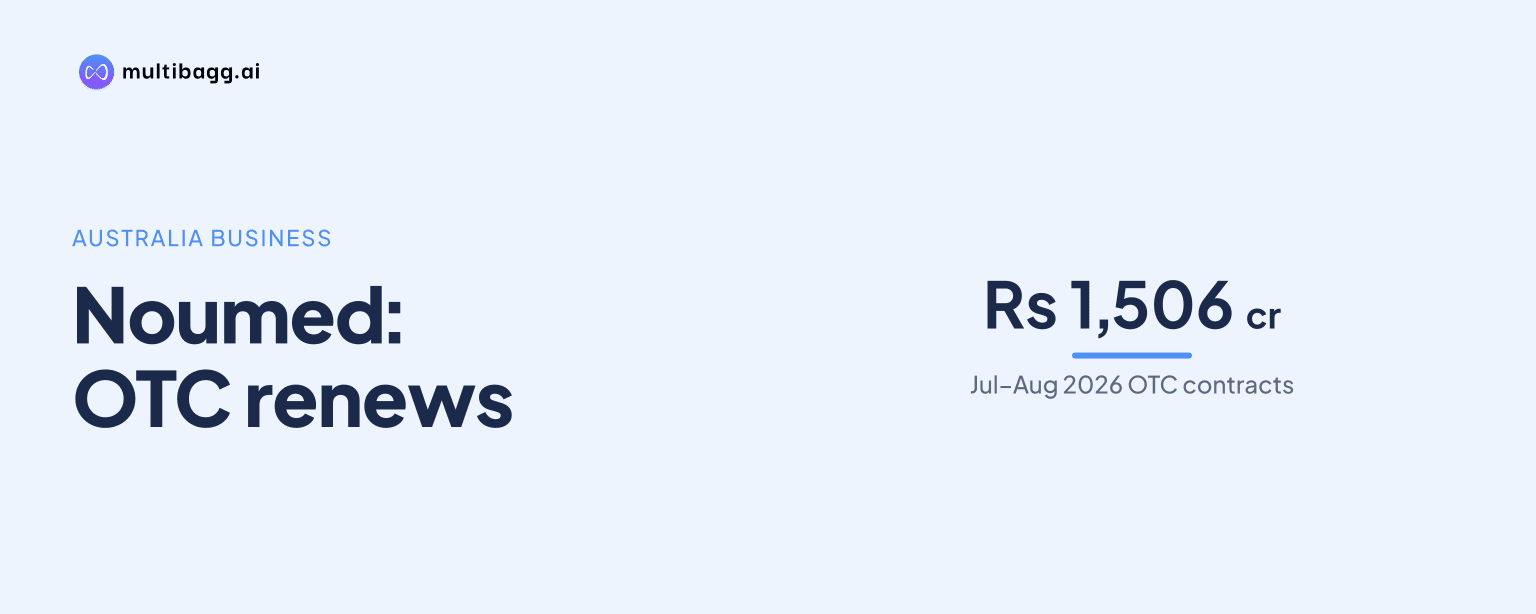
Noumed Pharmaceuticals renewed Australian OTC supply contracts worth Rs 1,506 crore in July and August 2026, providing contracted demand as its Adelaide facility targets January 2027 commissioning. Management said onshore production is intended to replace outsourced packing, reduce inventory holdings from nine to 10 months toward five to six months and improve supply reliability.
Know Sai Parenterals inside out
Results, valuation, peers and who's buying, in one view.
What Australian OTC contracts did Noumed renew?
Noumed renewed two Australian over-the-counter, or OTC, medicine supply agreements with a combined contracted value of Rs 1,506 crore. The first was a 7.5-year exclusive agreement renewed on 1 July 2026 with EBOS Group, covering the TerryWhite and Pharmacy Choice brands. The second was renewed with Wesfarmers on 25 August 2026 for a further three years, covering Priceline and Pharmacy Health.
Management said both agreements carry a larger product portfolio and a higher value than the contracts they replaced. The agreements can also expand through new products and line extensions during their terms, while requiring Noumed to introduce new products each year. This links the contract base to ongoing product development rather than limiting supply to the existing OTC range.
Noumed holds 451 dossiers approved by Australia’s Therapeutic Goods Administration, or TGA, according to management. Management said future development will take place within the Sai group rather than through third parties, creating a connection between Noumed’s Australian pharmacy contracts and the group’s development resources.
How will Noumed’s Adelaide facility change its supply model?
Noumed’s Adelaide facility is intended to bring outsourced packing and manufacturing in-house, enabling part of the current distribution margin to resemble a manufacturing margin on the same contracted revenue. Management expects the plant to be commissioned in January 2027, later than previously advised because logistics disruptions related to the Iran conflict delayed the programme.
The initial model will continue to use tablets supplied from India and support for early packing operations. Sai Parenterals Limited’s Unit III expansion at Bhongir is expected to start from December 2026, with output ramping from Q4 FY27 and most incremental volume directed to Australia and New Zealand. The Indian facility is therefore expected to support Noumed while Adelaide moves through commissioning.
Management’s plan is to lower inventory holdings from nine to 10 months toward five to six months once onshore manufacturing begins. It said shorter supply chains should release warehouse space and working capital, while reducing the disruption risk that affected supply during recent shipping interruptions.
When can Noumed begin commercial supply from Adelaide?
Noumed can begin commercial supply from Adelaide only after the TGA grants a manufacturing licence following the anticipated second-quarter 2027 inspection. Management expects commissioning in January 2027, but said commercial supply will start after the inspection and licence process are complete.
Sai Parenterals had also said Adelaide operations would begin in Q4 FY27, with commercial supply expected in Q1 FY28. The schedule therefore has two separate stages: physical commissioning of the facility and regulatory approval for commercial output. The timing of the licence remains the key unresolved milestone in the transition from outsourced operations.
The facility is intended to improve supply reliability for pharmacy partners served under the renewed agreements. Management said shipping disruptions had inhibited supply under the existing model, whereas local production should shorten the route between Noumed and Australian pharmacy customers once the licence is granted.
Got a follow-up? Ask IRIS
How significant is Australia within Noumed’s wider group operations?
Australia accounted for 76% of export revenue in Q2 FY27, down from 83% in Q1 FY27, reflecting a return toward management’s planned 70:30 export-capacity split between Australia and other markets. Management said the Q1 share was elevated because the group supplied additional volumes when Noumed’s third-party contract manufacturers fell short.
Exports made up about 73% of Sai Parenterals’ Q2 FY27 consolidated revenue, while contract development and manufacturing organisation, or CDMO, business contributed about 73% of quarterly revenue. Branded generics accounted for the remaining 27%, placing the Australian contracts within an export-led and CDMO-led revenue mix.
The Philippines increased to 16% of export revenue in Q2 FY27 from 12% in Q1 FY27 after the group added 11 molecules and 22 stock-keeping units, or SKUs. These included telmisartan-amlodipine, sacubitril-valsartan and rosuvastatin. South Africa accounted for 4% of export revenue and other markets 3%, leaving Australia as the largest export exposure.
What other capacity and financial developments support Noumed?
Unit III is planned to increase monthly manufacturing capacity from 85.5 million units to 155 million units, an 81% rise, with much of the additional output intended for Australia and New Zealand. The expansion includes high-capacity ointment manufacturing, a high-speed capsule-filling line, and high-speed liquid oral manufacturing and filling lines, with ramp-up expected from Q4 FY27.
Sai Parenterals reported Q2 FY27 consolidated revenue of Rs 196.1 crore, up 9% from Rs 179.9 crore in Q1 FY27. Earnings before interest, tax, depreciation and amortisation, or EBITDA, rose 67.4% sequentially to Rs 41.4 crore, while EBITDA margin increased to 21.1% from 13.7% as gross margin rose to 47.5% from 40.9%.
At 30 September 2026, Sai Parenterals had total borrowings of Rs 357 crore, compared with about Rs 320 crore at March 2026, and cash and cash equivalents of Rs 129 crore. Management said about Rs 70 crore was spent on projects in H1 FY27, mainly Adelaide and Unit III, and expects FY26 to be the peak debt year before assets start earning in FY28 and FY29.
Conclusion
The Rs 1,506 crore contract renewals give Noumed a multi-year supply base across four Australian pharmacy brands while the group prepares capacity in Adelaide and India. The model combines contracted OTC demand with a planned shift from outsourced packing to local manufacturing, while Australia’s export contribution moved from 83% in Q1 FY27 to 76% in Q2 FY27 after exceptional support volumes subsided.
The next events to watch are Adelaide’s targeted January 2027 commissioning, the anticipated TGA inspection in the second quarter of 2027, and commercial supply after licence approval. Management has also identified Unit III’s Q4 FY27 output ramp and the planned inventory reduction from nine to 10 months toward five to six months as operating milestones for the transition.