










Sai Parenterals targets July 2027 for 47% injectable lift
Key highlights
- Sai Parenterals targets July 2027 completion of its Rs 215 crore Gummadidala injectable facility.
- The planned facility is designed for approximately 154.66 million injectable units, 47% above the proposed Units I and II upgrade outcome.
- Management expects accreditation within about 12 months of completion, exports from FY28 and Europe entry from FY29.
- Unit III monthly capacity is expected to rise 81% to 155 million units from 85.5 million units.
powered by IRIS
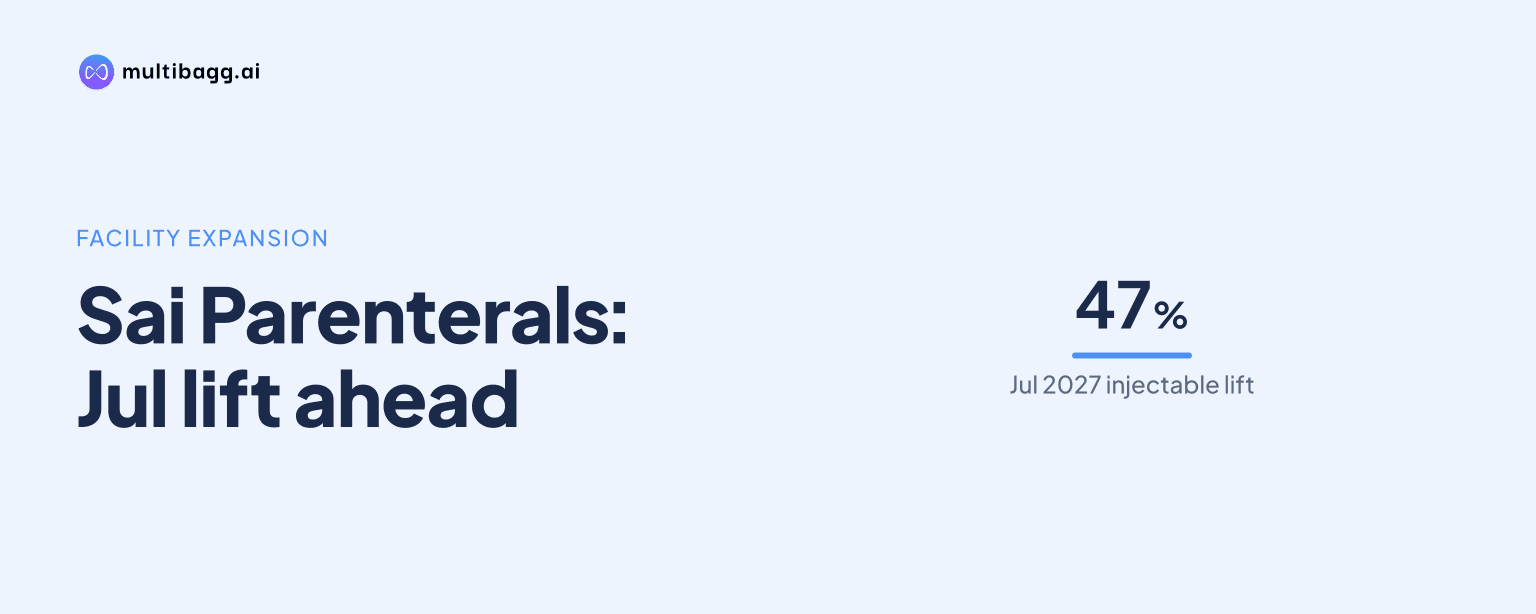
Sai Parenterals Limited is targeting July 2027 completion of a Rs 215 crore injectable facility that management says will take capacity to about 154.66 million units, 47% above the outcome from upgrading Units I and II. The Gummadidala plant is intended to meet European Union Good Manufacturing Practice and US Food and Drug Administration standards, with exports expected from FY28.
Know Sai Parenterals inside out
Results, valuation, peers and who's buying, in one view.
When will Sai Parenterals complete and accredit the new injectable plant?
Sai Parenterals is targeting July 2027 to complete the Saicriti Pharma injectable facility at Gummadidala, outside the Outer Ring Road. Management said foundation work was under way, the layout design was complete and purchase orders had been placed for process lines including liquid and lyophilised injectables, glucagon-like peptide-1, or GLP-1, pre-filled syringe products, dry-powder filling and ampoule filling. Clean utilities and heating, ventilation and air-conditioning systems remained in detailed engineering.
The July 2027 date is a construction target, not a date for regulated-market sales. Management expects accreditation within about 12 months of completion, exports from FY28 and entry into Europe from FY29. The plant is being built to European Union Good Manufacturing Practice, or EU GMP, and US Food and Drug Administration, or US FDA, standards, but management did not say that either regulator had approved the site.
How much injectable capacity will Sai Parenterals add?
Sai Parenterals expects the Gummadidala facility to take injectable capacity to approximately 154.66 million units, about 47% more than upgrading Units I and II would have delivered. The company is therefore replacing its two Jeedimetla injectable units rather than pursuing the previously contemplated upgrade. Management said Units I and II will be discontinued once the Saicriti facility is commissioned.
The facility adds lyophilisation and GLP-1 manufacturing, two capabilities management identified as new to the replacement project. Lyophilisation is a freeze-drying process used for certain injectable medicines. Sai Parenterals also plans to manufacture its domestic critical-care franchise, worth around Rs 52 crore according to management, at the new facility.
The injectable project is separate from the expansion of Unit III at Bhongir. Unit III is expected to start its new block from December 2026 and lift monthly capacity to 155 million units from 85.5 million units, an 81% increase. That expansion adds ointment, capsule and liquid-oral capacity, with most incremental volume planned for Australia and New Zealand, whereas Gummadidala is intended as the regulated-market injectable platform.
How will Sai Parenterals fund the Rs 215 crore project?
Sai Parenterals estimates the total cost of the Gummadidala project at Rs 215 crore, of which its contribution is Rs 83.83 crore. Management said this amount was unchanged from the sum originally earmarked for injectable capacity. The promoters of Saicriti Pharma will fund 40% of Saicriti’s equity, while the remainder is to come through project debt with a three-year moratorium and a seven-year repayment schedule.
The company has allocated Rs 98.83 crore of initial public offering proceeds to its two completed acquisitions: Rs 83.83 crore for a 60% stake in Saicriti Pharma and Rs 15 crore for a 60% stake in Sai Prathyak Laboratories. Shareholders approved the revised use of proceeds, under which Rs 3 crore originally set aside for a research centre was moved to general corporate purposes. Management said the strategic purpose remained EU GMP-compliant injectable capacity and a dedicated research and development platform.
At September 30, 2026, Sai Parenterals reported total borrowings of Rs 357 crore, compared with about Rs 320 crore at March 2026, and cash and cash equivalents of Rs 129 crore. It spent about Rs 70 crore on projects in H1 FY27, mainly on the Adelaide facility and Unit III. These reported balance-sheet figures precede the expected construction and debt funding of the Gummadidala project.
Got a follow-up? Ask IRIS
What products and development work will support Sai Parenterals' plant?
Sai Parenterals plans to use Sai Prathyak Laboratories as the group’s research and development platform after acquiring a 60% stake on September 15, 2026. Sai Prathyak has 65 personnel, including 28 research scientists, and three years of operating history in lyophilised, liposomal and nano-based complex injectables and oncology. Its portfolio comprises 174 molecules and 285 stock-keeping units across critical care and oncology.
Management said Sai Prathyak’s complex critical-care injectable portfolio will be transferred to the Saicriti site for the group’s own manufacturing. This is intended to avoid a further development period once the plant is built. Molecules developed before the acquisition remain with Sai Prathyak’s existing shareholders, although the group may use them for its own manufacturing and Saicriti is entitled to transfer them to the upcoming site.
Sai Parenterals has also developed 98 dossiers in-house in its standalone business, with 45 products commercialised and 76 under development for FY28. A dossier is a regulatory and technical product file used to support registrations. The group additionally has 599 approved registrations and more than 451 Therapeutic Goods Administration dossiers acquired with Noumed; Sai Prathyak expects to begin external research and contract research organisation development contracts from the next quarter, with revenue projected from FY28.
What does the project mean for Sai Parenterals' FY28 plans?
Sai Parenterals has described FY27 as a year of building and said FY28 is when its projects should begin to affect performance. For Gummadidala, management’s sequence is July 2027 completion, about 12 months for accreditation and exports from FY28, followed by Europe from FY29. These are management expectations that depend on construction completion and the required accreditation.
The plant does not contribute to the Q2 FY27 results. Consolidated revenue rose 9% sequentially to Rs 196.1 crore from Rs 179.9 crore in Q1 FY27, while earnings before interest, tax, depreciation and amortisation, or EBITDA, rose 67.4% to Rs 41.4 crore from Rs 24.7 crore. EBITDA margin increased to 21.1% from 13.7%, as gross margin rose to 47.5% from 40.9% following lower raw-material cost and inventory controls.
The nearer operational milestone is Unit III, where management expects added volumes to ramp from Q4 FY27. Separately, the Adelaide facility is expected to begin operations in Q4 FY27, with commercial supply expected in Q1 FY28 after licensing. Gummadidala has a later timetable and a different role: replacing the Jeedimetla injectable units while adding lyophilisation, GLP-1 capability and a planned route to regulated markets.
Conclusion
Sai Parenterals is using the Rs 215 crore Gummadidala project to replace rather than upgrade Units I and II, targeting approximately 154.66 million units of injectable capacity, 47% above the former upgrade outcome. The project also connects manufacturing capacity with Sai Prathyak’s 174-molecule portfolio and its 28 research scientists, while the separate Unit III expansion addresses ointment, capsule and liquid-oral output.
The next disclosed milestones are Unit III’s December 2026 start, its Q4 FY27 volume ramp, and Gummadidala’s July 2027 completion target. Management’s export forecast depends on the subsequent accreditation process of about 12 months, with exports expected from FY28 and European entry from FY29.