










Om Metallogic capacity rises 73%, FY26 utilisation falls
Key highlights
- Om Metallogic increased installed aluminium-alloy capacity by 73% to 9,125 tonnes a year in FY2025-26.
- FY2025-26 aluminium-alloy production fell to 3,074 tonnes from 3,184 tonnes in FY2024-25.
- Reported capacity utilisation declined to 34% in FY2025-26 from 60% in FY2024-25.
- Om Metallogic reported 1,844 tonnes of production in the six months ended September 30, 2026.
powered by IRIS
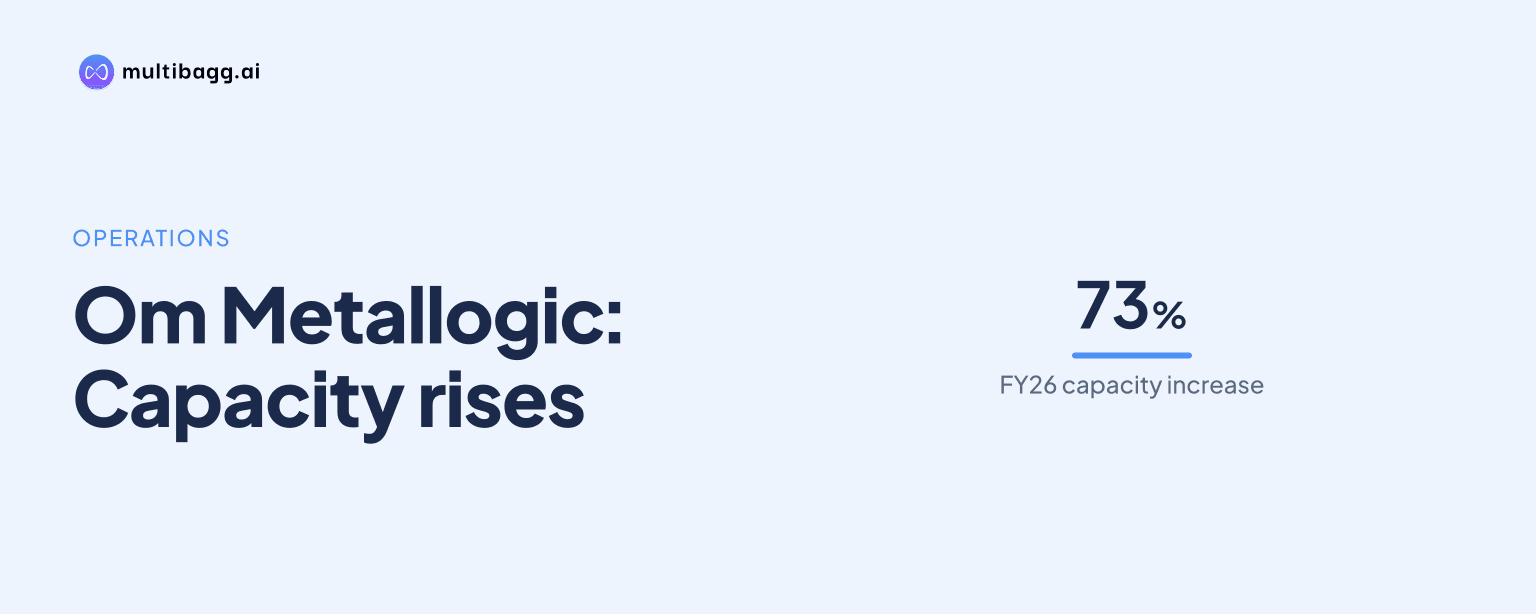
In FY2025-26, Om Metallogic Limited increased aluminium-alloy installed capacity by 73% to 9,125 tonnes a year, but actual production fell to 3,074 tonnes from 3,184 tonnes and reported capacity utilisation declined to 34% from 60%. The expansion therefore coincided with lower use of the company’s sole manufacturing facility.
Know Om Metallogic inside out
Results, valuation, peers and who's buying, in one view.
What changed in Om Metallogic’s aluminium-alloy capacity in FY26?
Om Metallogic increased its installed aluminium-alloy capacity to 9,125 tonnes a year in FY2025-26 from 5,280 tonnes in both FY2023-24 and FY2024-25. The 3,845-tonne increase equals about 73% of the earlier capacity base. The company reported the same 9,125-tonne annual installed capacity as of September 30, 2026.
Om Metallogic operates one manufacturing facility at Kila No. 17, Harfala Road, Village Sikri, Ballabhgarh, Haryana. The site has raw-material and finished-goods storage, quality-control equipment and a processing team. Its registered office and manufacturing facility are held under a five-year lease running from September 12, 2025 to September 11, 2030.
The capacity rise did not translate into higher FY2025-26 production. Actual output was 3,074 tonnes in FY2025-26, or 110 tonnes below FY2024-25 output of 3,184 tonnes. In FY2023-24, when installed capacity was also 5,280 tonnes, actual output was 2,407 tonnes, making FY2024-25 the highest-production year among the three full financial years disclosed.
Why did Om Metallogic’s utilisation fall in FY26?
Om Metallogic’s reported utilisation fell because capacity expanded materially while annual production declined. The disclosed utilisation rate moved from 60% in FY2024-25 to 34% in FY2025-26, a 26-percentage-point reduction. The company’s capacity-utilisation table notes that the figures are rounded off.
At the previous 5,280-tonne capacity, FY2024-25 output of 3,184 tonnes represented the disclosed 60% utilisation rate. In FY2025-26, installed capacity rose by 3,845 tonnes while output fell by 110 tonnes. This combination, rather than a reported reduction in manufacturing capability, accounts for the lower disclosed utilisation percentage.
Om Metallogic does not state in the disclosure why FY2025-26 production was lower than FY2024-25 production. It says production volumes are planned using demand forecasts, while sales are governed by short-term purchase orders rather than binding long-term customer commitments. The company identifies forecasting errors and demand that does not match production levels as risks to inventory, cash flows and operations.
How much of Om Metallogic’s FY26 capacity was unutilised?
Om Metallogic had approximately 6,051 tonnes of capacity not represented by FY2025-26 actual production, calculated as 9,125 tonnes of installed annual capacity less 3,074 tonnes produced. On the same basis, the gap was 2,096 tonnes in FY2024-25, when capacity was 5,280 tonnes and output was 3,184 tonnes. The calculated unused-capacity gap therefore widened by 3,955 tonnes year on year.
Om Metallogic explicitly warns that under-utilisation over extended periods, or significant under-utilisation in the short term, could adversely affect its business, growth prospects and future financial performance. Its disclosure does not quantify the financial impact of the 34% FY2025-26 utilisation rate and does not provide a target utilisation level for the 9,125-tonne facility.
For the six months ended September 30, 2026, Om Metallogic reported 1,844 tonnes of actual production and 20% capacity utilisation against the same 9,125-tonne annual installed capacity. This partial-period figure should not be treated as a full-year production forecast because the company labels the period as six months and does not annualise the 1,844 tonnes in its disclosure.
Got a follow-up? Ask IRIS
What operating factors could affect Om Metallogic’s capacity use?
Om Metallogic’s production is concentrated at its single Haryana facility, making continued operation of that site relevant to the use of its 9,125-tonne capacity. The company says the facility depends mainly on public or state power utilities, although it has a backup diesel-generator set for intermittent electricity supply. An extended power interruption could reduce production and increase production costs, according to the disclosure.
The manufacturing process involves melting aluminium in a hot-refining section, and Om Metallogic identifies equipment failure, accidents and industrial-production disruptions as operating risks. The company reported no material incident requiring an insurance claim during the past three financial years, but says an accident could suspend operations and result in liabilities or losses not fully covered by insurance.
Demand and customer concentration are additional factors. In FY2025-26, Om Metallogic’s top 10 customers accounted for 96.47% of revenue from operations, while its largest customer contributed 58.57%. Om Metallogic has not entered into long-term agreements with customers, so reductions, delays or cancellations in orders from major buyers could affect planned production volumes at the Haryana site.
Geographic concentration is also pronounced: Haryana accounted for 99.20% of FY2025-26 domestic revenue of Rs 75.13 crore, while Delhi and Uttar Pradesh accounted for 0.20% and 0.60%, respectively. Om Metallogic says adverse local, regional, environmental or transport developments could affect manufacturing, raw-material movement and product deliveries. Its principal raw materials include aluminium-based scrap and silicon, for which it does not have long-term supplier agreements.
Conclusion
Om Metallogic expanded installed aluminium-alloy capacity from 5,280 tonnes to 9,125 tonnes a year in FY2025-26, but output slipped from 3,184 tonnes to 3,074 tonnes. The result was a reported utilisation decline from 60% to 34%, with the calculated gap between installed capacity and production widening to 6,051 tonnes. The disclosed figures show that added capacity was not matched by higher production during FY2025-26.
The next indicator to watch is whether Om Metallogic can align production with customer demand and use more of its 9,125-tonne facility. Management says it plans production from demand forecasts and seeks to grow its presence in other markets, but the disclosure gives no utilisation target or timetable. The six months ended September 30, 2026, with production of 1,844 tonnes and reported utilisation of 20%, provides the latest disclosed operating datapoint.