










ONGC carries ₹15,583 crore PMT claim and ₹21,138 crore provision
Key highlights
- ONGC disclosed a ₹15,583 crore PMT arbitration demand as a contingent liability at September 30, 2026.
- ONGC recognised a ₹21,138 crore provision for disputed Service Tax and GST on royalty.
- ONGC had deposited ₹20,139 crore under protest against disputed royalty-tax demands by September 30, 2026.
- ONGC's PMT contingent liability increased from ₹15,225 crore at March 31, 2026.
powered by IRIS
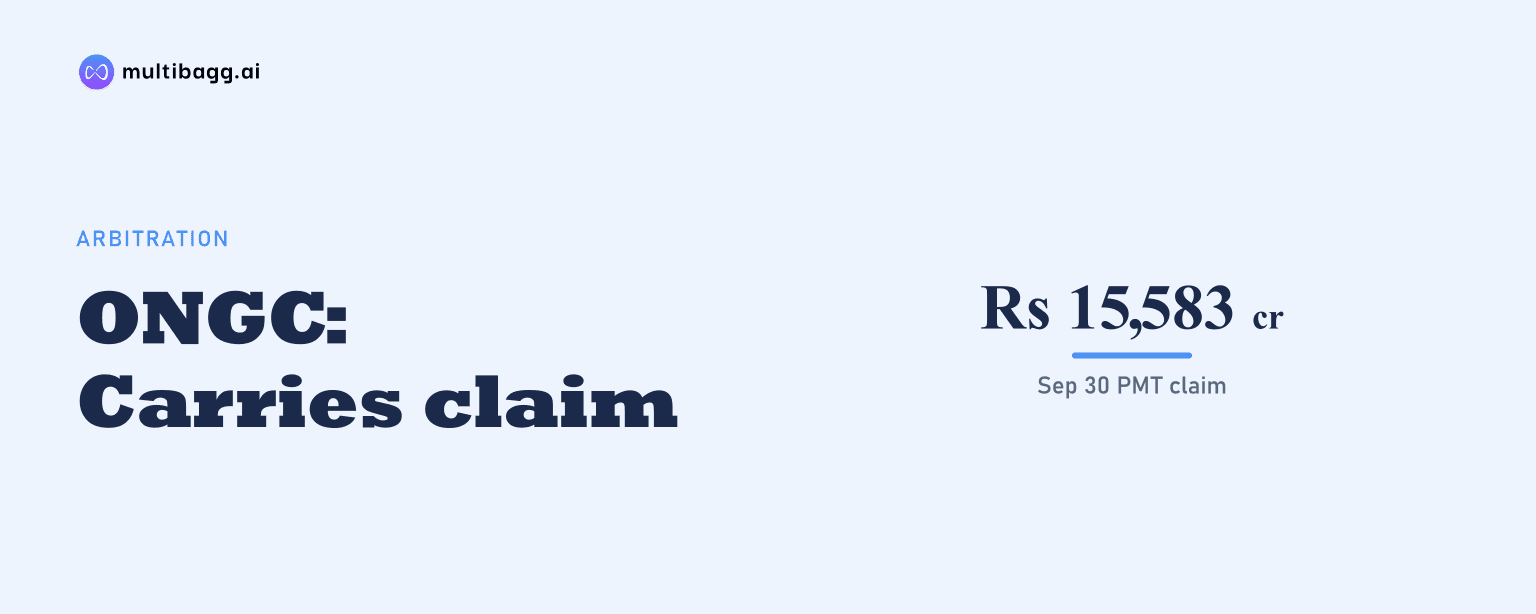
Oil and Natural Gas Corporation Limited disclosed a ₹15,583 crore Panna-Mukta and Mid & South Tapti, or PMT, contingent liability at September 30, 2026, while ONGC recognised a ₹21,138 crore provision for disputed royalty tax and had deposited ₹20,139 crore under protest. The filing gives the two matters different accounting treatment.
Know Oil & Natural Gas Corpn inside out
Results, valuation, peers and who's buying, in one view.
What is ONGC's ₹15,583 crore PMT arbitration exposure?
ONGC's ₹15,583 crore PMT exposure is a contingent liability rather than a recognised provision. It is ONGC's 40% participating-interest share of a Directorate General of Hydrocarbons demand for differential Government profit petroleum and royalty, including interest up to November 30, 2016, as translated at September 30, 2026.
The demand concerns two production sharing contracts for the Panna-Mukta and Mid & South Tapti fields signed with the Government of India on December 22, 1994. ONGC held a 40% participating interest, while Reliance Industries Limited and BG Exploration and Production India Limited each held 30%; the contracts expired on December 21, 2019, but the PMT asset-handover agreement makes the contractors liable for pre-existing liabilities.
The disclosed rupee equivalent increased by ₹358 crore during the six months to September 30, 2026. ONGC said the joint-venture partners contest the demand as premature because liabilities remain to be finally quantified and related awards remain subject to judicial and arbitral proceedings.
Why has ONGC not recognised a PMT provision?
ONGC has not recognised a provision because arbitration and court proceedings, including arbitration on the Cost Recovery Limit, or CRL, remain pending. ONGC said the CRL arbitration may reduce the liability, and it has therefore disclosed the ₹15,583 crore demand as a contingent liability pending finality on the issues.
The dispute followed the arbitration tribunal's Final Partial Award of October 12, 2016 on production-sharing contract provisions including cost recovery and profit petroleum. After a May 2, 2018 English Commercial Court verdict, the tribunal reconsidered some findings; the English Court upheld the revised arbitration award on June 9, 2022, and rejected the Government of India's appeal in August 2022.
A Delhi High Court decision dismissed the Government's execution petition on the 2016 Final Partial Award as premature and not maintainable. The Government appealed, and a division bench held that the appeal was maintainable; the hearing remained pending at the September 30, 2026 reporting date. ONGC said the PMT disclosure relies on information provided by BG Exploration and Production India Limited, a joint operator of the venture.
How does ONGC's royalty-tax provision differ from the PMT claim?
ONGC recognised a ₹21,138 crore provision for disputed Service Tax and Goods and Services Tax, or GST, on royalty, unlike the ₹15,583 crore PMT contingent liability. ONGC said it recognised the royalty-tax amount prudently because litigation had been prolonged, while continuing to challenge demand orders before judicial forums.
The royalty dispute concerns the nature and taxability of royalty paid for crude oil and natural gas under the Oilfields (Regulation and Development) Act. The matter was pending before the Supreme Court of India at September 30, 2026, so the provision does not resolve the underlying judicial dispute.
The provision increased by ₹1,493 crore over the six-month period, while deposits under protest rose by ₹1,492 crore. At September 30, 2026, the deposited amount was ₹999 crore below the provision, based on the standalone financial disclosure.
Got a follow-up? Ask IRIS
What other contingent liabilities has ONGC disclosed?
ONGC disclosed a further ₹7,186 crore contingent liability for other joint-venture partners' shares of disputed Service Tax and GST at September 30, 2026, compared with ₹6,683 crore at March 31, 2026. ONGC did not recognise this amount as a provision, citing contractual arrangements and legal opinion.
The other-partners matter includes disputes in joint-venture blocks and a fresh arbitration involving the Rajasthan joint venture. ONGC said its position is supported by an opinion of the Additional Solicitor General of India and relates to its view that production-sharing contract terms require joint-venture partners to pay Service Tax and GST.
Separately, ONGC disclosed ₹2,213 crore for disputed penalty demands and other matters, compared with ₹2,187 crore at March 31, 2026. Together, the PMT demand, other joint-venture partners' tax shares and penalty-related matters amounted to ₹24,982 crore of disclosed contingent liabilities at September 30, 2026, but they concern separate disputes.
How do the exposures sit in ONGC's September 2026 accounts?
ONGC reported total standalone provisions of ₹54,745.69 crore at September 30, 2026, comprising ₹52,215.06 crore of non-current provisions and ₹2,530.63 crore of current provisions. The ₹21,138 crore royalty-tax amount is within recognised provisions, whereas the ₹15,583 crore PMT matter is disclosed outside them as a contingent liability.
Standalone total assets were ₹4,88,818.07 crore at September 30, 2026, while total equity was ₹3,63,659.41 crore and total liabilities were ₹1,25,158.66 crore. Total liabilities declined from ₹1,29,505.76 crore at March 31, 2026, while equity rose from ₹3,31,770.44 crore, although neither movement determines the outcome of the legal matters.
For the half year ended September 30, 2026, ONGC generated ₹52,437.55 crore of net operating cash flow and paid ₹8,313.86 crore of income taxes, net of refunds. The filing identifies ₹20,139 crore of royalty-tax payments as deposits made under protest and does not give a timetable for either the Supreme Court matter or the PMT proceedings.
Conclusion
ONGC's September 2026 disclosure separates a ₹21,138 crore royalty-tax exposure already recognised as a provision from a ₹15,583 crore PMT demand carried as a contingent liability. The distinction reflects the status stated in the filing: the royalty-tax matter has led to a provision and ₹20,139 crore of protest deposits, while PMT proceedings remain unresolved and may affect the claimed amount.
The next disclosed matters to watch are the Supreme Court's adjudication of royalty taxability, the pending Delhi High Court division-bench hearing on the PMT enforcement matter, and the separate CRL arbitration that may reduce the PMT liability. ONGC's Board approved the quarter and half-year results on November 5, 2026.