










Optiemus plans 51:49 CMF venture to expand brand role
Key highlights
- Optiemus proposes a roughly 51:49 CMF joint venture with Nothing, subject to approvals and a definitive agreement.
- Optiemus says its EMS division would undertake the entire manufacturing operation for the proposed CMF venture.
- The cited PLI 2.0 framework includes a 5% baseline rate, plus possible 3% R&D and 1.5% sourcing additions.
- Optiemus separately plans to launch a second B2C category in Q4 FY27.
powered by IRIS
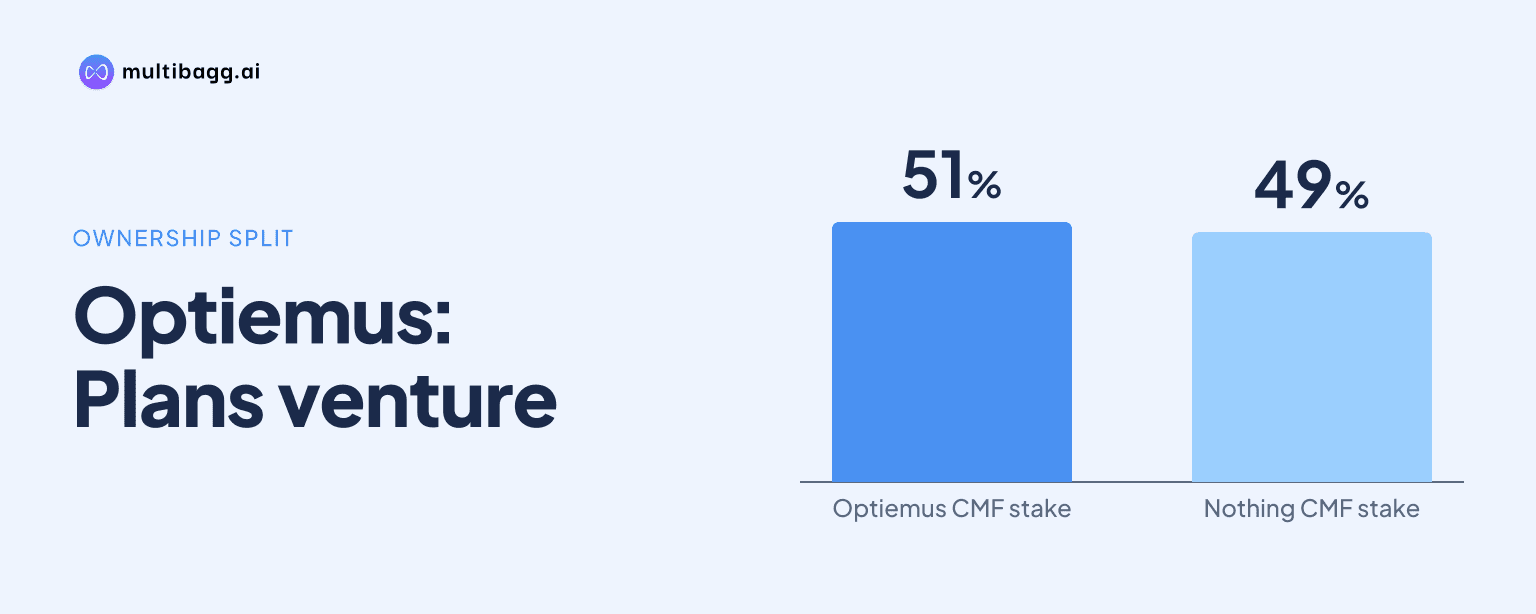
Optiemus Infracom Ltd. plans a roughly 51:49 joint venture with Nothing to create CMF as a standalone Indian consumer-electronics brand, with its entire manufacturing operation intended for Optiemus’ electronics manufacturing services division. The Q2 FY 2026–27 proposal remains subject to a definitive agreement, government guidelines and regulatory approvals.
Know Optiemus Infracom inside out
Results, valuation, peers and who's buying, in one view.
What is Optiemus planning with CMF?
Optiemus is planning a roughly 51:49 joint venture with Nothing to establish CMF as an independent, homegrown Indian consumer-electronics brand. Its Q2 FY 2026–27 presentation describes the proposed arrangement as a strategic joint venture with a controlling interest, but does not specify which party would own the approximately 51% stake.
The proposal has not been completed. Optiemus says a definitive agreement is in progress and that the transaction is subject to fulfilment of government guidelines and receipt of necessary regulatory approvals. The ownership structure, brand entity and manufacturing arrangement are therefore intended outcomes rather than reported current operations.
How would the CMF venture change Optiemus’ role?
The proposed CMF venture would move Optiemus from an electronics manufacturing services, or EMS, provider toward participation in a consumer-technology brand with end-to-end design and research and development, or R&D, capabilities. CMF is intended to operate as a standalone brand entity, rather than being presented only as an EMS manufacturing programme.
Optiemus contrasts the plan with its earlier AI+ smartphone manufacturing partnership, which it describes as a relationship to manufacture smartphones for an Indian brand. The CMF proposal adds brand ownership participation, indigenous design, engineering and advanced R&D to the stated manufacturing role, which Optiemus calls a move up the value chain.
Will Optiemus manufacture CMF products?
Yes, Optiemus says its EMS division would undertake the entire manufacturing operations for the proposed CMF venture. The company describes this routing as a large revenue opportunity for the EMS vertical, though its Q2 FY 2026–27 presentation gives no revenue forecast, production volume, plant location or manufacturing start date.
The proposed structure links a consumer-facing CMF brand to captive manufacturing volume at the EMS division. Optiemus says this arrangement would help it capture more of the value chain while driving factory activity through its manufacturing vertical, but it does not quantify expected capacity utilisation, handset volumes or the financial contribution.
The plan also has an export dimension. Optiemus says the proposed manufacturing-hub expansion is designed to serve growing domestic demand and global export markets, but it does not disclose export orders, destination countries, shipment targets or an overseas launch timetable.
Got a follow-up? Ask IRIS
What PLI 2.0 incentives does Optiemus cite?
Optiemus cites a Rs 62,500 crore production-linked incentive, or PLI, 2.0 scheme that provides Indian brands a 5% baseline incentive on eligible domestic smartphone sales. The company presents the CMF proposal as a way to pursue these incentives, not as evidence that the proposed venture has received any incentive payment.
The presentation identifies two additional incentive rates tied to operational localisation. It cites a 3% addition for in-house R&D and a 1.5% addition for domestic component sourcing, including enclosures and back glass, displays and cover glass, cameras, batteries and cables.
If all three cited rates applied, they would total 9.5% of eligible domestic smartphone sales. That total is an arithmetic combination of Optiemus’ disclosed 5%, 3% and 1.5% rates, rather than a forecast of incentive income, because the presentation does not state qualifying sales, thresholds or compliance conditions for CMF.
How would R&D and localisation be organised?
The proposed CMF entity would localise R&D and engineering for smartphone design, engineering and advanced research activities. Optiemus describes this as deeper vertical integration and indigenous capability-building, which aligns with the 3% in-house-R&D addition it cites under the PLI 2.0 framework.
Domestic component sourcing is another stated part of the strategy because the presentation identifies a possible 1.5% incentive addition for local enclosures, displays, cameras, batteries and cables. Optiemus does not disclose whether CMF products currently meet these sourcing conditions, the extent of existing localisation, or when the proposed entity could become eligible under government guidelines.
Is Optiemus launching another B2C category?
Yes, Optiemus separately says it plans to launch a second business-to-consumer, or B2C, category in Q4 FY27. The company describes the unidentified category as a rapidly expanding consumer segment in advanced development and says its manufacturing capability and distribution network can provide immediate go-to-market scale.
The Q4 FY27 category is not identified as part of the CMF proposal. Optiemus describes its B2C approach as manufacturing products in-house, branding them and distributing them through its network, but it does not disclose the product category, launch economics, sales target or whether it would use the proposed CMF joint-venture structure.
Conclusion
The proposed roughly 51:49 CMF venture would combine a standalone Indian consumer-electronics brand, local design and R&D, and captive manufacturing through Optiemus’ EMS division. The plan’s stated strategic rationale is to move beyond contract manufacturing while pursuing the PLI 2.0 structure, which lists a 5% baseline rate and potential additions of 3% and 1.5%.
The next disclosed milestones are completion of the definitive agreement, fulfilment of government guidelines and necessary regulatory approvals, all outstanding in Q2 FY 2026–27. Optiemus’ separate Q4 FY27 launch of a second B2C category is another scheduled event to watch, particularly for details on its product scope and use of the company’s manufacturing and distribution network.