










Ovobel Foods first-half profit more than doubles to Rs 19.85 crore
Key highlights
- Ovobel Foods’ first-half profit rose to Rs 19.85 crore from Rs 9.16 crore a year earlier.
- First-half revenue from operations increased to Rs 137.16 crore from Rs 119.33 crore.
- September-quarter profit fell to Rs 4.45 crore from Rs 6.41 crore a year earlier.
- Net operating cash flow reached Rs 12.58 crore, compared with Rs 6.77 crore in the prior-year half.
powered by IRIS
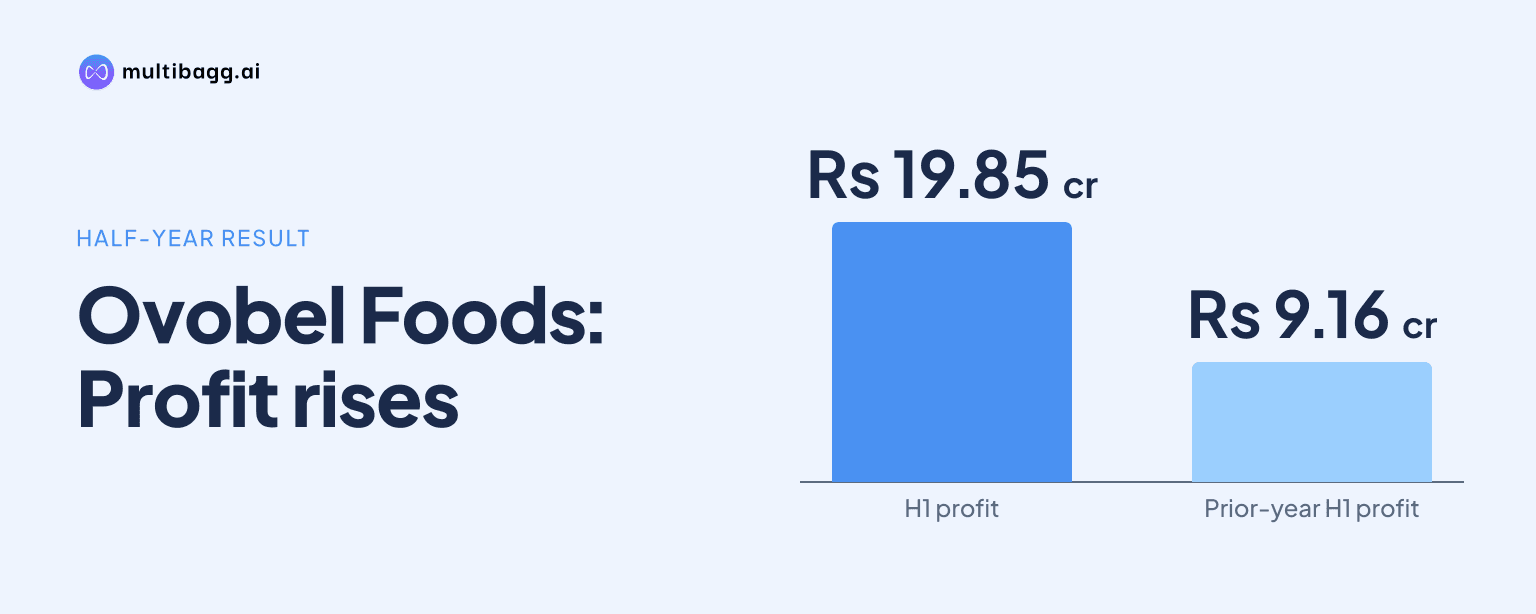
Ovobel Foods Limited reported unaudited profit of Rs 19.85 crore for the six months ended September 30, 2026, more than double Rs 9.16 crore a year earlier, while September-quarter profit fell to Rs 4.45 crore from Rs 6.41 crore. First-half revenue rose, but the latest quarter was below both the prior-year quarter and June 2026.
Know Ovobel Foods inside out
Results, valuation, peers and who's buying, in one view.
How did Ovobel Foods perform in the first half?
Ovobel Foods more than doubled first-half profit to Rs 19.85 crore in the six months ended September 30, 2026, from Rs 9.16 crore in the corresponding 2025 period. Revenue from operations increased to Rs 137.16 crore from Rs 119.33 crore, total income rose to Rs 143.49 crore from Rs 121.50 crore, and profit before tax increased to Rs 26.52 crore from Rs 12.31 crore.
Higher other income accompanied the first-half improvement, reaching Rs 6.33 crore from Rs 2.17 crore a year earlier. Total expenses increased to Rs 116.97 crore from Rs 109.19 crore, while tax expense was Rs 6.67 crore versus Rs 3.15 crore. Basic and diluted earnings per share, not annualised, were Rs 19.40, compared with Rs 9.64 in the prior-year half.
Ovobel Foods reports food products as a single operating segment under Indian Accounting Standard 108, so the results do not separate revenue or profitability by product category. The board took the unaudited results on record on November 6, 2026, following review by the audit committee, and ASA & Associates LLP issued a limited review report.
Why was Ovobel Foods’ September quarter lower?
Ovobel Foods reported September-quarter profit of Rs 4.45 crore, down from Rs 6.41 crore in the quarter ended September 30, 2025 and Rs 15.40 crore in the June 2026 quarter. Revenue from operations was Rs 57.19 crore, compared with Rs 58.41 crore a year earlier and Rs 79.97 crore in the preceding quarter.
Total income in the September quarter was Rs 59.83 crore, marginally above Rs 59.70 crore a year earlier because other income rose to Rs 2.64 crore from Rs 1.29 crore. However, profit before tax declined to Rs 5.98 crore from Rs 8.62 crore in the prior-year quarter and Rs 20.54 crore in June 2026.
The inventory-change line was an expense of Rs 3.28 crore in the September quarter, compared with income adjustments of Rs 5.75 crore in September 2025 and Rs 3.87 crore in June 2026. Material consumption declined to Rs 38.55 crore from Rs 45.67 crore a year earlier, while employee benefit expense rose to Rs 3.51 crore from Rs 3.16 crore and depreciation and amortisation rose to Rs 1.38 crore from Rs 1.07 crore.
Got a follow-up? Ask IRIS
What changed in Ovobel Foods’ investment accounting and income?
Ovobel Foods reassessed its business model for managing mutual-fund investments during the period and reclassified them from fair value through other comprehensive income, or FVOCI, to fair value through profit or loss, or FVTPL. The company said the reclassification was applied prospectively from the applicable date under Indian Accounting Standard 109 on financial instruments.
Under the revised treatment, subsequent gains or losses from changes in the investments’ fair value will be recognised in other income in the statement of profit and loss, while their fair value remains recognised on the balance sheet. Current investments stood at Rs 39.98 crore at September 30, 2026, compared with Rs 35.21 crore at March 31, 2026.
Finance cost for the first half fell to Rs 66.11 lakh from Rs 1.04 crore, while depreciation and amortisation increased to Rs 2.48 crore from Rs 2.23 crore. Other expenses were broadly unchanged at Rs 13.56 crore, compared with Rs 13.54 crore. Management said outstanding trade receivables were expected to be realised within 180 days and that no expected-credit-loss provision was required at the reporting date.
What do Ovobel Foods’ cash flow and balance sheet show?
Ovobel Foods generated net operating cash flow of Rs 12.58 crore in the six months ended September 30, 2026, compared with Rs 6.77 crore in the prior-year period. Cash generated from operations was Rs 17.82 crore, while direct taxes paid, net of refunds, were Rs 5.23 crore.
Investing activities used Rs 8.50 crore in the first half, compared with an outflow of Rs 1.72 crore a year earlier. Net spending on property, plant and equipment was Rs 6.40 crore against Rs 2.86 crore, and investments in mutual funds were Rs 4.86 crore. Financing activities used Rs 92.05 lakh, including a net repayment of borrowings of Rs 23.38 lakh.
Cash and cash equivalents were Rs 8.73 crore at September 30, 2026, up from Rs 5.56 crore at March 31, 2026 and Rs 1.96 crore at September 30, 2025. Total assets were Rs 173.03 crore, compared with Rs 167.74 crore at March 31. Trade receivables declined to Rs 9.38 crore from Rs 15.11 crore, while inventories increased to Rs 38.67 crore from Rs 37.74 crore.
Total equity rose to Rs 129.94 crore at September 30 from Rs 110.09 crore at March 31. Current borrowings declined to Rs 24.59 crore from Rs 25.34 crore, while non-current borrowings rose to Rs 3.38 crore from Rs 2.86 crore. Total current liabilities fell to Rs 36.67 crore from Rs 51.67 crore, with other current liabilities declining to Rs 4.22 crore from Rs 19.07 crore.
Conclusion
Ovobel Foods recorded substantially higher first-half profit as revenue, total income and operating cash flow increased from the prior-year period. The September quarter nevertheless showed a different pattern, with lower revenue and profit than both the comparable quarter and June 2026, while the inventory-change line moved from an income adjustment to an expense.
The next disclosed developments to watch are the effect of the prospective FVTPL treatment on other income and whether trade receivables are realised within the 180 days expected by management. The company also reported Rs 6.40 crore of first-half net spending on property, plant and equipment, alongside a Rs 4.86 crore investment in mutual funds.