










Panasonic Energy India leaves BWMR obligation unprovided
Key highlights
- Panasonic Energy India reported a Rs 15.49 crore loss after tax for the quarter ended September 30, 2026.
- B S R and Co qualified its review because Panasonic Energy India did not quantify or provide for its BWMR obligation.
- Revenue from operations fell to Rs 54.74 crore in September 2026 from Rs 68.64 crore a year earlier.
- A July 2026 fire at Pithampur produced a Rs 7.26 crore exceptional loss in the September quarter.
powered by IRIS
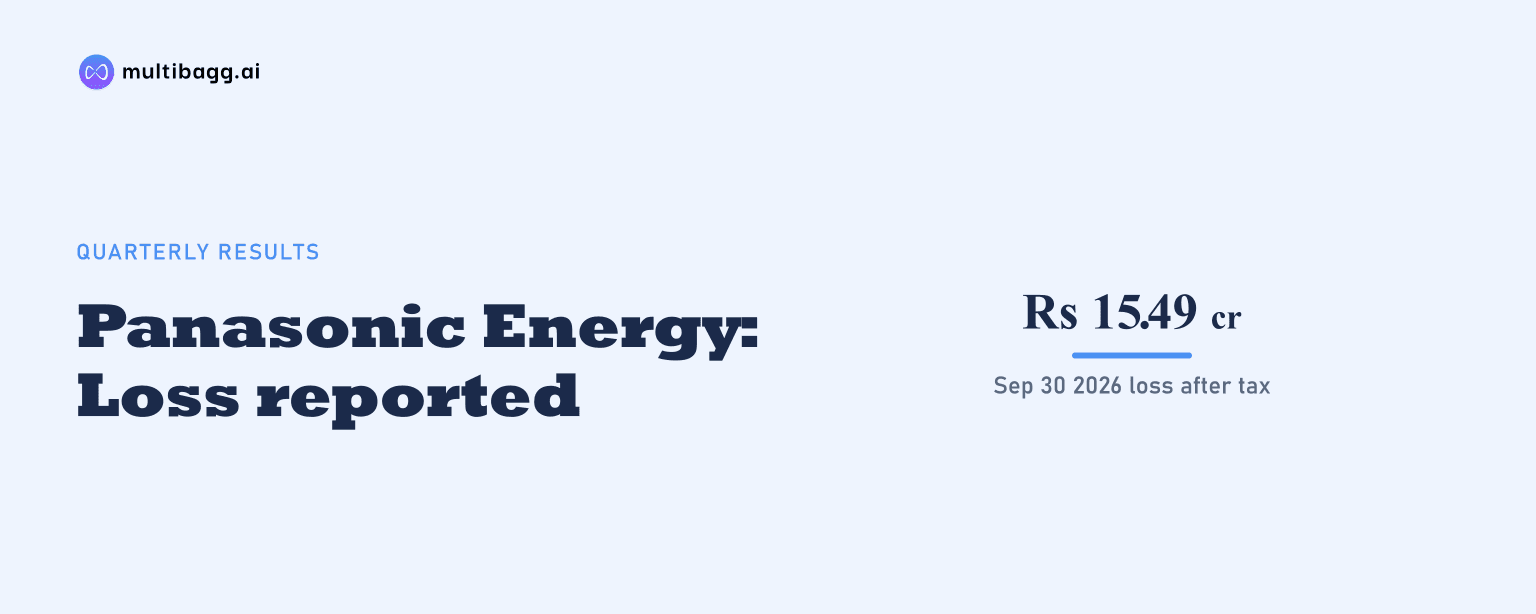
Panasonic Energy India Company Limited left its Battery Waste Management Rules, 2022 obligation unprovided in results for the quarter ended September 30, 2026, leading B S R and Co to qualify its review because it could not assess whether adjustments were needed; the company reported a Rs 15.49 crore loss after tax.
Know Panasonic Energy India Company inside out
Results, valuation, peers and who's buying, in one view.
Why did Panasonic Energy India receive a qualified review?
Panasonic Energy India received the qualification because B S R and Co could not obtain sufficient and appropriate evidence on whether an adjustment, including additional disclosure, was required for the unprovided Battery Waste Management Rules, 2022 obligation. The limited-review report dated November 5, 2026 says the company has been unable to comply with provisions of the Rules.
The Rules require Extended Producer Responsibility, or EPR, for recycling and/or refurbishment targets. Although the Central Pollution Control Board, or CPCB, has notified environmental-compensation rates for failure to meet those targets, Panasonic Energy India had neither estimated nor recognised a provision in its September 30, 2026 financial results.
The matter was already present in the financial results for the year ended March 31, 2026. B S R and Co said its opinion on those annual results was also qualified over the same issue, while Panasonic Energy India’s statement on the September 2026 audit qualification describes its frequency as repetitive.
Why has Panasonic Energy India not made a BWMR provision?
Panasonic Energy India says it cannot reliably estimate the expected outflow under the Battery Waste Management Rules, 2022, and consequently made no adjustment in the September 30, 2026 financial statements. Management’s qualification statement says the provision amount is not quantifiable, so the potential impact on reported income, liabilities and earnings per share has not been calculated.
The company says the prescribed cost calculation is based on different battery chemistry and composition, specifically citing lithium and zinc, while it considers the related compliance cost significant. Panasonic Energy India’s only reportable segment under Indian Accounting Standard 108 is the sale of batteries, making the recycling and refurbishment requirements directly relevant to its business.
Through the Resource Efficiency and Circular Economy Industry Coalition, or RECEIC, industry participants have asked the Ministry of Environment, Forest and Climate Change to review targets, associated compliance costs and implementation timelines. As of November 5, 2026, Panasonic Energy India said a ministry response was awaited; the Federation of Indian Chambers of Commerce and Industry is RECEIC’s primary secretariat.
A separate court proceeding remains unresolved. The Indian Battery Manufacturers Association and certain electronic manufacturers have filed a writ petition in the Delhi High Court concerning the E-Waste (Management) Rules, 2022 and Battery Waste Management Amendment Rules, 2024, particularly the regulated pricing mechanism for EPR certificates; the matter was under consideration at the financial-statement date.
Got a follow-up? Ask IRIS
How did Panasonic Energy India’s September 2026 results change?
Panasonic Energy India reported lower revenue and a loss in the September 2026 quarter compared with a year earlier. Revenue from operations fell to Rs 54.74 crore from Rs 68.64 crore, while loss after tax was Rs 15.49 crore against profit after tax of Rs 1.92 crore in the quarter ended September 30, 2025.
The September-quarter result included a Rs 7.26 crore exceptional loss related to a fire during the night of July 5 and July 6, 2026 at the Pithampur manufacturing facility. The incident partly damaged property, plant and equipment and inventory at assembly lines, affected production, and led Panasonic Energy India to implement business-continuity arrangements during restoration.
For the six months ended September 30, 2026, revenue from operations declined to Rs 118.25 crore from Rs 126.65 crore in the corresponding 2025 period. Loss after tax was Rs 13.83 crore, compared with profit after tax of Rs 2.76 crore a year earlier, while the fire-related exceptional item totalled Rs 7.26 crore for the half year.
What changed in Panasonic Energy India’s financial position?
Panasonic Energy India’s total equity stood at Rs 87.82 crore on September 30, 2026, down from Rs 103.17 crore on March 31, 2026. Total liabilities increased to Rs 51.18 crore from Rs 42.61 crore over the same period, but the balance sheet does not contain a separately measured BWMR obligation because management has not quantified one.
Cash and cash equivalents increased to Rs 4.93 crore at September 30, 2026 from Rs 1.36 crore at March 31, 2026. Net cash flow from operating activities was Rs 4.56 crore for the six months ended September 30, 2026, compared with Rs 8.35 crore in the corresponding 2025 period.
The company also classified Rs 5.53 lakh of assets as held for sale at September 30, 2026. Its board approved the sale of leasehold land at Vadodara and the building constructed on it on August 7, 2026, and management intends to complete the transaction within one year.
What needs to happen before the qualification is resolved?
Panasonic Energy India needs a basis to measure the expected BWMR outflow before it can book a provision, according to its November 5, 2026 qualification statement. Management said the regulator had begun formulating a special implementation committee to consider the industry’s concerns, but no further update had been received by the financial-statement date.
The auditor’s issue is not whether CPCB rates have been notified, as they have, but whether Panasonic Energy India can quantify the obligation arising from unfulfilled EPR targets. Until the regulatory representations and litigation provide clarity, B S R and Co says it cannot determine whether the September 2026 results require adjustment or further disclosure.
Conclusion
Panasonic Energy India’s September 2026 results carry an unresolved accounting issue rather than a quantified environmental charge. The company reported a Rs 15.49 crore quarterly loss and Rs 87.82 crore of equity, but neither figure reflects a separately measured BWMR provision because management says the outflow cannot yet be reliably estimated.
The next disclosed milestones are a response to RECEIC’s representations, progress of the proposed implementation committee and the Delhi High Court matter involving the Indian Battery Manufacturers Association. Panasonic Energy India also intends to complete its Vadodara land-and-building sale within one year of the August 7, 2026 board approval, while its insurance assessment continues for the Rs 7.26 crore fire-related loss.