










Goyal Salt first-half revenue rises 29%, profit falls 26%
Key highlights
- Goyal Salt’s standalone revenue from operations rose 29% to Rs 113.53 crore in the half year ended September 30, 2026.
- Standalone net profit fell 26% to Rs 4.71 crore from Rs 6.38 crore a year earlier.
- Inventories increased to Rs 56.92 crore at September 30, 2026 from Rs 28.69 crore at March 31, 2026.
- Goyal Salt reported Rs 5.07 crore of net cash used in operating activities during the half year.
powered by IRIS
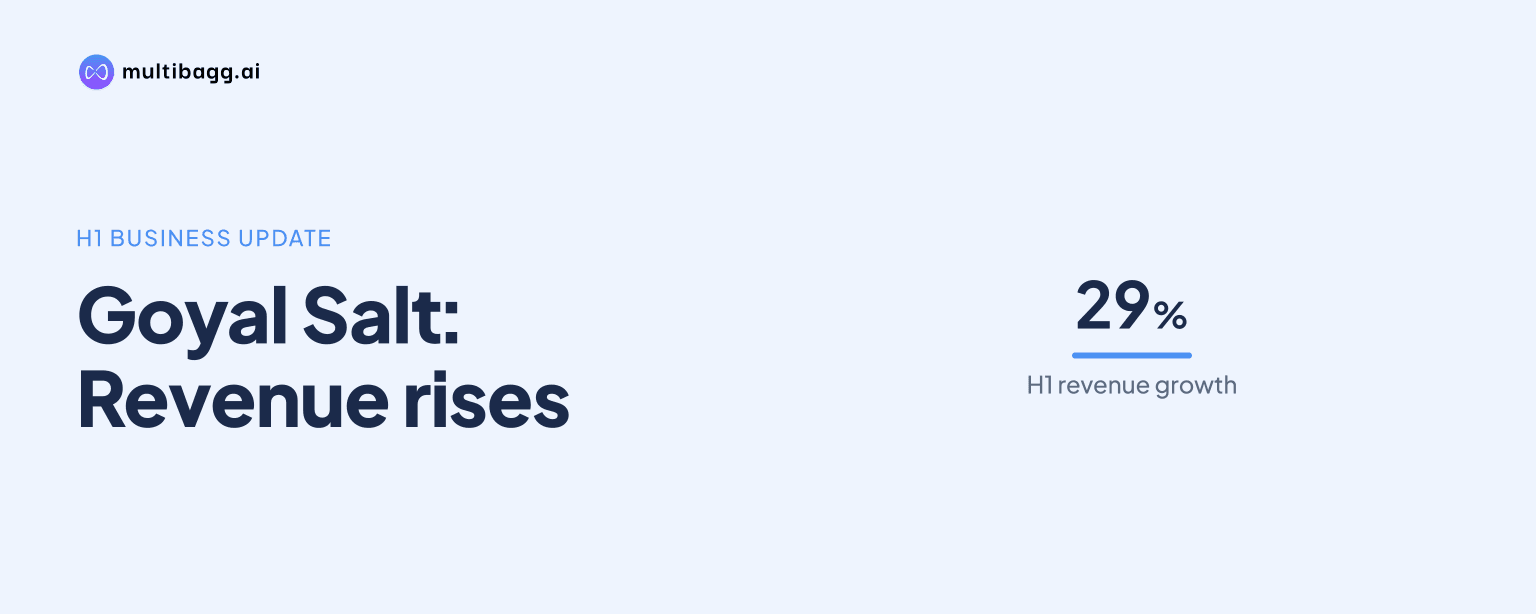
Goyal Salt Limited reported standalone revenue from operations of Rs 113.53 crore for the half year ended September 30, 2026, up 29% from Rs 88.19 crore a year earlier, while net profit fell 26% to Rs 4.71 crore from Rs 6.38 crore as total expenses rose 34% to Rs 107.29 crore.
Know Goyal Salt inside out
Results, valuation, peers and who's buying, in one view.
What were Goyal Salt’s results for the half year ended September 2026?
Goyal Salt reported total income of Rs 113.59 crore for the half year ended September 30, 2026, compared with Rs 88.31 crore in the corresponding half of the prior year. Revenue from operations contributed Rs 113.53 crore, while other income was Rs 6.04 lakh, lower than Rs 11.88 lakh in the half year ended September 30, 2025.
Standalone profit before tax was Rs 6.30 crore, down from Rs 8.53 crore a year earlier, and net profit was Rs 4.71 crore versus Rs 6.38 crore. Current tax declined to Rs 1.30 crore from Rs 2.06 crore, while deferred tax expense increased to Rs 28.93 lakh from Rs 8.49 lakh. Basic and diluted earnings per share fell to Rs 2.63 from Rs 3.56.
The difference between sales and expense growth reduced the profit outcome in the September 2026 half year. Revenue increased by Rs 25.34 crore, but total expenses increased by Rs 27.51 crore. The statement also recorded a prior-period item of Rs 7,000, taking profit before tax from Rs 6.30 crore to Rs 6.30 crore after rounding.
Why did Goyal Salt’s profit fall despite higher revenue?
Goyal Salt’s profit fell because several cost lines increased faster than revenue during the half year ended September 30, 2026. Cost of materials consumed rose 61% to Rs 35.66 crore from Rs 22.15 crore, purchases of stock-in-trade increased to Rs 39.97 crore from Rs 35.30 crore, and other expenses rose to Rs 26.23 crore from Rs 18.81 crore.
Finance cost increased to Rs 2.15 crore from Rs 1.34 crore, while depreciation and amortisation rose to Rs 3.23 crore from Rs 2.48 crore. Employee benefit expense was Rs 2.56 crore, compared with Rs 2.09 crore a year earlier. Together, these increases contributed to profit before tax falling by Rs 2.23 crore despite the rise in operating revenue.
The statement included a Rs 2.50 crore credit from changes in inventories of finished goods, work in process and stock-in-trade, compared with a Rs 2.38 crore credit in the corresponding prior-year half. The larger inventory-related credit partly reduced reported expenses, but it was not sufficient to offset the increases in material costs, stock purchases, finance cost, depreciation and other expenses.
Goyal Salt operates in a single segment of refining raw salt, according to the notes accompanying the September 2026 results. The company therefore did not provide segment-wise revenue or profitability figures that could separate the contribution of individual products or customer markets to the Rs 113.53 crore of revenue from operations.
Got a follow-up? Ask IRIS
How did working capital affect Goyal Salt’s cash flow?
Goyal Salt used Rs 5.07 crore in operating activities in the half year ended September 30, 2026, although it reported net profit after tax of Rs 4.71 crore. Profit before working-capital changes was Rs 10.05 crore after adjustments including Rs 3.23 crore of depreciation and Rs 2.15 crore of finance cost.
Inventory was the principal disclosed use of operating cash. The cash-flow statement records a Rs 28.23 crore increase in inventories during the half year, compared with a Rs 14.87 crore increase in the year ended March 31, 2026. The balance sheet shows inventories at Rs 56.92 crore at September 30, 2026, up from Rs 28.69 crore at March 31, 2026.
Trade receivables increased by Rs 3.96 crore during the half year and stood at Rs 30.53 crore at September 30, compared with Rs 26.57 crore at March 31. Higher trade payables supplied Rs 14.49 crore of cash-flow support, while other current liabilities added Rs 2.40 crore and short-term provisions added Rs 30.02 lakh; these inflows did not cover the inventory and receivables movements.
Goyal Salt used Rs 3.67 crore in investing activities, including Rs 3.26 crore for fixed assets and Rs 1.41 crore for non-current investments. Financing activities generated Rs 8.68 crore, reflecting Rs 8.94 crore of short-term borrowings and Rs 1.88 crore of long-term borrowings, offset by Rs 2.15 crore of finance-cost outflow. Cash and cash equivalents ended at Rs 42.09 lakh, down from Rs 48.57 lakh at March 31, 2026.
What do Goyal Salt’s balance sheet and consolidated results show?
Goyal Salt’s standalone balance-sheet total rose to Rs 153.58 crore at September 30, 2026 from Rs 120.70 crore at March 31, 2026. Tangible assets increased to Rs 54.46 crore from Rs 47.53 crore, while capital work-in-progress, reported at Rs 6.93 crore at March 31, was nil at September 30.
Short-term borrowings increased to Rs 39.38 crore from Rs 30.43 crore, and long-term borrowings rose to Rs 15.82 crore from Rs 13.94 crore. Trade payables to creditors other than micro and small enterprises were Rs 22.55 crore at September 30, compared with Rs 1.15 crore at March 31. Share capital was unchanged at Rs 17.90 crore, while reserves and surplus increased to Rs 53.66 crore from Rs 48.95 crore.
Consolidated net profit was Rs 4.66 crore for the half year ended September 30, 2026, compared with standalone net profit of Rs 4.71 crore. Consolidated total expenses were Rs 107.37 crore, Rs 8.11 lakh above the standalone figure, and the consolidated statement recorded Rs 3.76 lakh of profit attributable to non-controlling interest.
Earlier consolidated figures are not fully comparable with the latest period because the subsidiaries became part of the group during the half year ended September 30, 2026. The filing identifies Goyal Exim Private Limited as a wholly owned subsidiary and Goyal Foods Industries Private Limited as a subsidiary, while stating that earlier comparative figures are those of Goyal Salt. Arvind R Agrawal & Co issued limited-review reports dated November 14, 2026 for the standalone and consolidated statements.
Conclusion
The September 2026 half-year figures show revenue growth did not convert into higher standalone earnings, as a Rs 25.34 crore increase in revenue was exceeded by a Rs 27.51 crore increase in expenses. The Rs 28.23 crore inventory build-up and Rs 3.96 crore receivables increase also coincided with Rs 5.07 crore of operating cash outflow, despite reported net profit of Rs 4.71 crore.
The next disclosed unresolved matter is management’s process of identifying parties covered under the Micro, Small and Medium Enterprises framework. Goyal Salt said no such parties had been identified by the date of review, while the September 2026 balance sheet reported Rs 22.55 crore of trade payables to creditors other than micro and small enterprises.