










Goyal Salt Limited H1 FY27 Revenue Rises 28.7%, Profit Falls 26.2%
Key highlights
- Goyal Salt's standalone H1 FY27 revenue rose 28.7% year on year to ₹113.53 crore.
- Goyal Salt's standalone H1 FY27 net profit fell 26.2% year on year to ₹4.71 crore.
- Goyal Salt reported H1 FY27 operating profit of ₹11.5 crore and an operating margin of 10.2%.
- Goyal Salt's finance costs rose 59.7% to ₹2.15 crore in H1 FY27.
powered by IRIS
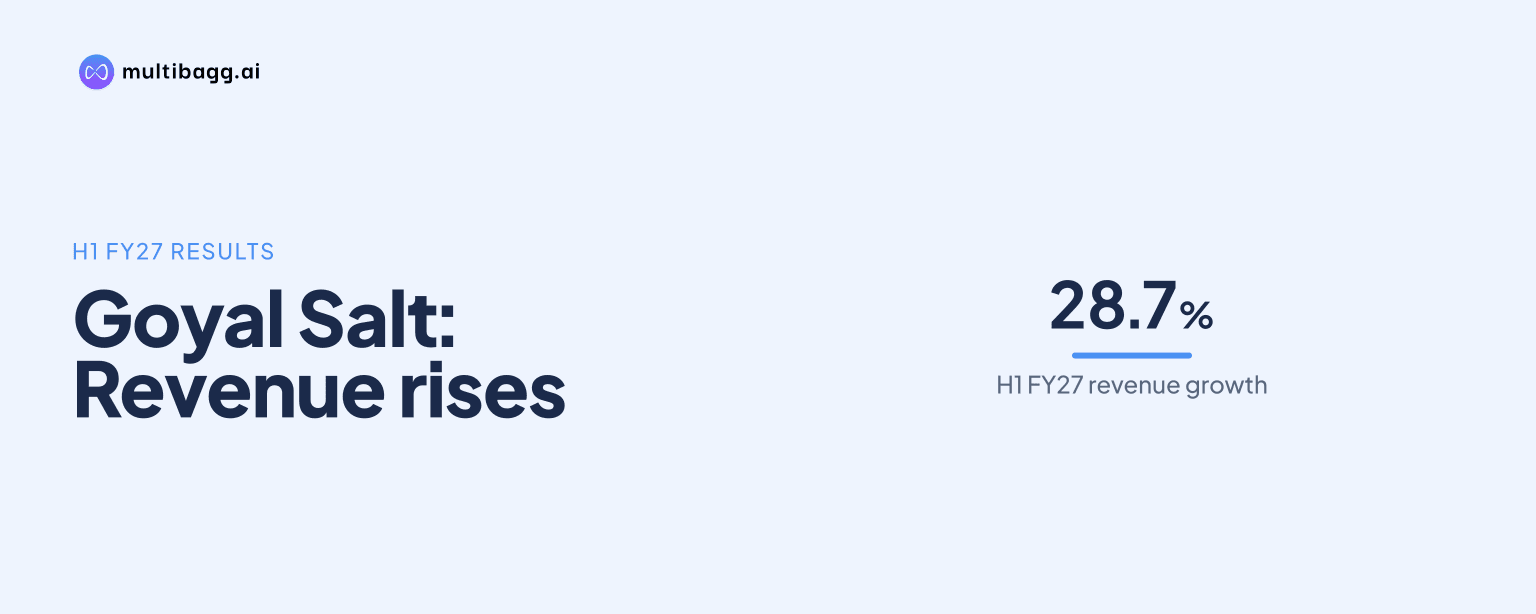
Goyal Salt Limited's standalone revenue rose 28.7% year on year to ₹113.53 crore in H1 FY27, while net profit fell 26.2% to ₹4.71 crore. The half-year result shows higher sales but lower profitability as input costs, finance costs and depreciation increased during the period ended September 30, 2026.
Know Goyal Salt inside out
Results, valuation, peers and who's buying, in one view.
What did Goyal Salt report for H1 FY27?
Goyal Salt Limited reported unaudited standalone financial results for H1 FY27 on November 14, 2026. Revenue from operations was ₹113.53 crore, compared with ₹88.19 crore in H1 FY26. The reported revenue figure was also rounded to ₹114 crore in the company results summary.
Operating profit for the six months stood at ₹11.5 crore, and the operating margin was 10.2%. Standalone net profit was ₹4.71 crore, compared with ₹6.38 crore a year earlier. Earnings per share for the period were ₹2.61.
The result followed the company's board-meeting intimation for November 14, 2026, when directors were scheduled to consider and approve unaudited financial results for the half year ended September 2026. Goyal Salt processes industrial and edible salts extracted from sub-soil brine in Rajasthan through an integrated refining process.
Why did Goyal Salt's profit decline despite higher revenue?
Goyal Salt's profit declined despite revenue growth because rising input costs, finance costs and depreciation affected earnings. Finance costs increased 59.7% to ₹2.15 crore in H1 FY27, according to the reported financial-results update.
The contrast between sales growth and lower net profit indicates that a larger share of revenue was absorbed by costs during the half year. The available result summary does not provide a detailed break-up of input costs or depreciation, but it identifies both as factors behind the year-on-year reduction in standalone profit.
At the operating level, the company reported a 10.2% operating margin and operating profit of ₹11.5 crore. This means Goyal Salt remained operationally profitable in the period, although the movement from operating profit to net profit was affected by costs below the operating line, including finance expenses and depreciation.
How does H1 FY27 compare with Goyal Salt's earlier results?
H1 FY27 revenue exceeded the ₹88.19 crore reported in H1 FY26, but net profit was below the ₹6.38 crore recorded in that earlier half year. The comparison marks a change from the sharp earnings growth Goyal Salt reported in H1 FY25.
In H1 FY25, Goyal Salt reported total income of ₹74.82 crore, EBITDA of ₹13.13 crore and profit after tax of ₹9.33 crore. That period's revenue was 59.67% higher year on year, while profit after tax increased 286.35% year on year. The H1 FY27 update, however, shows revenue expanding while net profitability moved in the opposite direction.
For FY26, Goyal Salt reported revenue from operations of ₹199.60 crore and net profit of ₹11.35 crore. Basic and diluted EPS for the full year were ₹6.34, compared with ₹7.40 in FY25. The company also reported total assets of ₹120.70 crore as of March 31, 2026, against ₹81.15 crore a year earlier.
Got a follow-up? Ask IRIS
What does the result mean for investors and operations?
The H1 FY27 result means investors have evidence of continued revenue growth alongside pressure on profit conversion. Revenue from operations rose by more than ₹25 crore from H1 FY26, but standalone net profit reduced by ₹1.67 crore over the same comparison period.
The reported 10.2% operating margin provides a measure of operating performance for the half year. But the increase in finance costs to ₹2.15 crore and the identified rise in depreciation are relevant when assessing why earnings per share were ₹2.61 despite revenue of ₹113.53 crore.
On a consolidated basis, Goyal Salt reported H1 FY27 profit after tax of ₹4.63 crore. It also reported negative operating cash flow of ₹5.16 crore, attributed to working-capital expansion. This makes working-capital movement an additional disclosed factor for investors monitoring the gap between reported profit and cash generation.
What broader financial trend is visible in Goyal Salt's results?
The broader trend is that Goyal Salt has expanded revenue while its margins and net income have faced pressure. FY26 revenue from operations of ₹199.60 crore was higher than FY25 revenue from operations of ₹129.97 crore, but FY26 net profit of ₹11.35 crore was below FY25 net profit of ₹13.25 crore.
The FY26 figures show EPS falling to ₹6.34 from ₹7.40 in FY25. The H1 FY27 numbers continue this focus on profitability, with revenue growth not translating into year-on-year net-profit growth. The disclosed data do not establish whether this pressure is temporary or persistent, but they identify expenses, financing costs, depreciation and working capital as relevant reported items.
For the salt-processing business, revenue growth can reflect higher sales volumes, pricing, product mix or a combination of these factors. Goyal Salt has not provided such a break-up in the supplied results information. Investors therefore have the reported financial metrics, rather than a volume or pricing analysis, to assess the half-year performance.
Conclusion
Goyal Salt delivered 28.7% year-on-year standalone revenue growth in H1 FY27 to ₹113.53 crore, but its ₹4.71 crore net profit was 26.2% lower than H1 FY26. The period highlights the effect of higher costs on earnings, including finance costs of ₹2.15 crore, alongside a reported operating margin of 10.2%.
The next reported item to watch is how Goyal Salt manages cost pressures, working-capital requirements and cash generation in the remaining part of FY27. The company disclosed negative operating cash flow of ₹5.16 crore on a consolidated basis in H1 FY27, making subsequent financial disclosures important for tracking its operational and financial position.