










Om Freight Forwarders Limited Reports 119% Q2 FY27 Profit Growth
Key highlights
- Om Freight Forwarders reported Q2 FY27 revenue of ₹202.60 crore, up 78.0% year-on-year.
- Consolidated net profit increased 119.0% year-on-year to ₹8.89 crore from ₹4.06 crore.
- EBITDA rose 92.7% to ₹15.07 crore, with EBITDA margin improving to 7.4%.
- Net profit margin expanded to 4.4% from 3.6% in Q2 FY26.
powered by IRIS
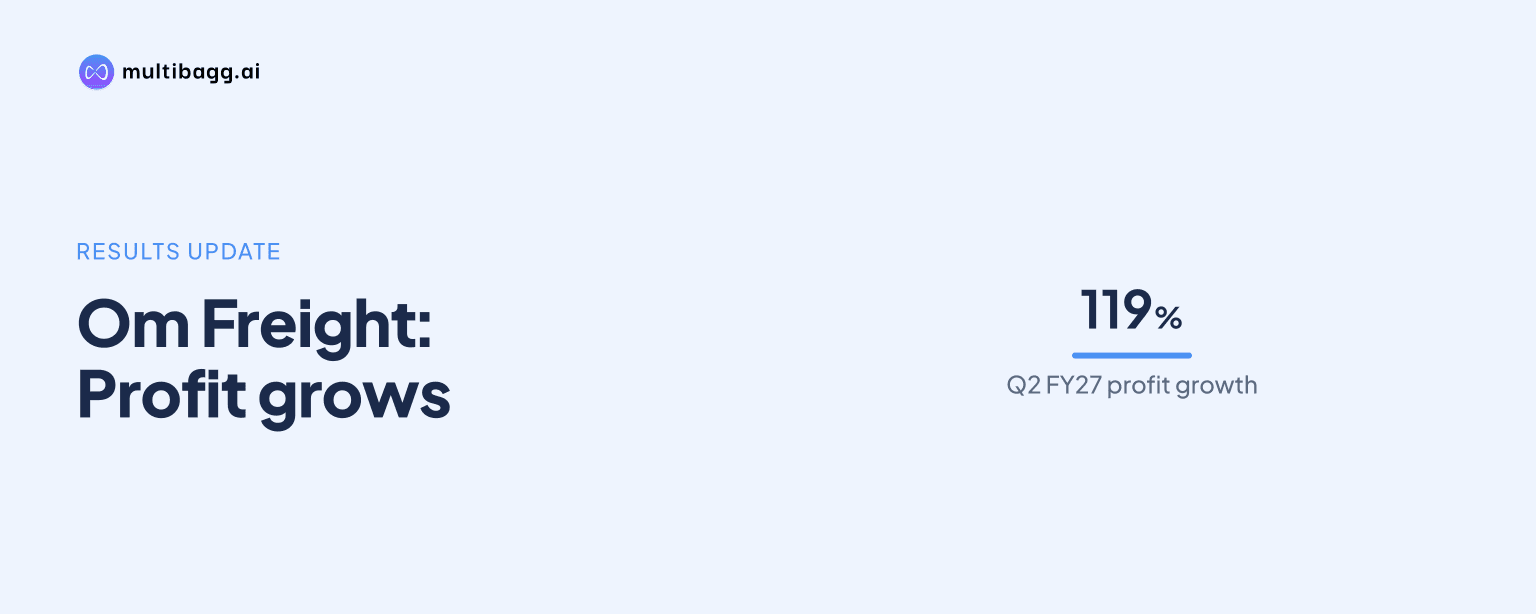
Om Freight Forwarders Limited reported consolidated net profit of ₹8.89 crore in Q2 FY27, up 119% year-on-year from ₹4.06 crore, while revenue from operations increased 78% to ₹202.60 crore in the quarter ended September 30, 2026. The result showed profit growth outpacing sales growth, supported by higher operating profit and improved margins.
Know Om Freight Forwarders inside out
Results, valuation, peers and who's buying, in one view.
What did Om Freight Forwarders report for Q2 FY27?
Om Freight Forwarders reported consolidated revenue from operations of ₹202.60 crore for the July-September 2026 quarter, compared with ₹113.84 crore in Q2 FY26. The ₹88.76 crore year-on-year increase translated into revenue growth of 77.97%, according to the company's results disclosures.
Consolidated net profit rose to ₹8.89 crore from ₹4.06 crore a year earlier, a gain of 118.97%. Net profit was also higher than the ₹7.30 crore reported in Q1 FY27. This represented sequential profit growth of about 21.8%, while quarterly revenue increased 4.8% from ₹193.35 crore in the preceding quarter.
The company declared its unaudited standalone and consolidated financial results for the quarter and half year ended September 30, 2026, on November 13, 2026. The board meeting to consider these results had also been scheduled for that date.
How did margins and operating profit change?
Om Freight Forwarders' EBITDA increased to ₹15.07 crore in Q2 FY27 from ₹7.82 crore in Q2 FY26, rising faster than revenue at 92.71%. EBITDA margin widened to 7.4% from 6.9% in the year-earlier quarter and from 5.8% in Q1 FY27.
Profit before tax was ₹11.43 crore, compared with ₹5.24 crore a year earlier and ₹9.62 crore in the June 2026 quarter. After tax of ₹2.86 crore, the company reported net profit of ₹8.89 crore. The net profit margin improved to 4.4%, from 3.6% in Q2 FY26 and 3.8% in Q1 FY27.
The improvement in profit margins is important because the company generated higher earnings on each rupee of revenue despite logistics being a cost-sensitive industry. The disclosed numbers show that operating profit, profit before tax and net profit all grew at a faster rate than revenue during the quarter.
What contributed to Om Freight Forwarders' revenue growth?
Higher freight rates on the India-US route contributed significantly to Om Freight Forwarders' revenue growth during the quarter, according to reports cited from Stockwatch. Those reports indicated that rates on the route doubled during the period, coinciding with the company's 78% increase in quarterly revenue.
The company also operates in logistics services including 3PL and 4PL activities. Reports accompanying the quarterly results linked increased volumes in these operations to recent capacity expansions in Maharashtra. The available information does not provide a segment-wise revenue split or quantify the contribution from each activity.
Freight forwarding revenue can be influenced by shipping rates, cargo volumes, trade routes and client demand. Therefore, the increase in revenue reflected both the stated route-rate backdrop and the reported operational activity, while the results filing provides the confirmed financial outcome for the quarter.
Got a follow-up? Ask IRIS
How does the Q2 result compare with the previous quarter?
Om Freight Forwarders' Q2 FY27 result improved sequentially, with revenue rising to ₹202.60 crore from ₹193.35 crore in Q1 FY27 and net profit increasing to ₹8.89 crore from ₹7.30 crore. EBITDA also rose from ₹11.29 crore to ₹15.07 crore over the same period.
The quarter-on-quarter expansion in EBITDA margin, from 5.8% to 7.4%, accompanied the rise in operating profit. Profit before tax increased from ₹9.62 crore in Q1 FY27 to ₹11.43 crore in Q2 FY27. These figures indicate that profitability improved alongside the modest sequential increase in revenue.
For investors, the result provides two points of comparison. Year-on-year growth was strong because Q2 FY26 revenue and profit were lower at ₹113.84 crore and ₹4.06 crore, respectively. Sequentially, the business also recorded higher revenue and profits than in Q1 FY27, which offers a more recent comparison for assessing the quarter's operating performance.
What does the result mean for the logistics business?
The Q2 FY27 numbers show that Om Freight Forwarders benefited from higher revenue and a stronger operating-profit conversion during the quarter. Revenue rose by ₹88.76 crore year-on-year, while EBITDA increased by ₹7.25 crore and net profit rose by ₹4.83 crore.
The results also underline the relevance of freight-rate conditions for forwarding businesses. The reported increase in India-US route rates was a material part of the quarter's context, while capacity expansion in Maharashtra was cited alongside higher volumes in 3PL and 4PL operations. Neither the financial figures nor the available disclosures establish how long these conditions may persist.
Customers and industry participants may view the quarter through the lens of logistics costs and freight availability, particularly on international routes. For shareholders, the central reported indicators are the 78% revenue increase, 119% net-profit increase, and margin improvement from the prior-year and preceding quarters.
Conclusion
Om Freight Forwarders delivered a substantially higher Q2 FY27 profit on the back of 78% revenue growth and improved operating metrics. Consolidated net profit reached ₹8.89 crore, EBITDA rose to ₹15.07 crore, and the EBITDA margin expanded to 7.4%, while net profit margin increased to 4.4%.
The next disclosed reference point will be the company's subsequent quarterly financial update, which can show whether revenue, freight-rate conditions and operating margins remain at similar levels. Investors can also track future disclosures for more detail on the contribution of logistics operations, capacity additions and international freight activity.